





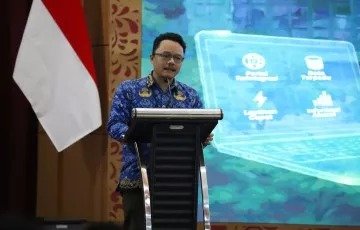
EduAsiaNews, Jakarta – Universitas Pembangunan Nasional “Veteran” Jakarta (UPNVJ), through its Academic Support Unit for Information and Communication Technology (UPA TIK), officially held the Soft Launch of the UPN Veteran Jakarta Integrated Digital Services Ecosystem at the Bhinneka Tunggal Ika Auditorium on Friday, July 17, 2026. Carrying the theme “From Service Needs to an Integrated Digital Ecosystem,” the event marked the beginning of the implementation of a system that integrates university services, data, users, and business processes. This initiative lays the foundation for UPNVJ’s digital transformation toward more effective, efficient, transparent, secure, and data-driven university governance.
Head of UPA TIK, Asep Saeful Ridwan, S.Kom., emphasized that the launch was not merely the introduction of a new application. Instead, the ecosystem is designed to overcome the fragmentation of previously isolated digital services by integrating them into a unified platform.
“What we are launching today is not merely an application, but the foundation of an integrated digital services ecosystem. Our challenge is no longer developing standalone applications, but connecting all services so they operate as a unified system capable of delivering the best possible experience for the university community,” Asep said.
According to him, the integrated digital services ecosystem is the result of collaboration among various stakeholders across UPNVJ. Its development has involved university leaders, administrative units, faculties, and the Faculty of Computer Science, which has played a key role in supporting system development and integration.
Asep stressed that digital transformation must be driven by the real needs of users rather than by technological trends alone. Therefore, every digital service should be designed to address the practical needs of students, faculty members, administrative staff, university units, and institutional leaders.
The development of the ecosystem has been carried out progressively since early 2025. The process has included mapping service requirements, inventorying existing university applications, aligning business processes, improving data governance, and strengthening information technology infrastructure and cybersecurity.
UPA TIK has also integrated systems across the university to ensure data consistency and support comprehensive service delivery. This integration is expected to eliminate redundant data entry, accelerate administrative processes, and provide users with more accurate and reliable information.
“Digital transformation is fundamentally about changing the way we work—not merely replacing applications. That is why we are building a foundation capable of integrating applications, data, users, and business processes to deliver faster, more efficient, transparent, and data-driven services,” Asep explained.
The integrated digital services ecosystem has been designed to provide tailored benefits for each user group. Students will enjoy easier access to more integrated campus services, while faculty members and administrative staff will benefit from simplified administrative processes. Meanwhile, university units are expected to improve the efficiency and effectiveness of their service delivery.
For university leadership, the integration of systems and data is expected to generate more accurate, up-to-date, and reliable information to support strategic policymaking and evidence-based decision-making.
Asep noted that technology alone does not determine the success of digital transformation. Effective implementation also depends on well-defined business processes, high-quality data, aligned institutional policies, robust information security, and the willingness of the university community to embrace new ways of working.
“The success of digital transformation is not determined solely by the sophistication of the technology employed. It depends equally on sound governance, data quality, information security, and the readiness of all users to embrace change,” he stated.
The development of UPNVJ’s digital ecosystem will continue in accordance with the university’s digital transformation roadmap. The next phase includes evaluating service quality, expanding system integration, strengthening information security, improving data quality and consistency, and enhancing the overall user experience.
These evaluations will ensure that the services developed genuinely address the needs of the university community. Feedback from users will also serve as the basis for improving system functionality, service workflows, accessibility, and long-term sustainability.
Asep further emphasized that data management is one of the cornerstones of UPNVJ’s digital transformation. Data should not merely function as an administrative record but should be recognized as a strategic asset that supports service evaluation, performance measurement, and institutional planning.
“Digital transformation is not only about technology; it is about fostering collaboration, managing data as a strategic asset, and delivering increasingly valuable services to the entire academic community,” he concluded.
The soft launch further reinforces UPNVJ’s commitment to building a modern and adaptive university governance system. Through the integration of services, the university aims to enhance service quality, strengthen coordination among organizational units, eliminate redundant administrative processes, and promote data-driven decision-making.(www.upnvj.ac.id)