




EduAsiaNews, Lampung – Universitas Lampung (Unila) has introduced the National Cassava Center, a national collaborative hub designed to integrate research, innovation, industry, and farmers into a unified ecosystem to accelerate the development of Indonesia’s cassava sector. The center is expected to enhance cassava productivity, strengthen cassava-based industries, and contribute to national food security and the bioeconomy.
Rector of Unila, Prof. Dr. Ir. Lusmeilia Afriani, D.E.A., IPM., ASEAN Eng., explained that Lampung is Indonesia’s largest cassava-producing province. However, cassava production continues to face several challenges, including relatively low farm productivity, inconsistent crop quality, limited adoption of improved varieties, and insufficient dissemination of research-based innovations to farmers. At the same time, industrial demand continues to grow, while climate change, cultivation efficiency, and global competitiveness present increasingly significant challenges.
According to the Rector, these circumstances underscore the need to establish the National Cassava Center as a national collaboration platform linking research, innovation, industry, and farmers within an integrated ecosystem. Beyond serving as a research facility, the center is envisioned as a catalyst for transforming Indonesia’s cassava industry.
The National Cassava Center will be developed on land granted by the Lampung Provincial Government in Kota Baru, Purwotani Village, Jati Agung District, South Lampung Regency.
The center will focus on seven strategic areas: research and innovation; germplasm conservation and seed development; smart farming and digital agriculture; downstream industrial development; farmer empowerment; training and technology transfer; and the establishment of an educational zone (Edu-Park). Through this integrated approach, research outcomes are expected to move beyond laboratories and be implemented in the field, delivering tangible benefits to both farmers and industry.
The Rector also revealed that Unila has formulated seven short-term programs, three of which are already underway. These include the designation of five superior cassava varieties as development priorities in Lampung Province—Kasetsart (UJ-5), Vamas-1, Daun Sembilan, Garuda, and UJ-3 (Thailand); the preparation of Good Agricultural Practices (GAP) for Cassava as a national cultivation standard; and the establishment of demonstration plots (demplot) that serve as field laboratories for testing and showcasing agricultural innovations to farmers.
The demonstration plot program is supported by PT Sungai Budi Group through a competitive proposal selection process. Of the eight proposals submitted, four were selected from three institutions: Prof. Suwarto of IPB University, Prof. Robet Asnawi of the National Research and Innovation Agency (BRIN), and Purba Sanjaya, S.P., M.Si., together with Fitri Yelli, Ph.D., from Universitas Lampung.
In addition, the National Cassava Center has established partnerships with the Lampung Provincial Government, PT Sungai Budi Group, PT Lambang Jaya, the Indonesian Cassava Society, BRIN, IPB University, and several international institutions, including the Thai Tapioca Starch Association, the Thai Tapioca Development Institute, Kasetsart University, and Mahidol University.
The Rector emphasized that the center’s primary mission is not merely to produce scientific publications but to generate practical solutions for farmers through the provision of improved planting materials, technical assistance, implementation of Good Agricultural Practices, production support, and downstream product development to increase the added value of cassava.
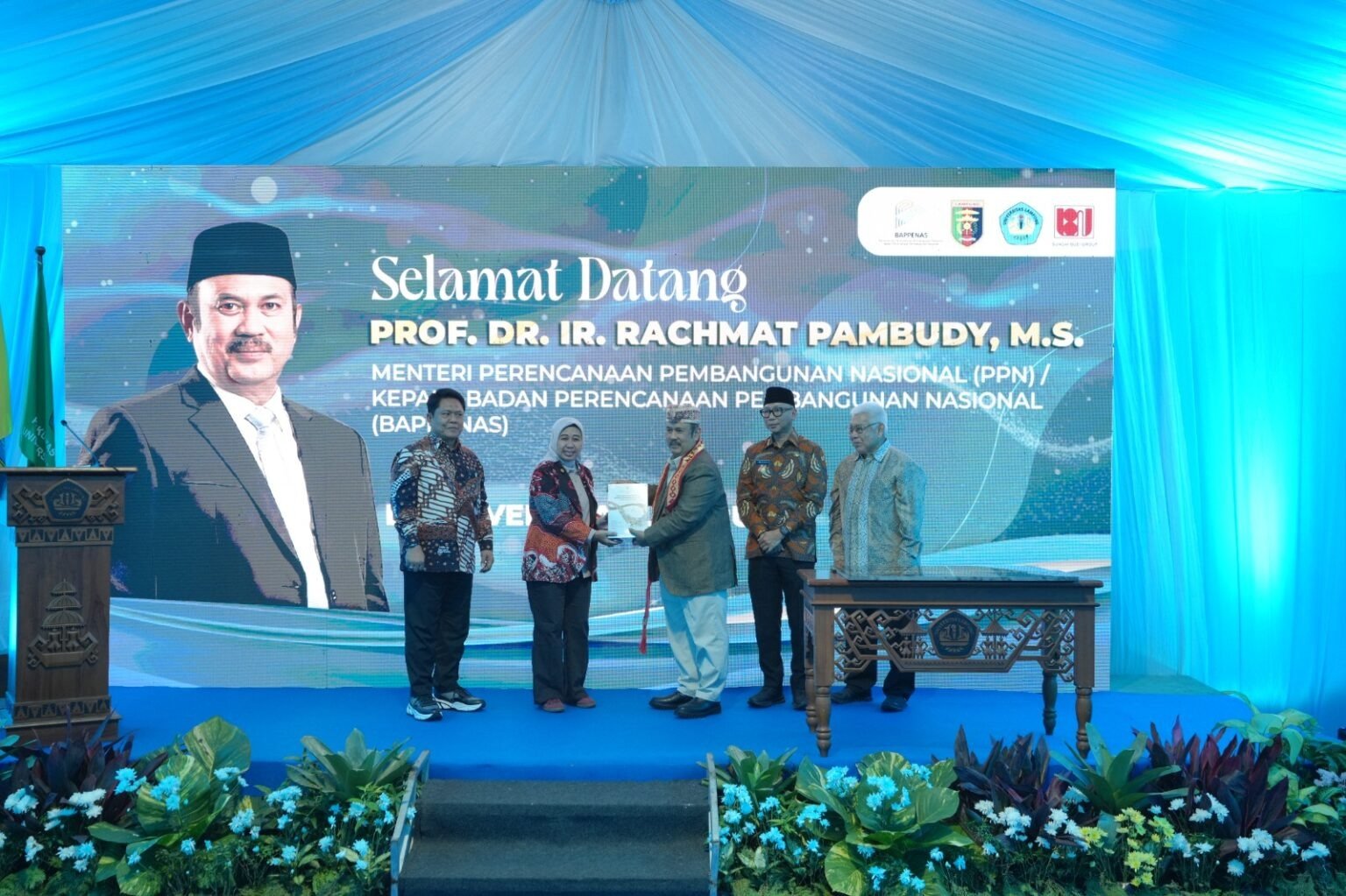
Meanwhile, the Minister of National Development Planning/Head of Bappenas, Prof. Dr. Ir. Rachmat Pambudy, M.S., welcomed the establishment of the National Cassava Center. He recalled that the Food and Agriculture Organization (FAO) had referred to cassava as a “miracle tree” as early as 1980, and stated that, after more than four decades, the National Cassava Center represents a concrete step toward realizing the crop’s enormous potential.
“If I have waited 45 years, it has certainly been worth the wait. Today, our colleagues in Lampung have made the National Cassava Center a reality,” he said.
The Minister stressed that the center should prioritize action-oriented research, increasing productivity, improving starch content, and promoting the implementation of Good Agricultural Practices (GAP) among farmers. He noted that these objectives can only be achieved through close collaboration among academia, government, industry, and farming communities.
He added that Indonesia’s agricultural progress has always depended on the contributions of both researchers and farmers. Cassava, he noted, holds tremendous potential not only as a raw material for tapioca but also as a source of food, animal feed, biofuel, and bioethanol.
On the same occasion, Lampung Governor Rahmat Mirzani Djausal, S.T., M.M., stated that the inauguration of the National Cassava Center represents far more than the launch of a research institution. Instead, it marks the beginning of an integrated ecosystem that brings together science, technology, investment, industry, and farmer welfare in a single collaborative platform.
According to the Governor, more than 70 percent of Indonesia’s cassava production originates from Lampung Province, making cassava a truly community-based crop. However, farmers and industry have traditionally operated independently, limiting gains in productivity. While competing tapioca-producing countries such as Thailand and Vietnam have focused on improving productivity, farmers in Lampung have generally relied on expanding cultivation areas.
Through the National Cassava Center, the Governor expressed his hope that cassava development in Lampung will shift toward improving productivity, product quality, and farmer welfare through stronger collaboration among government agencies, universities, researchers, and industry, thereby enhancing the global competitiveness of Indonesia’s cassava sector.
(Source: Universitas Lampung/Public Relations; Author: Shalu Munadiyan, Intern)