




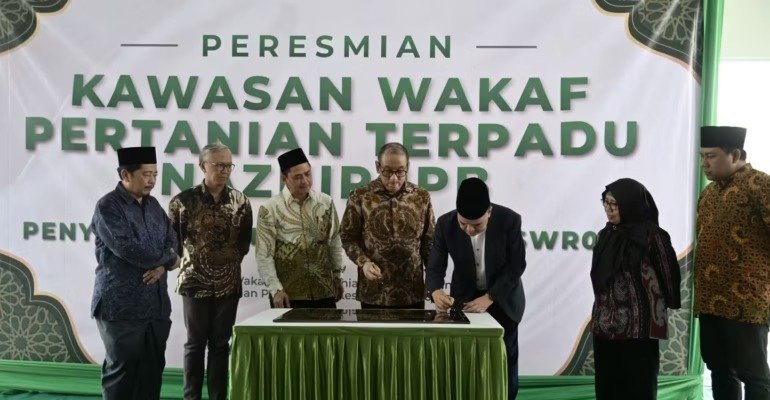
EduAsiaNews, Jakarta – IPB University is developing the Integrated Productive Agricultural Waqf Area (Kawasan Wakaf Produktif Terpadu Pertanian/KWPT) in Cihideung Ilir Village, Ciampea District, Bogor Regency, as part of its efforts to strengthen the role of waqf as an instrument for sustainable development.
Established on a 1.3-hectare waqf land donated in 2023, the site is designed not only as a center for agricultural and livestock development but also as a living laboratory that integrates research, innovation, and community empowerment.
Prof. Iskandar Z. Siregar, Vice Rector for Cooperation and Global Connectivity at IPB University, emphasized that the KWPT will serve as a learning hub capable of delivering tangible benefits to society.
“The KWPT must become a living lab that integrates academic excellence with real-world impact. Innovations developed here should not only be academically outstanding but also generate meaningful benefits for the community,” he said.
According to Prof. Iskandar, IPB University has a wide range of agricultural innovations ready to be implemented at the site, including superior crop varieties, fertilizers, and sustainable farming technologies. One of the concepts currently being prepared is the adoption of agri-photovoltaics, which integrates solar panels with agricultural land so that the generated renewable energy can support livestock operations and irrigation systems.
He also underscored the importance of cross-sector collaboration in developing the KWPT. The area is expected to become a national model that can be replicated across Indonesia through partnerships among universities, government agencies, industry, philanthropic organizations, and local communities.
Meanwhile, Prof. Alla Asmara, Head of IPB University’s Waqf and Social Fund Unit (UWDS), explained that the KWPT is being developed by integrating cattle farming, goat farming, and agricultural production as its core business units.
“We want this waqf asset to provide the broadest possible benefits for the community. In addition to expanding livestock facilities, we are also working to establish a clinic and strengthen community empowerment programs in the surrounding area,” he said.
The initiative received appreciation from Dr. H. Ahmad Zubaid, Vice Chairman of the Indonesian Waqf Board (BWI), who described IPB University’s productive use of waqf land as a strong example of how waqf assets can generate both economic value and long-term social benefits.
“Unused waqf land should be transformed into productive assets that maximize benefits for society. What IPB University has accomplished demonstrates how waqf can support education, community empowerment, and economic development,” he said.
Through the KWPT, IPB University aims to establish a science-, innovation-, and collaboration-based model of productive waqf management. The initiative is expected to become a hub for the development of applied technologies that promote sustainable agriculture while improving community welfare. In doing so, waqf is envisioned not only as an act of religious endowment but also as a catalyst for sustainable economic, social, and environmental development.