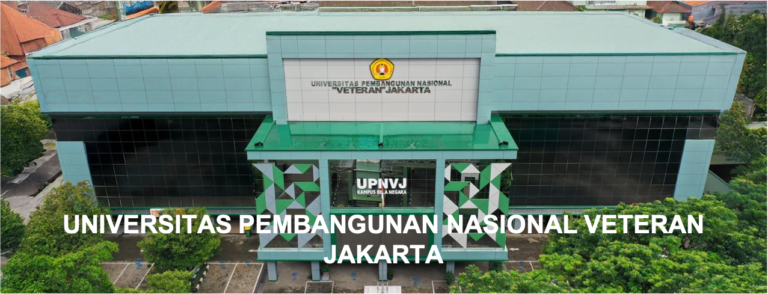





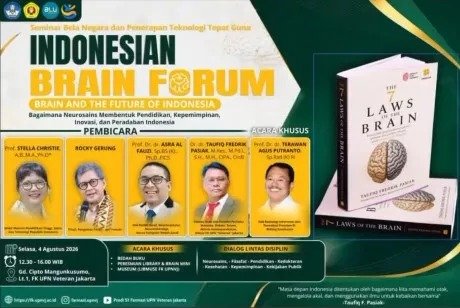
EduAsiaNews, Jakarta – The Faculty of Medicine at Universitas Pembangunan Nasional “Veteran” Jakarta (UPNVJ) hosted the Indonesian Brain Forum 2026 at the Cipto Mangunkusumo Building, Faculty of Medicine UPNVJ, Jakarta, on Tuesday (August 4, 2026). The interdisciplinary forum explored the application of neuroscience to strengthen education, leadership, innovation, healthcare, and public policy as key foundations for Indonesia’s human capital development.
Carrying the theme, “Brain and the Future of Indonesia: How Neuroscience Shapes Education, Leadership, Innovation, and Civilization,” the event brought together academics, practitioners, researchers, healthcare professionals, students, and members of the public. The forum also featured a book discussion on The 7 Laws of the Brain and the inauguration of the Faculty of Medicine’s Library & Brain Mini Museum (LibMuse).
The forum featured prominent national figures from diverse fields, including Deputy Minister of Higher Education, Science, and Technology Prof. Stella Christie, Ph.D.; philosopher Rocky Gerung; neurosurgeon Dr. dr. Asra Al Fauzi; Dean of the Faculty of Medicine UPNVJ Dr. dr. Taufiq Fredrik Pasiak, M.Kes., M.Pd.I., S.H., M.H., CIPA; and Prof. Dr. dr. Terawan Agus Putranto.
The participation of speakers from various disciplines broadened the discussion of neuroscience beyond medicine and healthcare to encompass philosophy, education, leadership, decision-making, innovation, and evidence-based public policymaking.
Opening the event, UPNVJ Rector Prof. Dr. Anter Venus, M.A., Comm. emphasized that scientific advancement must be directed toward addressing national challenges through interdisciplinary collaboration.
“Neuroscience is no longer confined to the field of medicine. It has evolved into a fundamental discipline for understanding how people learn, lead, make decisions, and ultimately build civilization,” said Prof. Anter Venus.
According to him, universities have a responsibility to create platforms for scientific dialogue that connect advances in science with societal needs and the national development agenda.
“Universities have a responsibility to provide scientific forums that bridge scientific progress with societal needs and national development,” he stated.
Prof. Anter explained that understanding how the brain functions can make significant contributions to improving teaching methodologies, character development, critical thinking skills, and decision-making quality.
For this reason, neuroscience research should continue to advance through multidisciplinary approaches, enabling research findings and innovations to be applied more broadly across society.
The Rector also reaffirmed UPNVJ’s commitment to strengthening a research and innovation culture that delivers tangible societal impact. This commitment is reflected in the university’s efforts to develop a collaborative, adaptive, and innovation-driven academic ecosystem.
Such initiatives align with UPNVJ’s transformation into a State Defense University, committed to excellence, innovation, and meaningful contributions at both the national and international levels.
Meanwhile, Dean of the Faculty of Medicine Dr. dr. Taufiq Fredrik Pasiak explained that the Indonesian Brain Forum was designed as a strategic platform to connect academics, practitioners, researchers, policymakers, and the broader community in expanding understanding of advances in brain science.
“We hope the Indonesian Brain Forum will become a collaborative platform that generates new ideas, research, and innovations in neuroscience,” said Taufiq.
He added that the Faculty of Medicine remains committed to advancing education and research that adapts to scientific progress while contributing to improved healthcare and the development of Indonesia’s human resources.
According to Taufiq, ongoing developments in brain science have opened new opportunities to improve multiple aspects of human life, including learning processes, mental health, creativity, character building, leadership, and public policymaking.
Realizing these opportunities requires cross-sector collaboration, as complex human and societal challenges cannot be addressed through a single academic discipline alone.
Throughout the forum, participants explored how the brain influences learning, creativity, behavior, leadership, and decision-making. Discussions also highlighted the connections between neuroscience, education, healthcare, philosophy, and the development of civilization.
Interactive exchanges between speakers and participants reinforced the understanding that neuroscience holds significant potential to support more effective, adaptive, and evidence-based strategies for human development.
In addition to the scientific discussions, the event marked the official inauguration of the Library & Brain Mini Museum (LibMuse) at the Faculty of Medicine. The facility has been established as a center for neuroscience education and literacy for students, faculty members, researchers, healthcare professionals, and the general public.
LibMuse is expected to expand public access to knowledge about brain structure and function through engaging and interactive educational approaches. The facility will also support medical education, neuroscience research, and broader public dissemination of scientific knowledge.
Through the Indonesian Brain Forum 2026 and the establishment of LibMuse, the Faculty of Medicine UPNVJ seeks to strengthen national collaboration in neuroscience education, research, and innovation.
Prof. Anter Venus noted that these initiatives reflect the evolving role of higher education, which extends beyond academic achievement toward creating meaningful societal impact.
According to him, stronger integration between science, technology, and the humanities is essential for universities to generate solutions to national challenges in education, healthcare, leadership, and sustainable development.
The organization of the Indonesian Brain Forum 2026 further underscores UPNVJ’s commitment to developing a future-oriented scientific ecosystem while positioning research and innovation as integral drivers of a more advanced, healthier, and globally competitive Indonesia.(www.upnvj.ac.id)