




EduAsiaNews, Boyolali — For most dairy farmers, providing drinking water is a routine task carried out several times each day. However, behind this seemingly simple activity lies a critical factor that is often overlooked. Continuous access to drinking water has a direct impact on dairy cattle health, feed intake, and milk productivity. Based on this scientific understanding, a research team from Universitas Diponegoro (UNDIP) has developed an automated drinking water system for dairy cattle, which is now being implemented through the IndoDairy 2 Program.
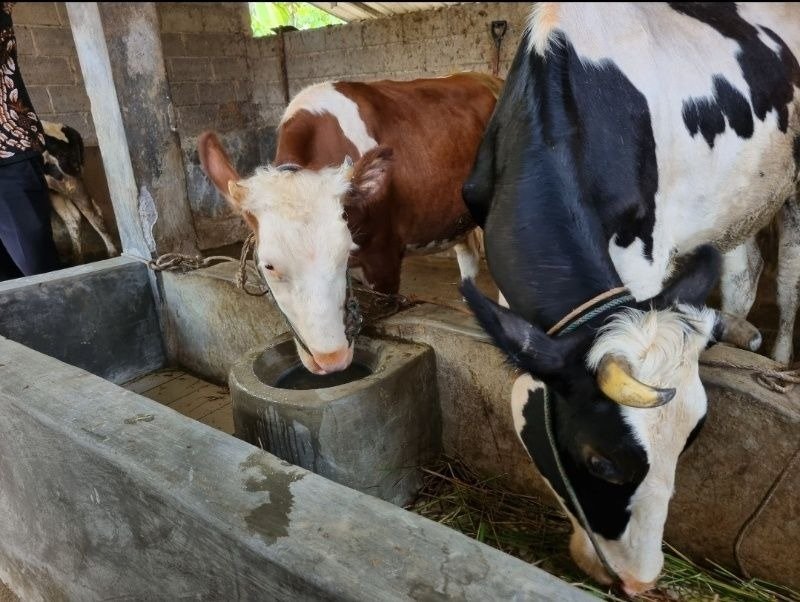
Funded by the Australian Centre for International Agricultural Research (ACIAR), the program is being implemented in Central Java and West Java as part of an initiative to improve the livelihoods of smallholder dairy farmers through the adoption of Good Dairy Farming Practices (GDFP). In Boyolali, one of Central Java’s major dairy production centers, UNDIP, in collaboration with KUD Mojosongo, has installed an ad libitum drinking water system on 24 demonstration farms (focus farms), enabling dairy cattle to access fresh water whenever needed without waiting for farmers to manually refill water troughs.
Before the program was introduced, approximately 70 percent of dairy farmers in Boyolali did not have dedicated drinking water containers for their cattle. Instead, they provided water mixed with concentrate feed, a practice locally known as the komboran system. Under this system, dairy cattle effectively had no access to separate drinking water, despite water being an essential requirement for maintaining health and supporting milk production.
The program has now been expanded to an additional 28 assisted farms within the KUD Musuk area of Boyolali and is planned to be replicated across other dairy farming centers throughout Central Java.
According to Drh. Dian Wahyu Harjanti, Ph.D., Project Leader of the UNDIP IndoDairy Team, the initiative extends well beyond the installation of drinking facilities. Over an 18-month period, participating farmers will receive continuous training, technical assistance, monitoring, and cooperative capacity-building to ensure the innovation is sustainably adopted. The program also includes guidance on feed management and livestock husbandry practices.
One of the most notable features of the drinking water technology is its simplicity. The system operates without sensors, microcontrollers, automatic pumps, or electricity. Instead, it functions entirely through a mechanical mechanism based on the principle of fluid equilibrium using a floating valve. As cattle consume water and the water level drops, the buoyancy of the float decreases, causing the valve to open automatically and replenish the trough. Once the water reaches the predetermined level, the float rises and closes the valve, maintaining a constant water supply.
Although floating valve technology has long been used in conventional water storage tanks, the UNDIP research team has developed a novel application specifically designed for smallholder dairy farming systems. The water level is carefully maintained at an optimal height, ensuring easy access for cattle while preserving hygiene and supporting ad libitum drinking behavior. Because the system is entirely mechanical, it is relatively inexpensive, resistant to humid barn conditions, requires no electricity, and is well suited to small-scale farms with limited infrastructure.
The ad libitum drinking water system was principally designed by Edi Prayitno, S.Pt., M.Si., a member of the UNDIP IndoDairy Team. According to the researchers, the innovation does not lie in the discovery of a new fluid mechanics principle but rather in the novel adaptation of the floating valve mechanism to meet the practical needs of dairy cattle management on smallholder farms. This approach makes the technology simpler, more affordable, easier to maintain, and more adaptable than many sensor-based automated systems currently available.
In addition to installing the automated drinking water system, the IndoDairy 2 Team has provided farmers with training on the importance of adequate water intake, feed formulation, production recording, and routine monitoring through cooperative extension teams. KUD Mojosongo serves as the program’s principal partner, ensuring that these innovations continue to be implemented through ongoing field assistance for participating farmers.
Initial results have been highly encouraging. Heni Prihatinningsih, Chairperson of KUD Mojosongo, reported that since the introduction of the ad libitum drinking water system, dairy cattle have appeared healthier, with smoother and shinier coats. Several farmers have also reported improvements in milk quality and increases in milk production of approximately one liter per cow per day. At the same time, farmers have experienced greater labor efficiency, as they no longer need to refill drinking water manually multiple times each day.
For the UNDIP IndoDairy Team, these achievements demonstrate that innovation does not necessarily require sophisticated or expensive technologies. By applying fundamental scientific principles in practical and appropriate ways, simple technologies can generate significant improvements in the productivity of smallholder dairy farming. Through collaboration among universities, cooperatives, government institutions, and farmers, the automated drinking water system is expected to become a sustainable model for dairy farming development while contributing to improved livelihoods for Indonesia’s dairy farming communities.
(Public Communication/UNDIP/Drh. Dian Wahyu Harjanti, Ph.D.; edited by Nurul)