




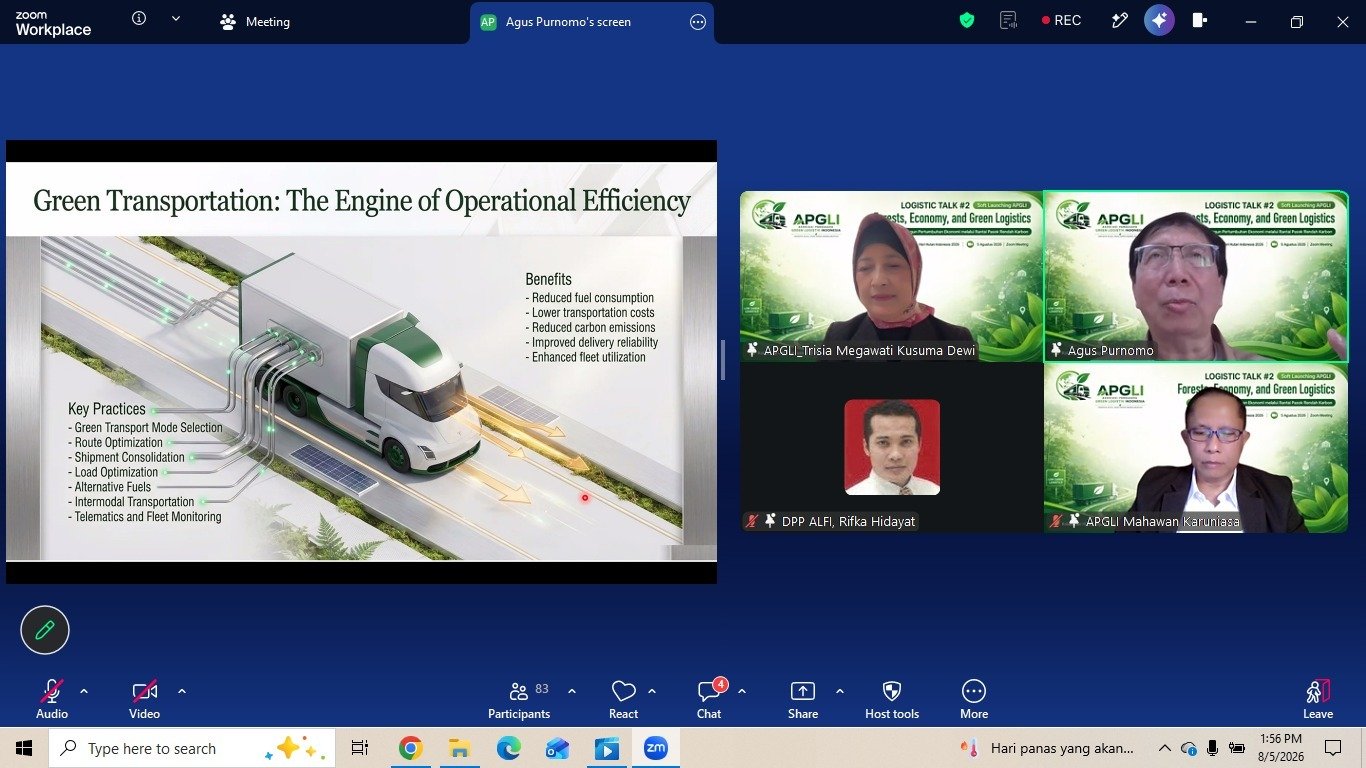
EdUAsiaNews, Jakarta – The transformation toward green logistics has become a key strategy for integrating economic growth, supply chain efficiency, environmental protection, and the achievement of Indonesia’s climate targets. This was highlighted during Green Logistics Talk #2 and the Soft Launch of the Indonesian Green Logistics Entrepreneurs Association (APGLI), held in Jakarta on Wednesday (August 5).
In his keynote address, “Forest Protection Policy Directions and the Role of the Logistics Sector in Supporting Low-Carbon Development,” Agus Justianto, Senior Policy Analyst at Indonesia’s Ministry of Forestry, emphasized that the logistics sector plays a strategic role in supporting Indonesia’s Nationally Determined Contribution (NDC) and the Indonesia’s FOLU Net Sink 2030 agenda. He noted that meaningful contributions can be achieved through energy efficiency, route and load optimization, multimodal transportation, the adoption of low-emission vehicles and clean energy, and digitalization to improve supply chain traceability.
“Green logistics is not merely an environmental agenda. It is a business strategy, an efficiency strategy, and a competitiveness strategy,” said Agus Justianto.
APGLI Chairperson Netty Sri Rejeki explained that the association was established in response to the logistics sector’s significant role in supporting Indonesia’s economic growth while addressing pressing challenges such as high operating costs, transportation safety, and increasing customer demand for responsible business practices.
“We believe green logistics should not remain a grand concept that is difficult to implement. It must be translated into practical measures that companies of all sizes can adopt according to their operational capabilities and conditions,” she said.
According to Netty, APGLI was created not only to promote the concept of green logistics but also to help the industry begin its transition.
“Our roadmap starts with building a strong organizational foundation, expanding member networks, developing educational forums, and introducing initial carbon measurement practices. We will then move toward strengthening the digital ecosystem, carbon reporting, and green financing collaborations. Ultimately, APGLI aims to position Indonesia as one of the regional centers for green logistics practices,” she added.
Meanwhile, Mahawan Karuniasa, a climate change and carbon expert and lecturer at the University of Indonesia, stressed that conducting a carbon inventory is the essential first step in developing a low-carbon logistics system. Accurate and measurable data are needed to identify major emission sources, or hotspots, enabling effective emission reduction strategies.
Supply chain management expert and First Vice Rector of the Bandung Institute of Logistics and Business (ULBI), Agus Purnomo, emphasized that green logistics has evolved beyond environmental compliance into a business strategy that enhances efficiency, resilience, safety, and the competitiveness of Indonesia’s supply chains.
“Its implementation includes green transportation, route and load optimization, fuel efficiency, energy-efficient warehousing, inventory management, environmentally friendly packaging, reverse logistics, and the utilization of digital technologies and renewable energy,” he explained.
Rifka Hidayat, Vice Chairman for International Affairs and Human Resources of the Indonesian Logistics and Forwarders Association (ALFI), described the establishment of APGLI as a strategic milestone in advancing green logistics in Indonesia. He affirmed ALFI’s readiness to collaborate in promoting an integrated, competitive, and sustainable green logistics system.
The Green Logistics Talk #2 and the Soft Launch of APGLI are expected to strengthen collaboration among government institutions, businesses, academia, and other stakeholders in developing a national green logistics ecosystem. This transformation is anticipated not only to support Indonesia’s climate commitments but also to improve operational efficiency, strengthen supply chain resilience, and enhance the competitiveness of the national logistics industry.