




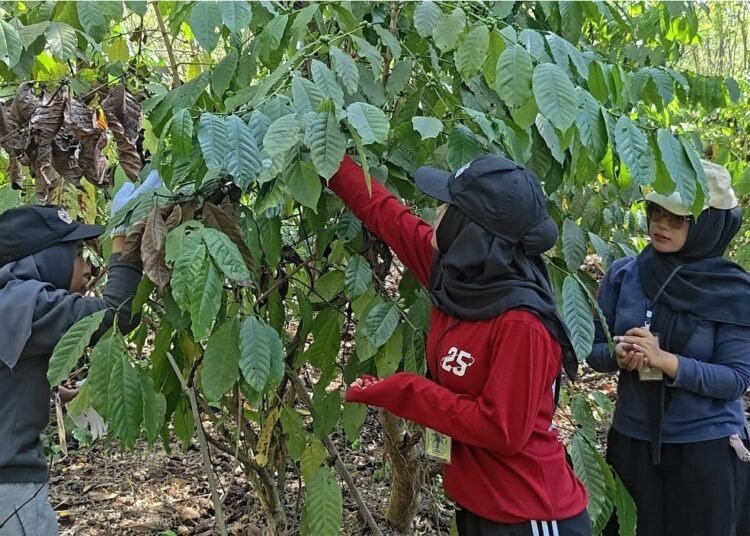
EduAsiaNews, Tanah Laut – Dozens of students from Universitas Lambung Mangkurat (ULM) participated in a hands-on coffee harvesting program at Bentok Kampung, Bati-Bati District, Tanah Laut Regency, on Saturday (July 18, 2026).
The activity took place at a coffee plantation owned by the ULM Rector and formed part of the Exchange Program Nasional (Expronas) 2026, organized by the International Association of Students in Agricultural and Related Sciences (IAAS) ULM.
In addition to harvesting coffee cherries, participants learned about the entire coffee value chain—from cultivation to downstream processing—providing practical knowledge to support the development of Indonesia’s agricultural sector.
With great enthusiasm, the students explored the approximately six-hectare coffee plantation, harvesting ripe coffee cherries using traditional baskets and buckets.
Learning from Theory to Practice
Muhammad Nasrudin, Chair of IAAS ULM, explained that Expronas is an annual program organized by the IAAS Exchange Department and implemented at universities across Indonesia.
This year, participants are undertaking a one-month internship, with Biji Kopi Borneo serving as one of the primary learning sites.
“Throughout the internship, we have not only studied the theoretical aspects of coffee production but have also gained valuable hands-on experience,” he said.
During the first week, participants learned about coffee varieties, plant characteristics, and suitable growing environments. In the second week, they studied pruning techniques and selective cherry picking.
“Today, we had the opportunity to conduct a harvesting practicum at the Rector’s coffee plantation, which spans approximately six hectares,” he added.
According to Nasrudin, the experience enables students to better understand the potential for coffee development in South Kalimantan while acquiring practical knowledge of coffee cultivation, plantation management, and proper harvesting techniques.
Harvesting Practice as a Critical Stage
Meanwhile, Dwi Putra Kurniawan, Chair of the South Kalimantan Regional Executive Board of the Indonesian Peasants Union (SPI), noted that Expronas 2026 marks the program’s fifth cohort.
Each year, the program offers internships at several learning sites. This year, three host locations were selected, including Biji Kopi Borneo, which welcomed approximately 23 students from various departments within ULM’s Faculty of Agriculture.
“For two weeks, participants studied coffee cultivation, harvesting, and processing through classroom instruction. Today, they applied that knowledge by practicing proper harvesting techniques, focusing on picking only fully ripe red coffee cherries,” he explained.
Dwi emphasized that harvesting is one of the most critical stages in coffee production, as the quality of the final product is largely determined by proper picking practices. Therefore, both farmers and students must understand appropriate harvesting techniques to produce coffee beans capable of competing in domestic and international markets.
He added that the activity also forms part of the preparations for the inauguration of the Teaching Factory Lambung Mangkurat Coffee & Roastery at ULM’s Faculty of Agriculture. The facility will provide students with comprehensive training in coffee processing, including pulping, sorting, and roasting.
Increasing the Value of Local Coffee
Dwi further highlighted that mastering the entire coffee production chain—from cultivation to downstream processing—is essential for increasing the value of locally produced coffee.
At present, many farmers continue to sell fresh coffee cherries, limiting their potential income.
“If farmers are able to market at least green coffee beans, the economic value of their products will increase significantly. In this regard, I believe ULM’s Faculty of Agriculture is responding effectively to future challenges,” he said.
He also stressed the importance of continued technical training and mentoring to help farmers consistently produce high-quality coffee that meets national and international market standards. He expressed hope that the Faculty of Agriculture would continue providing training, particularly in harvesting and post-harvest techniques, supported by the university’s modern coffee-processing facilities.
With coffee consumption continuing to rise and becoming an integral part of contemporary lifestyles—especially among younger generations—the rapid growth of coffee shops presents significant opportunities for farmers to improve both production and product quality.
“We hope that collaboration between farmers and universities will accelerate human resource development in the coffee sector. Students participating in this internship are expected to become mentors and knowledge-sharing agents who can support coffee farmers throughout South Kalimantan,” Dwi concluded.