




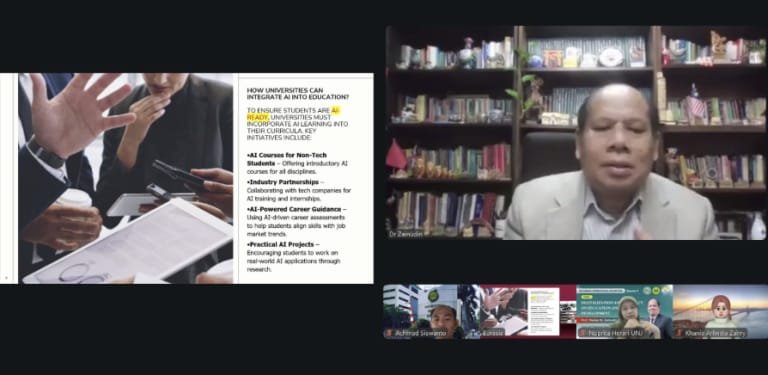
EduAsiaNews, Jakarta — Universitas Negeri Jakarta (UNJ), through the Faculty of Social Sciences and Law (FISH), has once again strengthened its commitment to developing students’ global perspectives by organizing The Eurasia International Course 2026 Session 9. The event, themed “Digitalization and AI Impact on Education and Skill Development,” was held on Monday, May 11, 2026, from 13.00 to 15.00 WIB in a hybrid format, taking place at the Multipurpose Room, Building K, FISH UNJ, and also attended online via Zoom.
This session featured Prof. Zainudin bin H. Hassan from Universiti Teknologi Malaysia (UTM) as the keynote speaker. The event was conducted in both Malay and English, with Noprita Herari from the Communication Science Study Program serving as moderator.
Through this international academic forum, participants were invited to understand major transformations in education and the workforce driven by digitalization and artificial intelligence (AI). These technological developments require higher education institutions to focus not only on knowledge mastery, but also on strengthening students’ adaptive skills, creativity, digital literacy, emotional intelligence, and critical thinking abilities.
In his presentation, Prof. Zainudin stated that AI has become an integral part of transformation across various industrial sectors. The technology is now widely used to support automation processes, data processing, decision-making, and improved work efficiency. He explained that several types of jobs that are repetitive, high-risk, require high precision, or involve complex calculations can be assisted by AI. However, human roles remain irreplaceable in work that demands creativity, empathy, social sensitivity, ethics, and adaptability to new situations.
According to Prof. Zainudin, the presence of AI should not be seen solely as a threat to the future of employment. Instead, technological change also opens opportunities for the emergence of new types of jobs and competencies. He emphasized that students from all disciplines need to develop AI literacy in order to understand how the technology works, use it productively, and maintain critical thinking in both learning and working processes.
He further stressed that AI can serve as a strategic partner in education. In teaching and learning practices, AI can assist educators in administrative management, monitoring student progress, and providing more personalized learning support. This allows educators to focus more on human-centered aspects of education, such as character building, ethics, communication, collaboration, and the development of students’ emotional intelligence.
The discussion session was highly interactive, featuring several questions from participants. Abel Elysia from the Sociology Education Study Program raised concerns about the impact of AI on climate crises. In response, Prof. Zainudin highlighted energy efficiency as a key agenda in addressing technological development and sustainability challenges. He also shared an example from UTM, where a work-from-home policy is implemented for all faculties on Tuesdays and Thursdays as part of efforts to support energy efficiency.
Another question was raised by Marco from the Communication Science Study Program, who addressed how AI can generate new job opportunities while also posing challenges related to intellectual property rights and the arts. Prof. Zainudin explained that although AI can support many work processes, humans remain central in generating ideas, knowledge, and creativity. He also reminded participants that tools such as ChatGPT should be used as instruments to test and enrich knowledge, rather than being accepted uncritically.
The implementation of Eurasia International Course 2026 Session 9 aligns with the strengthening of Key Performance Indicators (IKU) for higher education institutions, particularly in providing students with learning experiences beyond the classroom through international academic forums, expanding collaboration with overseas partners, and promoting future-relevant learning processes. The activity also reflects FISH UNJ’s commitment to building an academic ecosystem that is adaptive to technological advancements and global dynamics.
In addition, the event contributes to the achievement of the Sustainable Development Goals (SDGs), particularly SDG 4 (Quality Education), through strengthening access to high-quality and relevant education. It is also linked to SDG 9 (Industry, Innovation, and Infrastructure), as it discusses the role of technology and innovation in education and employment, as well as SDG 17 (Partnerships for the Goals), through international academic collaboration between UNJ and partners from the Asian region.
The event concluded with a group photo session featuring the “Intelligentia Dignitas UNJ” hand sign as a symbol of collaboration, unity, and UNJ’s commitment to promoting higher education that is human-centered, innovative, and ready to face the challenges of digital transformation. Through this program, UNJ continues to strengthen its role as a university that is not only responsive to technological advancement but also consistently places human values at the center of education and future development.