




EduAsiaNews, Lampung – The Coffee Berry Borer (CBB) pest and coffee leaf rust have long been major threats to coffee farmers in Tanggamus Regency, Lampung, causing yield losses of up to 50 percent. Addressing this critical challenge, a multidisciplinary team of five students from Universitas Lampung (Unila) has developed a groundbreaking solution: an AI-powered biomimetic unmanned aerial vehicle (UAV) designed to resemble a beetle, capable of detecting crop threats in real time with high precision.
The innovation was developed under the 2026 Student Creativity Program for Innovative Works (PKM-KI). The team consists of Rafidto Farras Achdiar Azizul Haqqi as project leader, together with Ariq Hazel, Gita Rahmania, Bayu Dwi Setiawan, and Elfi Nuraini Maridah, under the supervision of Aryanto, S.T., M.T. Their proposal, titled “Innovation of a Beetle-Inspired Intelligent Unmanned Aircraft as a Solution for Enhancing Coffee Productivity for Smallholder Farmers and Sustainable Industry in Indonesia,” successfully secured funding from Indonesia’s Ministry of Higher Education, Science, and Technology.
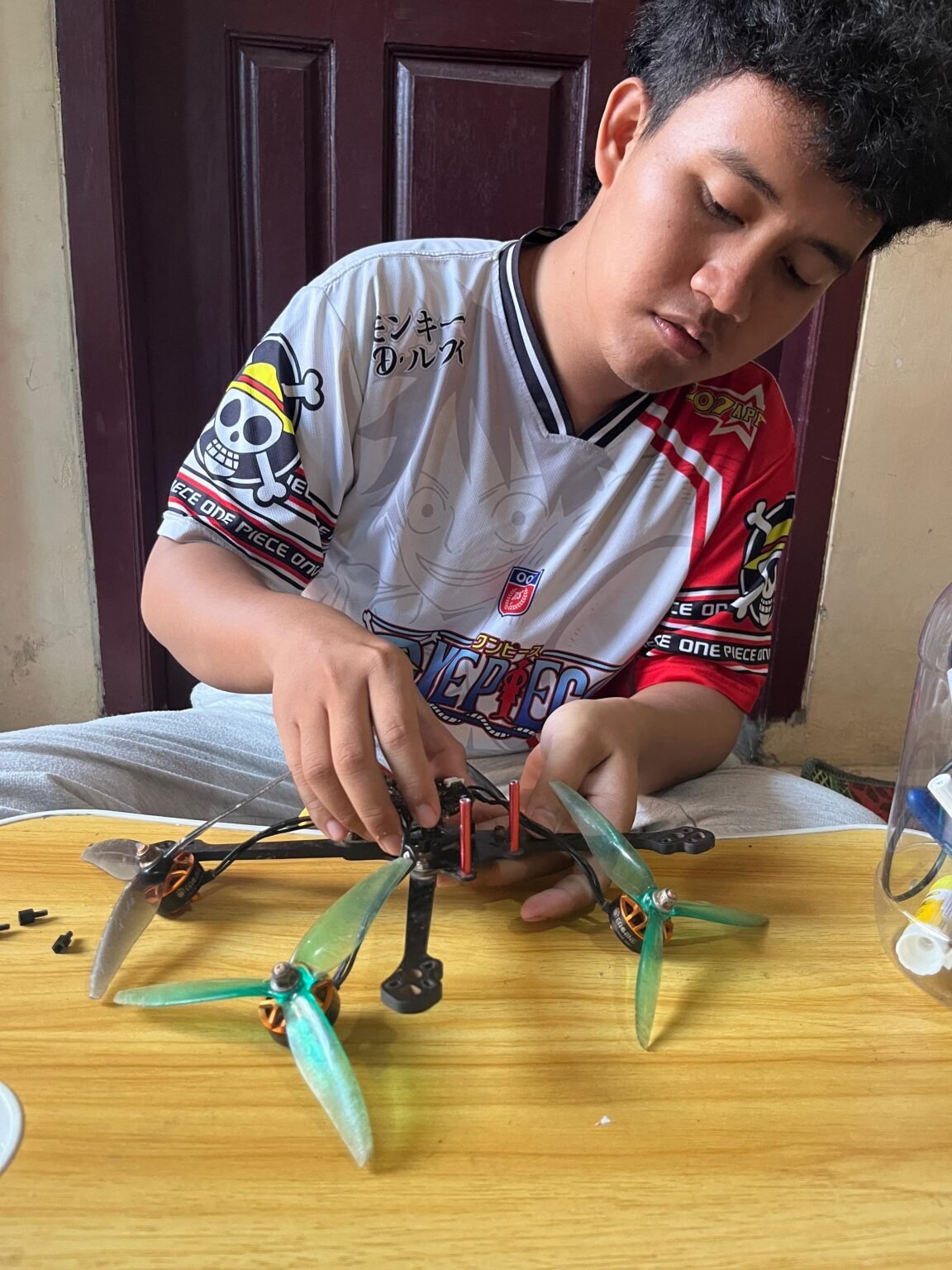
Unlike conventional commercial drones, the Unila team’s innovation adopts the physical form of a beetle. This biomimetic design enables the drone to maneuver efficiently beneath the dense canopy of coffee trees—an area too confined for conventional drones to access. Equipped with an AI system based on YOLOv8 and ResNet technologies, an ESP32-CAM camera, and an IoT-based monitoring system, the drone functions as an autonomous scanner that detects plant diseases at an early stage and instantly transmits precise geospatial maps of pest infestations to a monitoring dashboard.
The drone’s most significant advantage lies in the dramatic improvement in operational efficiency, as explained by the project leader.
“The most immediate benefit experienced by farmers is the remarkable reduction in inspection time. Previously, they had to spend several days walking through steep hillsides to manually inspect each coffee tree. With our beetle drone, the entire inspection process can now be completed in approximately 15 minutes,” said Rafidto Farras during an interview on July 5, 2026.
Rafidto added that the drone, which incorporates advanced components such as a Raspberry Pi Pico microcontroller and a Ublox M8N GPS module, was intentionally designed to remain affordable, with an estimated production cost of only Rp6–8 million (approximately US$370–490) per unit.
“Through our field trials, we aim to demonstrate the measurable improvements achieved after deploying the drone, including faster disease detection, reduced reliance on excessive chemical pesticides, and significant increases in coffee plantation productivity,” he explained.
Field trials conducted at a partner coffee plantation in Ulubelu District, Tanggamus Regency, demonstrated that the innovation is more than a laboratory prototype—it offers a practical solution that directly addresses the needs of smallholder coffee farmers.
Sumardi (51), one of the participating coffee farmers, expressed his appreciation for the technology.
“For smallholder farmers like us, discovering a pest infestation too late often means losing the harvest, making it difficult to repay fertilizer loans or afford our children’s education. We used to feel helpless once leaf rust spread throughout the plantation. The arrival of the Unila students with this beetle drone has truly been a technological breakthrough for our farms. Within minutes, we know exactly which trees are infected and need immediate treatment. We now use much less pesticide, and our harvests are protected. Unila has truly delivered a practical solution for farmers like us,” said Sumardi.
Despite facing significant technical challenges—including integrating multiple IoT and multi-agent systems into the drone’s compact body while maintaining stable real-time data communication—the student team remains optimistic that the innovation will perform competitively at the national level.
The beetle drone is expected to compete in the 2026 National Student Scientific Week (PIMNAS). Beyond the competition, Unila aims to complete full validation of the technology and further develop it into a mass-produced product suitable for industrial-scale application. The initiative underscores the university’s commitment to accelerating the transformation of Indonesia’s coffee sector toward a modern, precision-based, sustainable, and farmer-centered agricultural system.