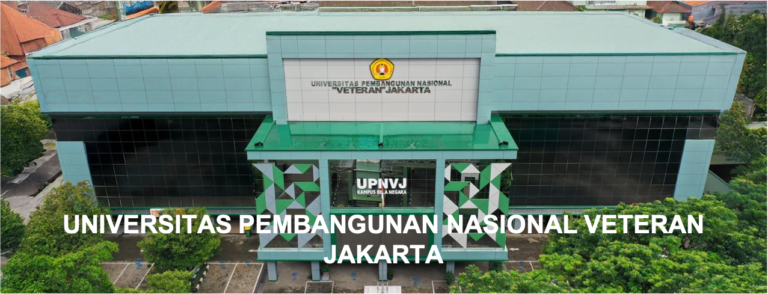





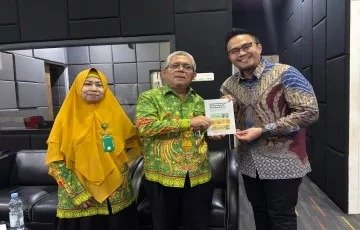
EduAsiaNews, Jakarta – The Institute for Quality Assurance and Learning Development (LPMPP) of Universitas Pembangunan Nasional “Veteran” Jakarta (UPNVJ), through its Center for General Education Courses (MKWK), organized a technical training program for General Education Course lecturers on Wednesday, August 5, 2026, from 8:00 to 11:00 a.m. at the UPNVJ Pondok Labu Campus in South Jakarta. The program was led by Dra. Aniek Irawatie, M.Si., Head of the MKWK Center, and featured Associate Professor Taufan Teguh Akbari, M.Si., Ph.D., as the keynote speaker.
The training was designed to equip lecturers with the knowledge and skills to integrate artificial intelligence (AI) into Semester Learning Plans (RPS), teaching methodologies, and assessment practices in a proportional, transparent, ethical, and responsible manner. Through this initiative, LPMPP UPNVJ promotes AI as a learning support tool that enhances educational quality without replacing students’ critical thinking, creativity, reflection, academic integrity, or personal responsibility.
The program aims to produce Personal Action Plans that lecturers can implement beginning in the following semester. Participants were encouraged to revise their Semester Learning Plans, develop Project-Based Learning (PjBL) strategies, establish guidelines for student AI usage, design authentic assessment methods, and prepare implementation schedules for AI-integrated instruction.
Taufan emphasized that integrating AI into course plans requires more than simply allowing students to use AI technologies. Lecturers must redesign learning outcomes, instructional methods, assignments, project-based activities, assessment strategies, AI usage boundaries, and identify which aspects of coursework must remain dependent on human reasoning and decision-making.
Within this framework, AI is positioned as a tool to strengthen learning rather than replace human capabilities. Its use must remain centered on critical thinking, source verification, ethical reflection, students’ academic voice, lecturer accountability, and the core values embedded in the General Education Curriculum.
Lecturers were also encouraged to develop authentic assessments based on real-world problems, verified sources, documented learning processes, iterative revisions, presentations, and oral defenses. Such approaches ensure that students demonstrate not only final outputs generated with AI assistance but also their analytical processes, decision-making, and reflective thinking.
The training differentiated AI applications according to risk levels. The use of AI to collect or transfer personal data, conceal academic misconduct, fabricate references, or complete closed-book examinations was identified as unacceptable practice.
Conversely, AI may be used in a limited capacity for editing, generating examples, conducting simulations, summarizing information, visualizing data, and supporting personalized learning. Any AI-assisted work must be openly disclosed, while all outputs must ultimately be reviewed, evaluated, and validated by human users.
Transparency was highlighted as a fundamental principle of AI-integrated learning. Students are expected to disclose the AI tools they used, explain which stages of their work involved AI, and clarify the extent of AI’s contribution to their assignments.
The same principle applies to lecturers. Faculty members are encouraged to openly acknowledge the use of AI in developing teaching materials, preparing examinations, designing assessment rubrics, creating learning simulations, and providing feedback to students.
The implementation of AI was further contextualized according to the characteristics of four General Education courses: Religious Education, Pancasila Education, Civic Education, and Indonesian Language.
In Religious Education, AI may be used to compare perspectives and develop ethical dilemma scenarios. However, it cannot replace religious sources, moral authority, or students’ reflective processes.
In Pancasila Education, AI may assist in stakeholder mapping, social scenario development, and policy analysis grounded in Pancasila values. Students remain responsible for identifying bias, verifying sources, engaging in deliberation, and determining solutions that reflect humanity, unity, democracy, and social justice.
In Civic Education, AI is intended to support digital citizenship literacy, public issue analysis, fact-checking, and deliberative simulations. It must not be used to generate disinformation, manipulate identities, create deepfakes, or fabricate evidence.
Meanwhile, in Indonesian Language courses, AI may function as a writing assistant, style comparison tool, limited editing aid, object of language criticism, and audience simulator. Students must continue to demonstrate original ideas, maintain their personal voice, ensure source accuracy, exercise appropriate language use, and uphold authorship responsibility.
The technical training also introduced various AI tools that can be adapted to educational needs, including ChatGPT, Gemini, NotebookLM, Consensus, Scite, Perplexity, Google Fact Check Explorer, Canva Magic Studio, Grammarly, CapCut AI, and Adobe Podcast.
Participants were further trained in effective prompt engineering, covering key elements such as role, context, objectives, tasks, constraints, and output format. This structured approach enables AI systems to generate more relevant, specific, and pedagogically appropriate responses.
Taufan brings more than 18 years of experience in higher education, specializing in communication, leadership, human resource development, community engagement, and sustainability. He has held several leadership positions at the LSPR Institute of Communication and Business, including Vice Rector for Student Affairs, Career, and Alumni, as well as Vice Rector for Reputation, Business Innovation, and Stakeholder Engagement.
His professional background also includes teaching, book authorship, scholarly publications, communication training, leadership development, and higher education transformation, providing a practical foundation for guiding lecturers in developing technology-enhanced, human-centered learning.
Through this technical training, LPMPP UPNVJ, through the MKWK Center, seeks to encourage lecturers to design learning experiences that are more contextual, critical, collaborative, and evidence-based. AI integration is expected not only to strengthen lecturers’ technological competencies but also to reinforce academic integrity, assessment quality, and students’ social responsibility.
This faculty development initiative also supports the policy direction of UPNVJ Rector Prof. Dr. Anter Venus, M.A., Comm., in enhancing learning quality and accelerating the university’s academic transformation. AI implementation at UPNVJ is intended to cultivate graduates who are technologically adaptive while maintaining critical thinking, human values, academic integrity, and the university’s State Defense (Bela Negara) character.(www.upnvj.ac.id)