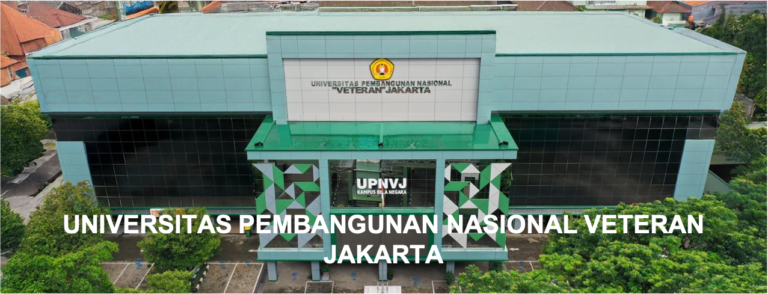






EduAsiaNews, Jakarta – Universitas Pembangunan Nasional “Veteran” Jakarta (UPNVJ) has opened admissions for its newly established Bachelor’s Program in Logistics Engineering for the 2026/2027 academic year. A total of 35 seats are available through the UPNVJ Special Independent Admission pathway, with applications open from July 31 to August 4, 2026. The introduction of the new program under the Faculty of Engineering reflects UPNVJ’s commitment to preparing graduates capable of addressing the evolving challenges of the logistics industry, supply chain management, transportation, warehousing, distribution, and digital transformation.
The Bachelor’s Program in Logistics Engineering officially received authorization after UPNVJ obtained an approval decree from the Higher Education Service Institution (LLDIKTI) Region III on July 28, 2026. The university has also secured approval for its Single Tuition Fee (UKT) and Institutional Development Contribution (IPI) rates from the Directorate General of Higher Education, Ministry of Higher Education, Science, and Technology, through a letter issued on July 29, 2026.
The inaugural intake of 35 students is intended to ensure a focused and effective learning environment. Students will benefit from academic mentoring, practice-oriented instruction, laboratory activities, case studies, applied research, and opportunities to collaborate with industry and business partners.
Tuition Fees (UKT) and Institutional Development Contribution (IPI)
The UKT for the Bachelor’s Program in Logistics Engineering is divided into eight categories:
- Group I: IDR 500,000
- Group II: IDR 1,000,000
- Group III: IDR 4,400,000
- Group IV: IDR 5,900,000
- Group V: IDR 7,400,000
- Group VI: IDR 8,900,000
- Group VII: IDR 10,400,000
- Group VIII: IDR 11,900,000
Students admitted through the Special Independent Admission pathway will also pay an Institutional Development Contribution (IPI), set at IDR 25 million, IDR 30 million, or IDR 35 million, depending on the assigned category. Both UKT and IPI classifications are determined in accordance with UPNVJ regulations and assessment procedures.
Admission Schedule
Applications must be submitted online through the UPNVJ admissions portal according to the following schedule:
- Online registration: July 31, 2026 (09:00 WIB) – August 4, 2026 (15:00 WIB)
- Application fee payment: July 31, 2026 (09:00 WIB) – August 4, 2026 (17:00 WIB)
- Completion of all registration requirements: July 31, 2026 (09:00 WIB) – August 4, 2026 (23:59 WIB)
- Admission results announcement: August 6, 2026 (15:00 WIB)
- Medical examination: August 7, 2026 (08:00–16:00 WIB)
- Enrollment payment: August 6, 2026 (15:00 WIB) – August 9, 2026 (15:00 WIB)
- Final enrollment: August 6, 2026 (15:00 WIB) – August 9, 2026 (23:59 WIB)
Applicants must be graduates of senior high schools, vocational schools, Islamic senior high schools, or equivalent institutions who meet the requirements for UPNVJ’s Special Independent Admission. Prospective students are encouraged to observe all deadlines, ensure the accuracy of submitted information, and complete all required administrative documents.
Focus on Urban and Digital Logistics
The Bachelor’s Program in Logistics Engineering has been designed with a specialization in urban and digital logistics, addressing contemporary challenges such as urban distribution systems, multimodal transportation integration, warehouse and inventory management, e-commerce logistics, and last-mile delivery.
The curriculum comprises 146 credit units, covering fundamental subjects in mathematics, science, information technology, and engineering before progressing to specialized courses in logistics system planning, supply chain management, data analytics, artificial intelligence, logistics automation, information systems, urban and multimodal transportation, and warehouse and inventory management.
Students may further develop their expertise through elective courses, including Humanitarian Supply Chain, Halal Logistics, Cold Chain, Healthcare Logistics, Reverse Logistics, Freight Forwarding, Vehicle Routing, and Last-Mile Delivery Systems. The curriculum also incorporates experiential learning opportunities through the Impact Campus Program, including industry internships, research projects, entrepreneurship, student exchanges, humanitarian initiatives, and community service.
The program prepares graduates for three primary career profiles: Professional Logistics Engineer, Technopreneur, and Lifelong Learner. Graduates are expected to be capable of designing, managing, evaluating, and optimizing technology-driven logistics systems while fostering innovation and entrepreneurship in logistics and supply chain management.
Teaching and learning activities will be strengthened through partnerships with government agencies, state-owned enterprises, private companies, logistics service providers, manufacturing industries, professional associations, and international institutions. These collaborations will support curriculum alignment, internship opportunities, practitioner involvement in teaching, joint research, and the development of solutions to national logistics challenges.
The Logistics Engineering program is also envisioned as a center for advancing knowledge and innovation in smart and sustainable logistics. Technologies such as the Internet of Things (IoT), artificial intelligence (AI), big data, and logistics information systems will play a central role in preparing graduates to meet the evolving demands of the logistics industry.
The establishment of the Bachelor’s Program in Logistics Engineering further reinforces UPNVJ’s academic transformation agenda by providing technology-driven, student-centered education that is closely aligned with industry needs. The initiative supports the university’s strategic priorities of enhancing educational quality, strengthening graduate competencies, expanding industry collaboration, and generating meaningful societal impact.(www.upnvj.ac.id)