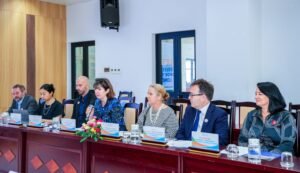




EduAsiaNews, Bogor – The Department of Marine Science and Technology (ITK), Faculty of Fisheries and Marine Sciences (FPIK), IPB University, successfully organized the third series of the International Summer Course on Marine Science and Technology (ISOSS) 2026.
The program focused on the application of cutting-edge technologies for marine conservation and featured two doctoral researchers from Wageningen University & Research (WUR), the Netherlands, as keynote speakers.
In his opening remarks, Dr. Syamsul Bahri Agus, Head of the Department of Marine Science and Technology at IPB University, emphasized the importance of adopting digital technologies and multimedia approaches to address the growing challenges posed by the degradation of marine ecosystems.
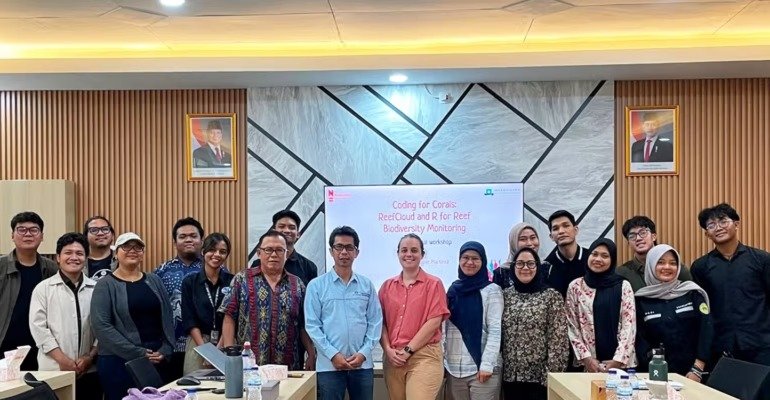
The first session, entitled “Coding for Coral: ReefCloud (AI) and R for Reef Biodiversity and Monitoring,” was delivered by Stephanie Martinez. She demonstrated how artificial intelligence (AI), through the ReefCloud platform, can significantly accelerate the analysis of underwater imagery to enable real-time monitoring of coral reef conditions.
In addition to AI applications, participants were introduced to data analysis using the R programming language. The integration of AI and R enables researchers to analyze biodiversity indices and monitor coral reef recovery trends with far greater speed, accuracy, and comprehensiveness than conventional manual methods.
Complementing the quantitative approach, the second session shifted to the field of science communication with a workshop entitled “Sea, Camera, Action! Master Marine Video Production,” presented by Agustin Capriati.
Agustin emphasized that robust scientific data must be communicated effectively to support evidence-based conservation policies and enhance public awareness. During the workshop, participants received practical training in professional marine video production, including camera handling in aquatic environments, underwater videography techniques, and the art of developing compelling, science-based visual storytelling.
“The integration of modern scientific tools such as AI and R-based data analysis with visual communication skills through videography is an essential combination for marine researchers in the digital era,” Agustin told the participants, who included faculty members and students from various academic levels within the Department of Marine Science and Technology.
Through the implementation of ISOSS 2026, the Department of Marine Science and Technology at IPB University reaffirmed its commitment to strengthening international research collaboration while cultivating a new generation of marine conservation leaders capable of leveraging emerging global technologies.