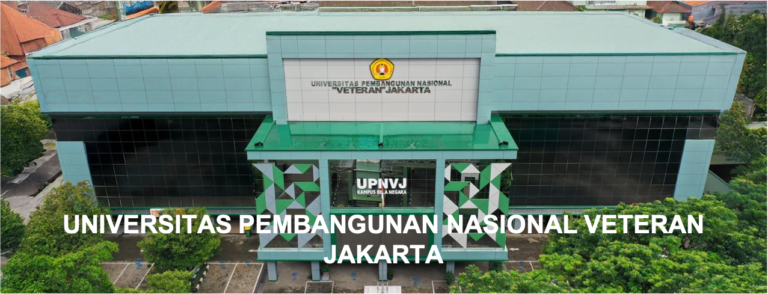





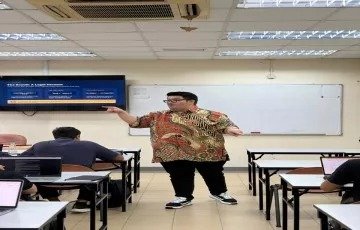
EduAsiaNews, Jakarta – Universitas Pembangunan Nasional “Veteran” Jakarta (UPNVJ) continues to strengthen its higher education internationalization agenda through the participation of a Faculty of Law lecturer in the Visiting Global Lecture program at Universiti Teknologi MARA (UiTM), Malaysia. Held on Friday, July 3, 2026, at Cempaka 1 Room B07, UiTM, the event featured Rianda Dirkareshza, S.H., M.H., a lecturer from UPNVJ’s Faculty of Law, as a visiting lecturer delivering a lecture to students of UiTM’s Faculty of Law. Through this global lecture, UPNVJ promoted cross-border knowledge exchange, particularly on issues related to intellectual property law, copyright, and the advancement of Generative Artificial Intelligence (Generative AI).
During the lecture, Rianda presented his research entitled Generative AI Is Not a Mere Tool: Revisiting Indonesian Copyright Law, which has been published in The Journal of World Intellectual Property. The study examines the implications of advances in Generative Artificial Intelligence for Indonesia’s copyright regime, particularly as AI technologies become increasingly capable of independently generating creative works and challenging the conventional concept of authorship under existing legal frameworks.
Rianda explained that Generative AI can no longer be regarded merely as a tool that assists the creative process. Powered by machine learning capabilities, AI systems are now able to autonomously produce creative expressions, raising fundamental questions regarding who can be legally recognized as the author of a work from the perspective of copyright law.
The research further reveals that Indonesia’s copyright regime, which remains predominantly human-centric, has yet to fully accommodate works independently generated by Generative AI. This situation may create a legal vacuum, as such works may satisfy the legal criteria of copyrightable creations while lacking a legal subject who can be recognized as the author under Law Number 28 of 2014 on Copyright.
As one possible solution, the study proposes the establishment of a sui generis legal regime specifically for works generated by Generative AI. Under this model, AI-generated works would continue to be recognized as creative works but would have neither a legally recognized author nor a copyright holder. Instead, such works would immediately enter the public domain upon creation, while attribution to the AI system responsible for generating the work would remain mandatory. The proposal is expected to contribute to future policy development and reform of Indonesia’s copyright framework.
The Visiting Global Lecture was attended by approximately 20 students from UiTM’s Faculty of Law. The session featured an engaging and interactive discussion, with participants demonstrating strong interest in the rapid development of artificial intelligence and its implications for copyright law. Several students were already familiar with AI-related developments in Indonesia, allowing the discussion to extend beyond theoretical perspectives to address regulatory challenges, the concept of authorship, and comparative legal approaches adopted by Indonesia and Malaysia in responding to Generative AI technologies.
The participation of UPNVJ’s Faculty of Law lecturer in this international academic forum forms part of the university’s broader strategy to expand its global network through internationally recognized scholarly publications, knowledge exchange, and collaboration with partner universities abroad. The initiative also reinforces UPNVJ’s position as a public university that actively responds to contemporary legal issues, particularly in the fields of intellectual property and digital technology.
UPNVJ Rector, Prof. Dr. Anter Venus, M.A., Comm., views international academic engagements such as this as an integral component of the university’s transformation toward becoming a more adaptive, impactful, and globally competitive institution. Through its faculty members’ contributions to international academic forums, UPNVJ not only enhances its institutional reputation but also advances scholarly ideas that are relevant to the development of public policy, scientific knowledge, and legal governance in the era of artificial intelligence.(www.upnvj.ac.id)