




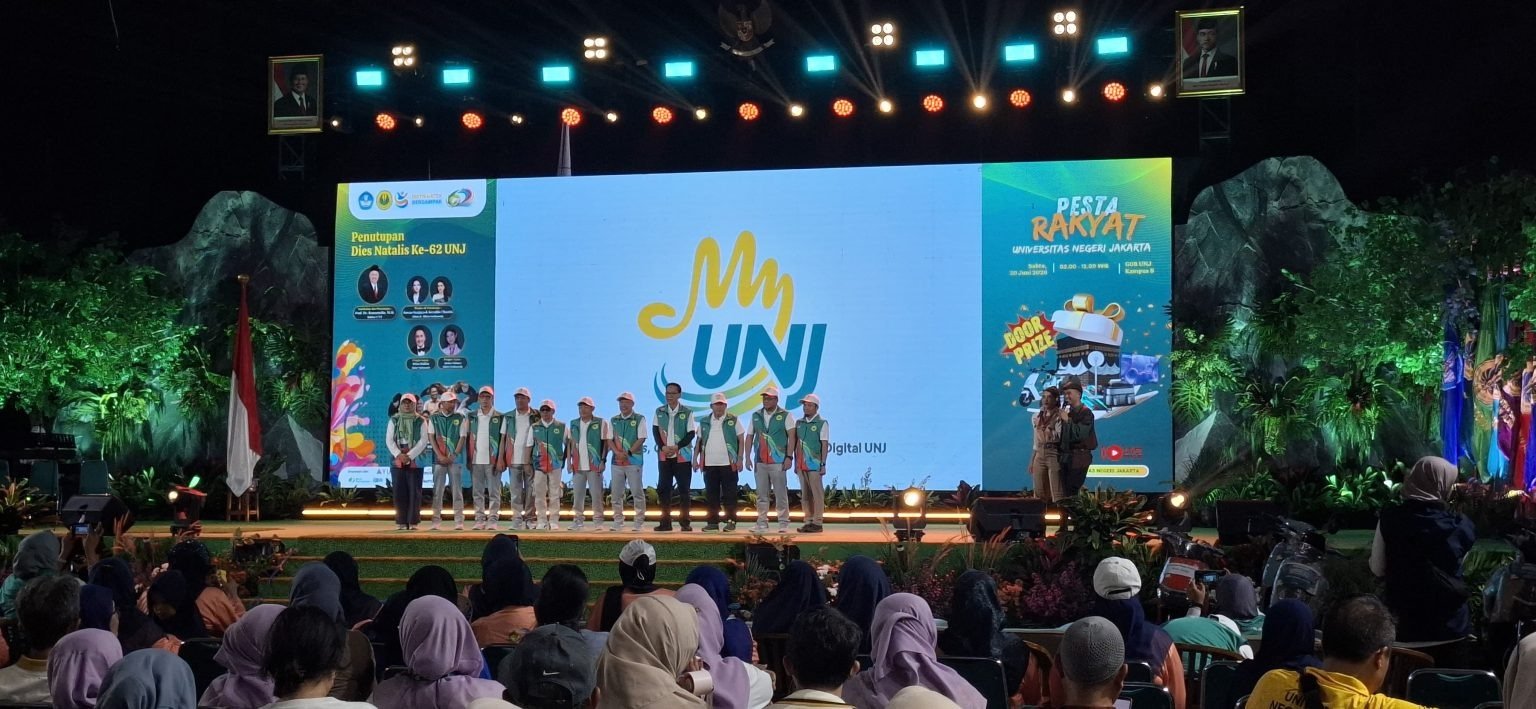
EduAsiaNews, Jakarta – Jakarta State University (UNJ) marked a significant milestone in its digital transformation journey with the launch of MyUNJ, an integrated campus service platform designed to provide easier access to information and a wide range of digital services for the entire academic community. The platform was officially launched during the People’s Festival and Closing Ceremony of UNJ’s 62nd Anniversary Celebration, held at the UNJ Sports Hall (GOR), Campus B, on Saturday, June 20, 2026.
The introduction of MyUNJ reflects UNJ’s commitment to developing a modern, efficient, and technology-driven university governance system. The platform serves as a solution to the previously fragmented digital services that required users to access multiple applications and portals separately.
Through Single Sign-On (SSO) technology, MyUNJ enables students, faculty members, administrative staff, and other stakeholders to access various digital services using a single account and password. This integrated authentication system offers a more convenient, faster, and secure user experience.
Beyond unifying access to services, MyUNJ features a personalized dashboard tailored to the specific needs of each user. Through this functionality, members of the university community can access information and services that are relevant to their roles and activities within the institution.
As part of the development of a more comprehensive digital ecosystem, the launch of MyUNJ also introduced eight new digital services integrated into a single platform. These include e-SPPD for the digital management of official travel administration, SATU DATA UNJ as the institution’s strategic data integration hub, SIMRISK to support risk management governance, and LAD (Digital Archive Cabinet), which facilitates secure, efficient, and transparent document management and access.
In addition, UNJ launched SIAKAD V3, a more modern and responsive academic information system, as well as PPID Mobile, designed to expand access to public information and documentation services. Several other digital services were also introduced to support the effective implementation of the university’s tridharma missions of education, research, and community engagement.
With the introduction of MyUNJ, all administrative, academic, and information services can now be accessed through a single integrated digital ecosystem, eliminating the need for repeated logins across multiple applications. This innovation is expected to enhance work efficiency, productivity, service quality, and the overall digital experience of the university community.
UNJ Rector, Prof. Komarudin, stated that the launch of MyUNJ represents an important milestone in the university’s digital transformation toward becoming a world-class institution that is adaptive to technological advancements.
“The launch of MyUNJ is not merely about introducing a new application; it reflects UNJ’s commitment to fostering an integrated, efficient, and user-oriented work and service culture. Digital transformation must provide convenience, accelerate service processes, and support data-driven decision-making,” said Prof. Komarudin.
Meanwhile, Prof. Fahrurrozi, Vice Rector for Research, Innovation, and Information Systems, explained that MyUNJ was developed as the primary foundation for information system integration across the university.
“Through MyUNJ, we aim to create a digital experience that is simpler, more connected, and sustainable. This platform is a strategic initiative to unify the university’s various digital services within a single ecosystem that promotes effective governance, collaboration, and innovation at UNJ,” he explained.
MyUNJ can be accessed through UNJ’s official platform and will continue to be developed progressively, introducing new features and services to better support the needs of the university community.
Guided by the spirit of “Digital Transformation for a Better Future,” UNJ invites all members of its academic community to become part of a sustainable digital transformation journey aimed at creating a more excellent, integrated, innovative, and future-ready university.