




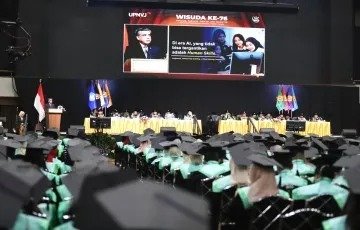
EduAsiaNews, Jakarta – Prof. Yassierli, Ph.D., Indonesia’s Minister of Manpower, reminded graduates of the University of Pembangunan Nasional “Veteran” Jakarta (UPNVJ) not to rely solely on academic degrees when entering the workforce. The message was delivered during his remarks at UPNVJ’s 76th Graduation Ceremony in Jakarta on Monday, 18 May 2026. According to Yassierli, today’s industrial sector is moving toward skills-based hiring amid major transformations driven by artificial intelligence, digitalization, the green economic transition, and global demographic dynamics.
“Today, industries and businesses no longer focus on which school someone attended, where they studied, or what degree they earned. What they are looking for are skills,” Prof. Yassierli stated before graduates, university leaders, lecturers, parents, and invited guests.
He explained that changes in the labor market are occurring very rapidly and require university graduates to continuously update their competencies. Based on the data he presented, 73 percent of professional recruiters now prioritize skills-based recruitment.
Prof. Yassierli emphasized that this condition serves as an important signal for UPNVJ graduates. Educational background remains important; however, practical abilities, adaptability, and readiness to face change have become the primary factors determining graduates’ success in the workplace.
In his presentation, Prof. Yassierli identified artificial intelligence (AI) as one of the key factors reshaping the global employment landscape. According to him, AI is no longer a future issue, but has already become part of today’s industrial requirements.
“My data shows that 78 percent of companies require prospective employees to possess at least a basic understanding of AI,” he said.
He acknowledged that automation may eliminate a number of routine jobs. Nevertheless, technological advancement is also creating opportunities for a greater number of new occupations to emerge.
“Reports indicate that 92 million jobs will disappear globally by 2030 due to automation. However, many more new jobs will also be created,” he explained.
Prof. Yassierli cited several professions that were virtually unknown two decades ago but have now become essential components of the modern employment ecosystem. These include social media managers, data scientists, and other digital economy-based professions.
“There is research from LinkedIn showing that 80 percent of jobs experiencing significant growth today did not exist 20 years ago,” he added.
Despite rapid technological development, Prof. Yassierli stressed that human skills remain core competencies that cannot be fully replaced by machines. He noted that eight out of the eleven core competencies expected to remain relevant over the next decade are related to interpersonal abilities and human-centered thinking.
“What are they? Judgment, relationship building, critical thinking, and empathy,” he said.
According to Yassierli, technology should be understood as a supporting tool rather than a substitute for human beings. Therefore, university graduates must master critical thinking, collaboration, relationship building, adaptability, and empathy in the workplace.
“People first, and technology is merely an enabler,” Prof. Yassierli remarked.
On the same occasion, he also reminded graduates not to stop learning after obtaining their degrees. Yassierli emphasized the importance of maintaining a growth mindset so that graduates can survive and thrive amid changes in the labor market.
“Do not become someone with a fixed mindset—someone who believes intelligence is a status. ‘I already have a degree; I am already sufficient,’” he said.
He added that the journey of building competencies does not end upon graduation from university. Graduates must continue pursuing upskilling and reskilling in order to remain relevant to industry demands.
“Our journey in developing our competencies does not end once we obtain our diploma,” Prof. Yassierli stated.
In addition to delivering messages to graduates, Prof. Yassierli also outlined several government initiatives aimed at preparing human resources that are more adaptive to labor market needs. According to him, the Ministry of Manpower continues to expand vocational training and internship programs to help graduates enter the workforce.
One of the government’s priority programs is an internship initiative for 100,000 participants, providing monthly allowances equivalent to the minimum wage for six months. The program is intended to connect graduates with real industrial work experience.
“Last year, we had a priority internship program for 100,000 people, with allowances paid according to the minimum wage for six months,” he explained.
In addition, the government is developing project-based learning programs in future-oriented sectors such as the digital economy, green jobs, AI technology, and smart cities. Through this approach, trainees are expected not only to understand theory but also to become accustomed to solving real-world industrial problems.
“This year, we received a budget allocation to provide vocational training for more than 300,000 people,” Prof. Yassierli stated.
He expressed hope that UPNVJ graduates would view changes in the labor market as opportunities for growth rather than obstacles. According to him, opportunities will always be available for graduates who are willing to learn, adapt, and continuously develop their competencies.
“There are many opportunities. Wherever opportunities exist, the challenge is how we can transform those opportunities into business achievements and success,” he concluded.(www.upnvj.ac.id)