




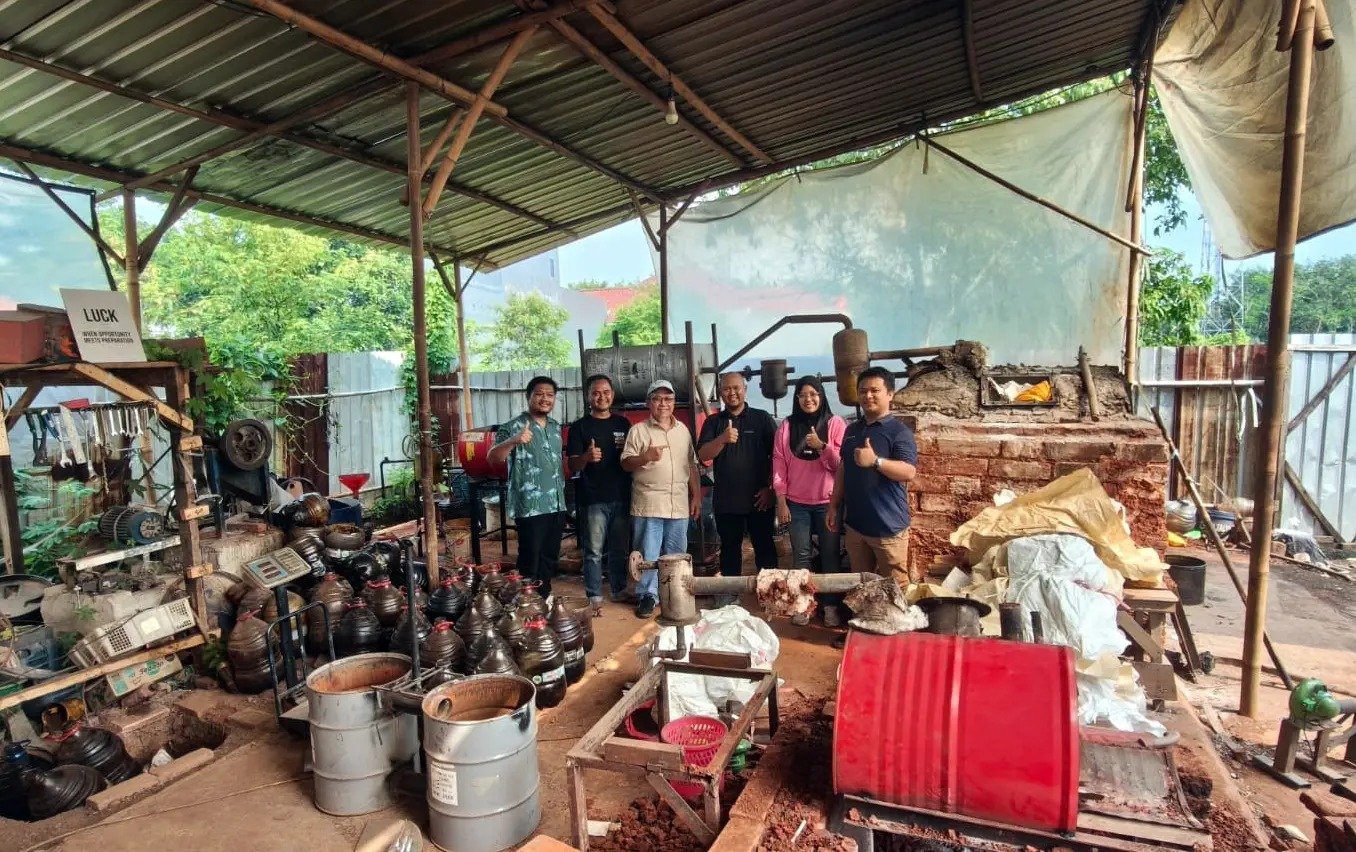
EduAsiaNews, Batang – Diponegoro University (UNDIP), in collaboration with its industrial partner, has officially launched a flagship strategic program entitled “Catalytic Pyrolysis Technology for Converting Non-Organic Waste into Fuel to Support the Low-Carbon Energy Transition in Industry.” This jointly funded collaborative research initiative has been underway since March 2026 in Batang Regency, Central Java.
This large-scale program brings together researchers from the Department of Chemical Engineering at UNDIP and industry experts from the waste management sector. The intensive collaboration has been designed to address two pressing global challenges: the growing accumulation of plastic waste and the ongoing fossil energy crisis. Through this initiative, both parties are committed to creating tangible synergy between university laboratory research and industrial-scale implementation.
Synergy and Innovation in Catalytic Pyrolysis Technology
The urgency of this program stems from the increasing volume of mixed non-organic plastic waste that is difficult to decompose and poses serious environmental threats. At the same time, industries are under increasing pressure to accelerate their transition toward cleaner, low-carbon energy sources. To bridge these challenges, the collaboration has established a complementary and well-structured division of responsibilities.
Diponegoro University serves as the primary technology developer, overseeing the engineering design of the pyrolysis reactor, the synthesis of zeolite-based catalysts, and comprehensive chemical analyses of the resulting products using Gas Chromatography–Mass Spectrometry (GC-MS) and Detailed Hydrocarbon Analysis Gas Chromatography (GC-DHA). Meanwhile, the industrial partner, PT Dahana Solusi Inovasi, acts as the field implementation partner by providing warehouse facilities, plastic shredding equipment, plastic waste feedstock, as well as financial and in-kind support.
The Head of the UNDIP Research Team, Prof. Didi Dwi Anggoro, expressed strong optimism regarding the strategic project:
“Our collaboration with industry in Batang serves as a crucial bridge that brings academic research beyond the laboratory and into industrial reality. The project began by upgrading the pyrolysis unit from a 50-kilogram capacity to a 100-kilogram system while enhancing the condensation process and evaluating the liquid fuel products in accordance with ASTM standards. Furthermore, by transforming the reactor design from a static configuration into a rotary reactor, we have significantly improved combustion efficiency and thermal conversion performance. We are targeting a pyrolysis oil yield of 50–70 percent during the initial phase, increasing to approximately 75 percent in the second year, thereby producing a stable liquid fuel suitable for commercial applications as an alternative energy source. This represents a concrete contribution from academia toward strengthening Indonesia’s national energy security.”
Tangible Benefits for the Environment and Society
The implementation of catalytic pyrolysis technology is expected to generate substantial and long-term environmental and socio-economic benefits. From an ecological perspective, the pilot-scale reactor will significantly reduce the volume of mixed plastic waste that would otherwise accumulate in landfills or pollute local ecosystems. The surrounding communities are also expected to benefit economically through the creation of new employment opportunities in waste collection, sorting, shredding, and daily plant operations.
Agni Sakti, Director of PT Dahana Solusi Inovasi, welcomed the strategic partnership and stated:
“As the industrial partner, we are honored and enthusiastic to participate in this strategic collaboration with Diponegoro University. For us, this initiative goes far beyond academic research—it offers a practical solution to the industry’s need for sustainable non-organic waste management. The redesign from a static reactor to a rotary reactor, developed jointly with the research team, has proven significantly more effective in processing plastic materials under operational conditions. Looking ahead, we aim to commercialize this technology on a larger scale, with processing capacities reaching one ton. We are fully prepared to become an early adopter that brings catalytic pyrolysis technology into broader commercial markets.”
In addition to reducing environmental pollution, converting plastic waste into liquid fuels comparable to gasoline and diesel provides local industries with a more affordable alternative energy source, thereby lowering production costs and reducing regional carbon emissions. Moreover, by reutilizing process gases as an internal energy source for reactor operations, the system adopts circular economy principles that maximize energy efficiency while minimizing secondary waste generation.
Contributing to the Sustainable Development Goals and Advancing the University’s Vision
The strategic collaboration between UNDIP and its industrial partner represents a tangible contribution to achieving the Sustainable Development Goals (SDGs). The project directly supports SDG 7 (Affordable and Clean Energy) by producing low-carbon pyrolysis oil as an alternative fuel source. It also advances SDG 9 (Industry, Innovation and Infrastructure) by increasing the Technology Readiness Level (TRL) from laboratory research to TRL 8, representing a pre-commercial system ready for industrial application.
Furthermore, the project’s contribution to improved waste management aligns with SDG 11 (Sustainable Cities and Communities) and SDG 12 (Responsible Consumption and Production) through the implementation of circular economy-based plastic waste management. Finally, the initiative embodies the spirit of SDG 17 (Partnerships for the Goals) by fostering close collaboration between higher education institutions and industry.
Through the successful development of an innovative, economically viable, environmentally friendly, and commercially applicable catalytic pyrolysis technology, Diponegoro University reaffirms its commitment to serving the nation. This comprehensive research downstreaming initiative fully reflects and advances the University’s guiding motto: “UNDIP Bermartabat, UNDIP Bermanfaat” (“UNDIP with Dignity, UNDIP for the Benefit of Society”).