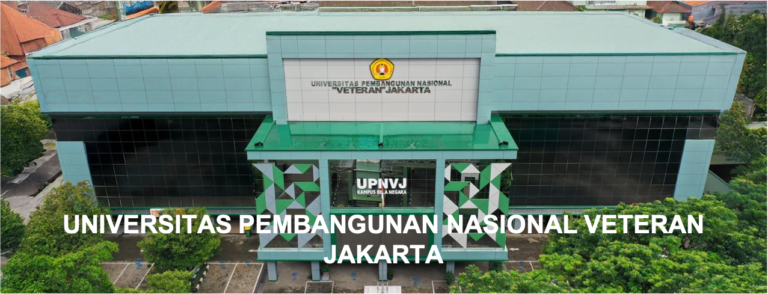





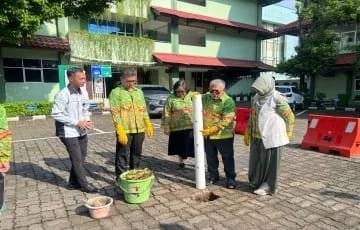
EduAsiaNews, Jakarta – Universitas Pembangunan Nasional “Veteran” Jakarta (UPNVJ) has launched a biopore program as a concrete step toward realizing sustainable campus environmental management. The program was officially inaugurated in front of the Faculty of Medicine Building on Wednesday, April 15, 2026, and was attended directly by the Rector of UPNVJ, Prof. Dr. Anter Venus, MA, Comm, along with the university leadership.
Through this program, UPNVJ targets the construction of 250 infiltration holes distributed across the Pondok Labu and Limo campuses. This initiative is designed to improve water absorption, reduce the risk of flooding, and strengthen organic waste management within the campus environment.
During the launch event, the Rector symbolically created a biopore hole and inserted a PVC pipe that will be used as a medium for depositing organic waste. This action marks the beginning of a collective movement among the academic community to build an environmental management system that is simple, measurable, and has a direct impact on campus environmental quality.
The biopore program is considered important due to its dual function. In addition to enhancing soil’s ability to absorb rainwater and thereby reducing the risk of waterlogging, biopores also serve as a means of utilizing organic waste so that it does not entirely end up as landfill waste. Through this approach, the university not only strengthens environmental cleanliness but also fosters ecological habits that can be sustainably practiced by all members of the university community.
Prof. Dr. Anter Venus, MA, Comm emphasized that the program is not merely a ceremonial activity, but part of the university’s long-term commitment to building a green and environmentally friendly campus. “This biopore program is not just a ceremonial activity, but a sustainable commitment by UPNVJ to create a green and environmentally friendly campus. We hope that all members of the academic community will actively participate in protecting the environment, starting from simple actions such as managing organic waste,” he stated.
The implementation of the program across two campus locations, Pondok Labu and Limo, demonstrates that UPNVJ places the environmental agenda as part of institutional governance rather than an incidental activity. The distribution of 250 biopore points is expected to serve as effective supporting infrastructure for groundwater conservation while also contributing to more orderly and functional organic waste management.
Beyond its ecological benefits, the program also has an educational dimension. The presence of biopores on campus can serve as a contextual learning medium for the academic community regarding the importance of environmental management through simple, low-cost, and applicable actions. In this way, the campus functions not only as a formal learning space but also as a place for practicing sustainability values in everyday life.
The Rector of UPNVJ emphasized that strengthening a sustainable campus must be built through consistent policies and collective participation. Through this biopore program, UPNVJ demonstrates its commitment to continuously implementing policies that have a tangible impact on campus environmental quality, while also strengthening the university’s role as a higher education institution that is excellent, adaptive, and responsible for the future of sustainability.(www.upnvj.ac.id)