




EduAsiaNews, jakarta — The Communication Studies curriculum can no longer be designed merely as a list of courses, but must originate from the learning outcomes expected of graduates when entering the workforce.
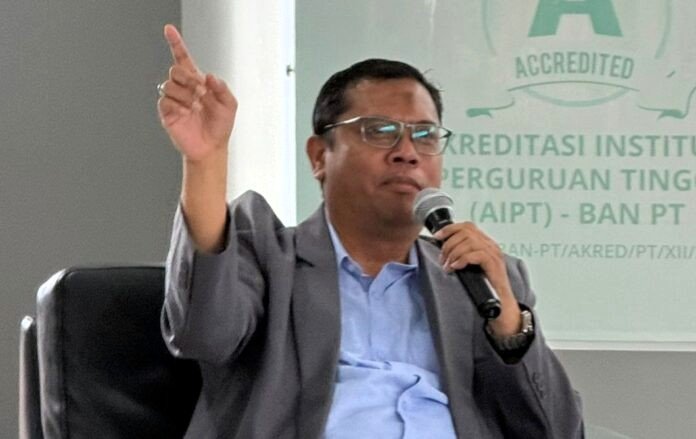
This was stated by the Dean of the Faculty of Social and Political Sciences, Universitas Pembangunan Nasional “Veteran” Jakarta (UPNVJ), Dr. S. Bekti Istiyanto, while serving as a speaker at the ASPIKOM Jabodetabek Regional Curriculum Workshop held at BINUS University Anggrek Campus, West Jakarta, on Tuesday (14/4/2026).
In his presentation titled “Preparing an Adaptive and Industry-Aligned Outcome-Based Education (OBE) Curriculum,” Bekti emphasized that an OBE-based curriculum must be designed starting from measurable graduate learning outcomes that are relevant to industry needs.
According to Bekti, the fundamental concept of OBE requires universities to begin curriculum design not from teaching materials, but from the competencies that graduates must possess.
He added that the entire learning process must be focused on graduate learning outcomes, structured based on industry needs, defined by clear standards, and allow for diverse learning methods so that all students can achieve the targeted competencies.
“Do not start from teaching materials; start from the end result. OBE is designed from measurable learning outcomes, not from a list of courses,” said the former Chairperson of ASPIKOM.
Bekti further noted that curricula must be designed with clear focus so that every learning activity truly leads to competencies required by industry.
He also highlighted the challenges of current curricula in Communication Studies programs. According to him, industry development is accelerating rapidly with the rise of digital media, artificial intelligence, social media analytics, and real-time crisis communication.
On the other hand, there remains a gap between graduates who understand theory and the practical skills required by industry. Many graduates still struggle when asked to develop content plans, interpret engagement data, or respond to fast-moving digital communication dynamics.
“The industry is moving very fast, but universities are often lagging behind. As a result, some graduates are strong in theory but not yet ready when asked to create content plans, read engagement data, or handle real-time communication dynamics. Today, industry values portfolios and soft skills more than exam scores,” he said.
Bekti emphasized that an adaptive OBE curriculum must be dynamic and regularly evaluated based on industry feedback. Steps that can be taken include mapping graduate profiles based on industry needs, then formulating graduate learning outcomes (CPL) using measurable action verbs such as designing, managing, analyzing, writing, and editing.
From these CPLs, courses and assessment systems should be directed toward real-world projects involving industry partners so that students not only understand concepts but also produce demonstrable work.
“Today, real projects are more important than theoretical exams. Make industry feedback the driving force for curriculum change,” he explained.
He also provided examples of implementing an adaptive OBE curriculum through project-based assessment, such as students creating campaign proposals for real clients, producing analytical reports from company social media accounts using real data, and developing press release portfolios and media coverage clippings from published work.
Other learning models that can be applied include guest projects in each course. For example, photography and videography students producing promotional reels for local communities, public speaking students pitching in front of PR practitioners, and communication ethics students analyzing current viral cases.(www.upnvj.ac.id)