




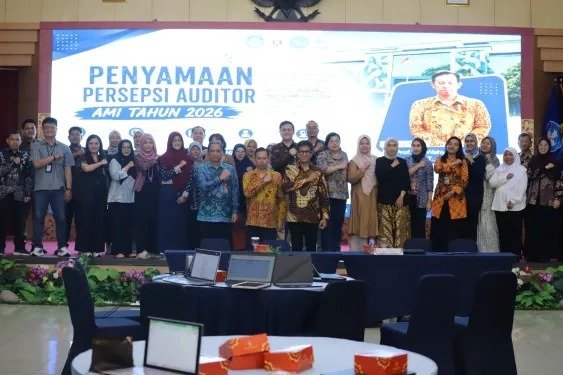
EduAsiaNews, Jakarta – Universitas Pembangunan Nasional “Veteran” Jakarta (UPNVJ) enhanced the competencies of its auditors through the program titled Enhancing Understanding, Competence, and Shared Perceptions of Internal Quality Audit (AMI) Auditors, held at the Bhinneka Tunggal Ika Auditorium on Friday (June 12, 2026). Featuring Professor of Universitas Sultan Ageng Tirtayasa, Prof. Dr. Ir. Wahyu Susihono, S.T., M.T., the program was designed to strengthen the implementation of risk-, evidence-, and impact-based auditing. This enhancement is essential to ensure that Internal Quality Audits (AMI) go beyond administrative reviews and effectively drive continuous quality improvement across UPNVJ.
In his presentation, Prof. Wahyu explained that the paradigm of quality auditing in higher education has evolved significantly. Audits are no longer limited to verifying the existence of documents or assessing administrative compliance; they must also evaluate the effectiveness of standard implementation and its impact on institutional performance.
This paradigm shift requires auditors to possess stronger analytical capabilities. Auditors must understand the interrelationship between established standards, program implementation, evidence of achievement, and the outcomes experienced by students and other stakeholders.
Prof. Wahyu also emphasized the strategic role of Internal Quality Audits within the PPEPP cycle—Determination, Implementation, Evaluation, Control, and Improvement (Penetapan, Pelaksanaan, Evaluasi, Pengendalian, dan Peningkatan). Within this framework, auditors are responsible for ensuring that every standard is not only implemented but also consistently evaluated and followed up through corrective actions.
Consequently, auditors are no longer tasked solely with identifying non-conformities. They have become integral components of the internal evaluation system, providing recommendations for improvement and assisting academic and administrative units in identifying opportunities for quality enhancement.
The program also addressed the role of AMI as an early warning system for potential quality risks at the study program level. Such risks include inconsistencies in implementing outcome-based education (OBE), inadequate evaluation of graduate learning outcomes, and the underutilization of tracer study results as a basis for curriculum improvement.
Through a risk-based approach, auditors are expected to focus their assessments on areas with the highest levels of vulnerability and the greatest potential impact on the achievement of quality standards. This approach enables audits to become more targeted and effective rather than merely oriented toward checklist compliance.
Auditors were further encouraged to formulate audit findings based on objective, measurable, and verifiable evidence. Audit findings should be supported by root-cause analysis and practical recommendations to facilitate systemic improvements rather than short-term administrative corrections.
In addition to strengthening internal quality assurance systems, the program highlighted the importance of aligning national standards with international quality indicators. Auditors must assess the readiness of study programs in achieving learning outcomes, engaging stakeholders, evaluating curricula, and implementing continuous quality improvement initiatives.
Establishing a shared understanding among auditors is equally important to ensure the consistent application of assessment standards and evaluation criteria. Such alignment is expected to produce audit processes that are consistent, objective, transparent, and accountable across all UPNVJ units.
Through this initiative, UPNVJ reaffirmed its commitment to fostering a quality culture that extends beyond document compliance and accreditation requirements. AMI auditors are expected to serve as agents of transformation who not only safeguard adherence to standards but also promote innovation, program effectiveness, and the continuous improvement of academic services.
From the perspective of university policy, enhancing auditor competence constitutes a crucial component of strengthening higher education governance. Audits conducted objectively and followed by measurable corrective actions will support improvements in education, research, and community service while reinforcing UPNVJ’s readiness to achieve superior national accreditation and international recognition.(www.upnvj.ac.id)