




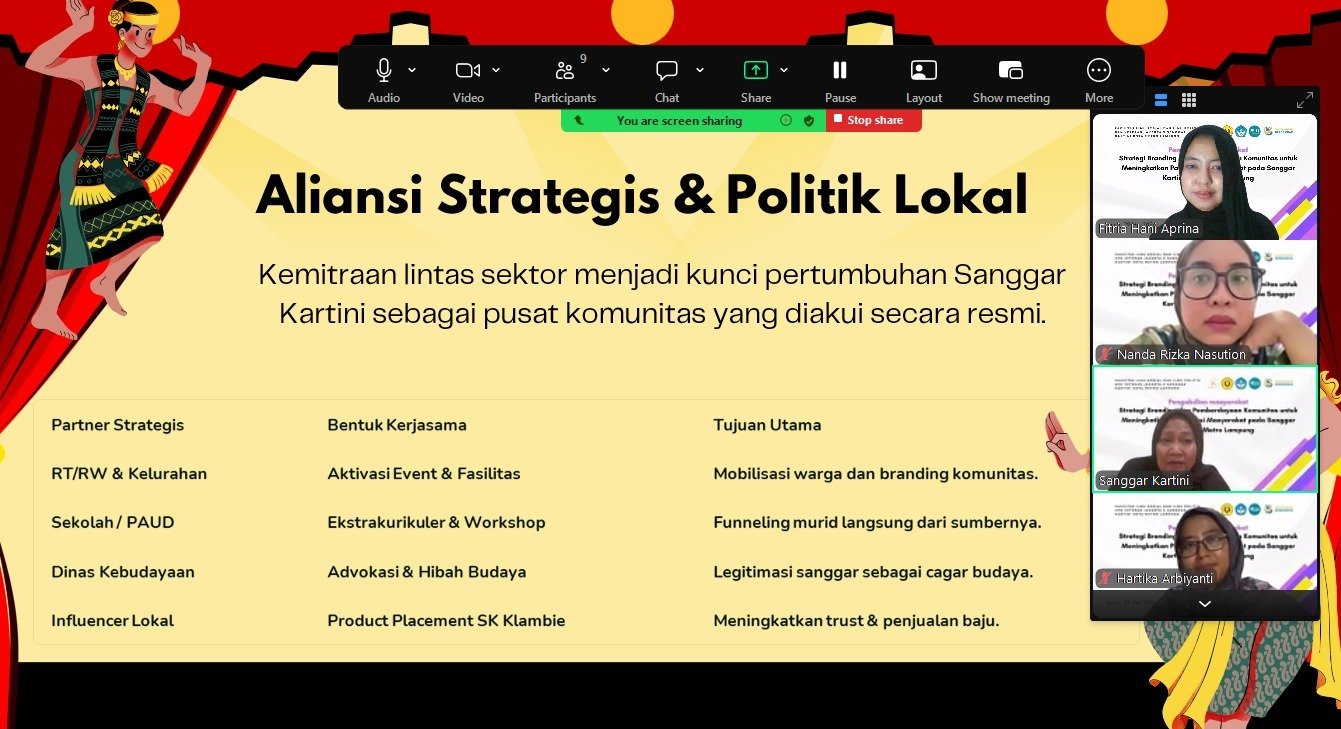
EduAsiaNews, Jakarta – As part of its commitment to fulfilling one of the pillars of the Tri Dharma of Higher Education, a team of lecturers from the Faculty of Social and Political Sciences (FISIP), Universitas Pembangunan Nasional “Veteran” Jakarta (UPNVJ), successfully conducted a Community Service Program (Pengabdian kepada Masyarakat/Abdimas). The program, titled “Branding Strategies and Community Empowerment to Enhance Public Participation in Sanggar Kartini, Metro City, Lampung,” was held virtually via Zoom Meeting on Friday evening (May 29).
The event was organized in response to a request from the management of Sanggar Kartini Metro Lampung to strengthen the community arts organization’s capabilities in communication, talent management, and digital marketing strategies. Four expert lecturers from FISIP UPNVJ participated as speakers, sharing strategic insights from both academic and practical perspectives.
Exploring Branding Strategies, Gender Politics, and Creative Industry Challenges
The presentation sessions were divided into three interconnected focus areas:
Gender and Cultural Politics
Presented by Nanda Rizka Syafriani Nasution, M.IP., this session explored ways to integrate women’s empowerment values—directly inspired by the legacy of Raden Ajeng Kartini—into the fashion industry and talent management practices. The objective was to help Sanggar Kartini build a brand identity as an inclusive, socially conscious community with strong public appeal.
Developing Digital Marketing and Personal Branding Strategies
Delivered by Fitria Hani Aprina, this session provided practical frameworks and strategies for effective digital marketing. These approaches were designed to expand the studio’s audience reach and attract broader public interest in collaboration and participation.
Addressing Creative Industry Challenges in the Global Era
Presented collaboratively by Hartika Arbiyanti and Syfa Amelia, the final session highlighted global trends and internal challenges faced by artists and cultural practitioners in preserving both traditional and contemporary art forms amid rapid societal change.
The community service program was highly interactive. Candra Kartini, Owner and Founder of Sanggar Kartini Metro Lampung, warmly welcomed the participation of FISIP UPNVJ academics. She shared the organization’s achievements, including collaborations with the Metro City Government, the establishment of the “SK Klambie” fashion line, and strategic partnerships with journalists and media professionals.
“We are currently facing a crucial issue within our organization, namely a declining interest in traditional dance among children in Group A, aged between 3 and 8 years old, who belong to Generation Alpha. Unlike the older teenagers in Group B, who have a strong passion for traditional dance, these younger children are far more enthusiastic about hip-hop and R&B dance. When they are pressured to learn traditional dances, they often choose not to attend the following week’s classes,” Candra explained.
Responding to this concern, Fitria Hani Aprina, who also has experience as a former dance coach, offered solutions based on the characteristics of younger generations.
“Generation Alpha has grown up with technology from an early age and is continuously exposed to global cultural influences. Children in this age group cannot be approached through pressure or overly strict educational methods,” Hani explained.
She then proposed a formula for “embedding tradition within modernity,” which includes:
Warm-Up Method: Allow children to perform the hip-hop or R&B dances they enjoy, while incorporating traditional dance movements as part of the warm-up session before the main class begins.
Implicit Value Integration: Gradually introduce cultural, moral, and ethical values during class closing sessions.
Modeling Method: Frequently involve Group A children in observing or attending public performances by their senior peers in Group B who perform traditional dances.
Through consistent visual exposure and value-based learning, appreciation for traditional dance is expected to develop naturally as children mature.
Through this community service initiative, FISIP UPNVJ hopes that the strategies and practical solutions developed collaboratively can be implemented effectively, enabling Sanggar Kartini Metro Lampung to remain sustainable, digitally adaptive, and firmly rooted in the preservation of Indonesia’s cultural heritage.(www.upnvj.ac.id)