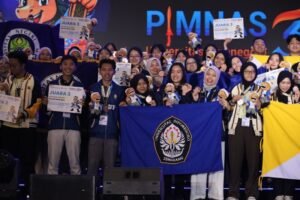





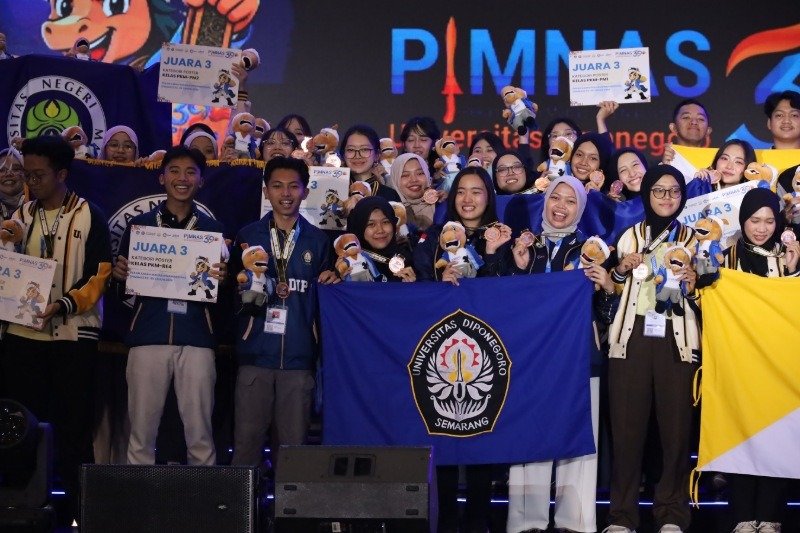
EduASiaNews, Semarang – Universitas Diponegoro (UNDIP) won 11 medals at the 39th National Student Scientific Week (PIMNAS) 2026, held at UNDIP from Nov. 2 to 7, 2026. The university secured one gold, five silver and five bronze medals across the presentation and poster categories. It also received three Favorite Team awards.
The awards announcement and medal ceremony took place during the closing ceremony of the 39th PIMNAS at Muladi Dome, UNDIP’s Tembalang Campus, on Friday (Nov. 6, 2026). UNDIP finished ninth in the national standings.
UNDIP Rector Prof. Dr. Suharnomo, S.E., M.Si., expressed his appreciation and pride in the university’s student teams for their dedication and efforts in competing at the 39th PIMNAS.
“Congratulations to all UNDIP delegates. Winning one gold, five silver and five bronze medals, along with three Favorite Team awards, is an outstanding achievement and a source of pride for UNDIP. Thank you for your hard work, determination and courage in competing at the national level. You have all given your best and made UNDIP proud,” he said.
The rector also thanked Vice Rector I for Academic and Student Affairs, Prof. Dr. Heru Susanto, S.T., M.M., M.T., for coordinating the preparation and mentoring of UNDIP’s delegation and ensuring the smooth organization of the 39th PIMNAS, with UNDIP serving as host. He also extended his appreciation to faculty advisers, the organizing committee and all parties who contributed to the students’ achievements and the successful staging of the event.
The competition brought together 100 universities from across Indonesia. UNDIP distinguished itself by securing awards in all three categories: presentations, posters and Favorite Team.
In the presentation category, UNDIP won two silver medals and three bronze medals.
The first silver medal went to a team led by Muhammad Fikri from the PKM KC-3 class for its project titled “Edge AI-Based Wearable ECG Prototype Using a 1D-CNN Algorithm for Early Detection of Arrhythmia.”
Another silver medal was awarded to a team led by Irgi Maulana Hakim from the PKM RE-2 class for its research titled “Integration of Graphene Quantum Dots Derived from Styrofoam Waste with Carbon Nanotubes to Enhance Conductivity and Lithium-Ion Diffusion in LiMnFePO Cathodes.”
A further silver medal was secured by a team led by Farsya Mutiara Kansha from the PKM RE-5 class for its project, “Innovation in Low-Methoxyl Pectin and β-Cyclodextrin-Based Granules for Linalool Immobilization as an Antioxidant with a Controlled-Release System.”
Three bronze medals were also awarded to UNDIP teams. One went to a team led by Zahra Najla Raniah from the PKM K-2 class for “KIREI: An Eco-Friendly Japanese Tissue Innovation Using Water Hyacinth and Banana Stems through Biopulp Technology for Physical Document Conservation.”
The other two bronze medals went to a team led by Bintang Adhiyaksa Dani Saputro from the PKM KC-2 class for developing a plasma-activated water system to inactivate fungi in shallots, and a team led by Naurah Safa Labibah from the PKM VGK class for proposing an integrated waste management model based on circular economy principles and waste valorization to support Indonesia’s energy independence by 2045.
In the poster category, UNDIP won one gold, three silver and two bronze medals.
The gold medal was awarded to a team led by Rizky Rahmad Danu Saputra from the PKM RE-2 class for its project titled “Development of a Nitrogen-Doped Carbon Quantum Dot-Based PET Microplastic Nanosensor Agent Derived from Rice Husk for Laundry Wastewater.”
The silver medals went to a team led by Tri Wahyu Utami from the PKM PM-3 class for developing a child development analysis system to support occupational therapy through daily livestock-farming activities at the Gracias Community, and to Muhammad Fikri’s team for its Edge AI-based wearable ECG prototype, which also earned a silver medal in the presentation category.
The two bronze medals were awarded to a team led by Sarah Uzmaya from the PKM K-1 class for developing Dentavera, an herbal mouthwash made from banana peel and clove oil, and a team led by Argitta Nova Triana from the PKM RE-4 class for researching potential apoptotic metabolites from Bruguiera gymnorrhiza leaves against HCT-116 colorectal cancer cells.
In addition to its medal tally, UNDIP received three Favorite Team awards.
One award went to a team led by Ja’far Omar Sidiq from the PKM GFT class for its proposal to integrate Vehicle-to-Everything technology with a Smart Microeconomy Hub to optimize mobility, economic activity and the development of Indonesia’s future capital, Nusantara (IKN), by 2045.
Another Favorite Team award was presented to a team led by Rivalino Marcha F.M. from the PKM RSH-3 class for its research on strengthening the rights of the Samin Indigenous Community against environmental criminalization through the reformulation of legal provisions concerning obstruction of mining activities based on local wisdom.
The third award went to a team led by Okhan Dimas Pramudya from the PKM RE-3 class for its research on the synthesis and modification of SnO₂ nanocomposites dispersed on reduced graphene oxide derived from styrofoam waste for high-performance lithium-ion battery anodes.
Universitas Diponegoro remains committed to strengthening student research, innovation and competencies through continuous mentoring and development programs. The results of the 39th PIMNAS will serve both as an evaluation and motivation for UNDIP to improve the quality of its student development programs and achieve greater success in future editions of the competition.
(Public Communication/UNDIP/Hanang and the PIMNAS 39 Media Center Team)