





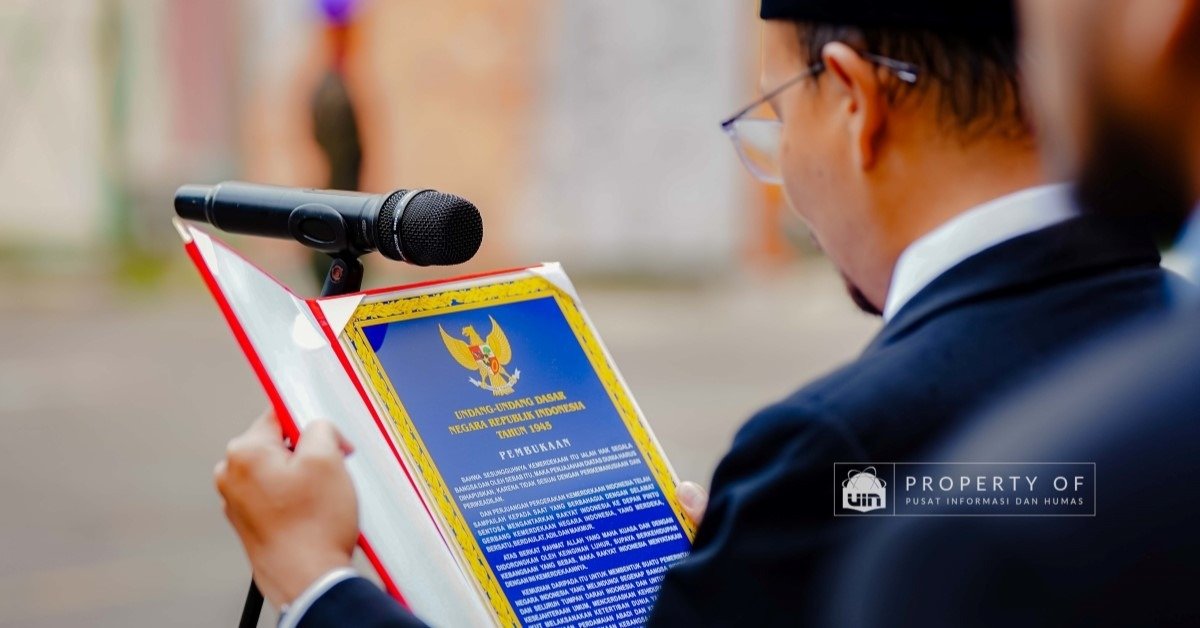
Professor at Syarif Hidayatullah State Islamic University Jakarta(Photo: UIN)
EduAsiaNews, Jakarta – On May 20, 1908, a group of students from the School tot Opleiding van Inlandsche Artsen (STOVIA) in Batavia gave birth to a new consciousness that would later be remembered as the starting point of Indonesia’s National Awakening.
Boedi Oetomo emerged from discussions among young people who were deeply troubled by the reality of their nation living under colonial rule. They came from different backgrounds and grew up within diverse traditions, yet they found a common bond that united them: the idea of Indonesia as a shared aspiration.
More than a century later, Indonesia commemorates the 118th National Awakening Day under the theme, “Safeguarding the Nation’s Youth for State Sovereignty.” The theme feels especially relevant amid the rapid pace of social transformation. Digital technology has fundamentally changed the way people think, interact, and construct their identities.
The public sphere no longer relies solely on schools, universities, organizations, or physical forums. Conversations about nationhood now unfold through smartphone screens that are constantly in the hands of the younger generation.
Amid these changes, a growing concern deserves attention. Various surveys indicate a decline in the spirit of nationalism among young people. Social media is often identified as one of the contributing factors behind this shift. The unrestricted flow of information has shaped new patterns of thinking that are more fluid, more global, and more individualistic.
Nationalism, which once developed through collective experiences, is now confronting new challenges in the age of algorithms.
The real issue, however, is not the disappearance of patriotism. Indonesia’s younger generation continues to demonstrate concern for the nation’s future. This energy is visible in various social movements, environmental campaigns, democratic advocacy efforts, and educational content independently produced through digital platforms. What has changed is the way young people express their engagement as citizens.
Declining Participation
The 2025 Youth Development Index (Indeks Pembangunan Pemuda / IPP) presents an interesting situation while also containing a serious warning. The domains of health and education show relatively positive achievements.
On the other hand, participation and leadership remain the weakest aspects. This reality conveys an important message: youth development has not yet fully succeeded in fostering young people’s connection to public life and national affairs.
This condition poses a major challenge toward Indonesia Emas 2045. The demographic bonus is often viewed as a strategic asset because Indonesia possesses a large youth population. However, a demographic bonus requires a strong national foundation so that the energy of the younger generation can be directed into productive strength. A large population must be accompanied by equally strong participation.
Samuel P. Huntington (1968) warned that rapid social modernization, when not balanced by strong political institutionalization and civic education, could create tensions within national life.
Huntington’s perspective remains highly relevant in understanding Indonesia today, where digital technological development is advancing far more rapidly than the capacity of social and educational institutions to cultivate civic character among young people.
Nationalism in the Digital Era
In the education sector, civic education is still often trapped in a formalistic approach. Nationalism is introduced through memorization of symbols and normative knowledge, even though young people live within a highly dynamic information ecosystem.
They are accustomed to engaging with global issues such as climate change, social inequality, digital rights, artificial intelligence, and economic justice. National education therefore requires a new approach that is more contextual, dialogical, and relevant to everyday realities.
Schools and universities need a transformation in perspective when building national consciousness. Nationalism cannot merely be conveyed as a slogan or moral doctrine. It must be experienced as a living reality whose benefits are felt through democratic practices, social justice, public services, and respect for citizens’ dignity.
At the same time, the digital sphere requires more serious attention as an arena for shaping public character. So far, policy approaches have focused more on content supervision than on strengthening society’s capacity to understand information critically. Yet the greatest challenge of the digital era is not simply the flood of information, but the ability to filter, verify, and process information critically.
Digital literacy, therefore, must be positioned as part of the nation’s essential infrastructure. This effort requires systematic support from the state, involving schools, universities, communities, youth organizations, and digital content creators. Young people need guidance so that technology can become a tool for strengthening democracy and social solidarity.
Another equally important aspect is the example set by the elite. Young people are growing up in an era of information transparency in which all public behavior is easily accessed and permanently archived. They observe how the language of nationalism is delivered in speeches, then compare it with everyday political practices and governance. In this context, public trust becomes a crucial element in fostering nationalism.
National consciousness grows when society witnesses consistency between values and actions. Young people will believe in the idea of Indonesia when they experience justice in social life, when the law is enforced consistently, and when leadership is exercised with integrity.
For this reason, the commemoration of National Awakening Day should not end as a mere annual ceremony. This momentum should become a space for reflection in redesigning strategies for youth development.
Reforming civic education, strengthening digital literacy, and expanding opportunities for youth participation in public life are urgent tasks that must be carried out collectively.
The founders of Boedi Oetomo built national consciousness through the spaces available to them in their era. Today’s younger generation inhabits different spaces. They live within a global digital network that transcends geographical boundaries. The spirit of awakening still exists. It simply moves through new mediums that require new ways of understanding.
It is at this point that the theme, “Safeguarding the Nation’s Youth for State Sovereignty,” finds its deepest meaning. The future sovereignty of the state will largely depend on this nation’s ability to nurture the national consciousness of its younger generation.
National awakening does not always emerge from podiums and ceremonies. More often, it grows in small spaces where young people discover reasons to believe that Indonesia is worth fighting for.