




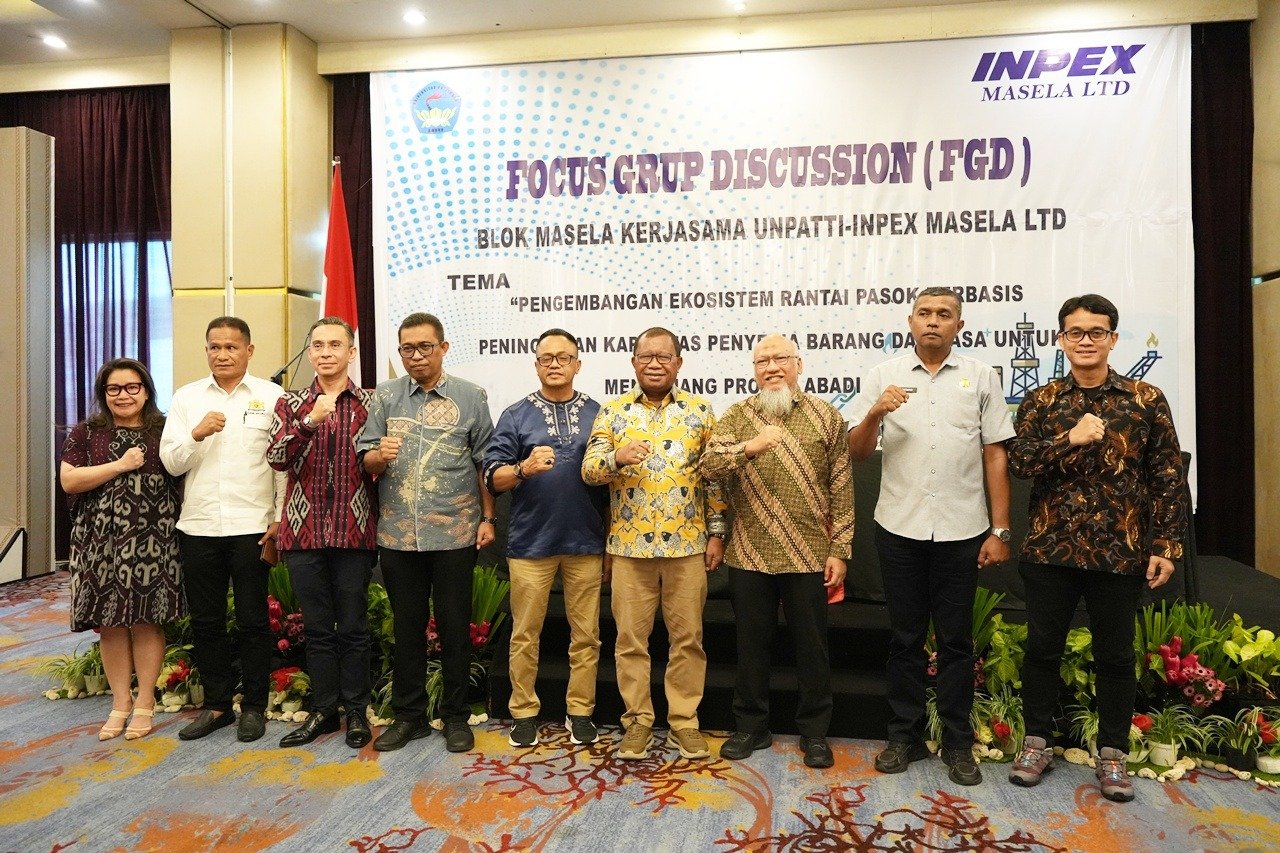
EduAsiaNews, Ambon — The Rector of Universitas Pattimura, Prof. Dr. Fredy Leiwakabessy, M.Pd., has affirmed that the development of the supply chain ecosystem to support the Masela Block LNG Abadi Project must deliver tangible benefits for the improvement of the welfare of the people of Maluku.
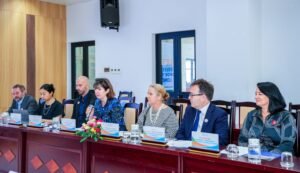
This statement was made during the opening of a Focus Group Discussion (FGD) on the Masela Block, organised through a collaboration between Universitas Pattimura and INPEX Masela, Ltd., under the theme “Development of a Supply Chain Ecosystem Based on Capacity Building of Goods and Services Providers to Support the Masela Block LNG Abadi Project,” held at the Swiss-Belhotel Ambon, Thursday, 11/6.
In his opening remarks, the Rector conveyed that the forum constitutes a strategic consultative platform aligned with the direction of national policy, particularly the commitment of the Government of the Republic of Indonesia to realising national self-reliance through the strengthening of energy security.
According to the Rector, the Masela Block LNG Abadi Project is one of the nation’s strategic projects that plays a significant role in supporting Indonesia’s vision as an energy-independent nation, while simultaneously serving as a new centre of economic growth in eastern Indonesia. He further elaborated that, in line with the Impactful Campus paradigm currently being developed by the Ministry of Higher Education, Science, and Technology, higher education institutions are no longer expected to function solely as centres of knowledge development, but must also be capable of offering solutions to the various development challenges faced by communities and regions. The Rector additionally noted that through its collaboration with INPEX Masela Ltd., Universitas Pattimura has conducted a number of strategic studies aimed at mapping the region’s readiness in anticipation of the project. These studies encompass a local vendor readiness study, a human resources readiness study, as well as a supply chain survey and local procurement opportunities assessment.
The local vendor readiness study was conducted to ensure the availability of goods and services providers meeting industry standards, so that local business actors may actively participate in the project’s supply chain. Meanwhile, the human resources readiness study aims to prepare a locally competent workforce in accordance with industry requirements.
The supply chain survey and local procurement opportunities assessment, in turn, focuses on identifying the potential of the food sector and various local commodities that can support the project’s operational needs while simultaneously stimulating the regional economy.
The Rector affirmed that the success of strategic projects such as the Masela Block is determined not only by investment and infrastructure development, but also by the readiness of a supporting ecosystem that involves local business actors, skilled labour, and a robust and sustainable supply chain system.
To this end, the Rector expressed his hope that the discussions involving regional government bodies, business associations, banking institutions, academics, and various other stakeholders would yield data-based policy recommendations that can be implemented in a concrete and meaningful manner.
The VP of SCM & IMT (Supply Chain Management & Information Management Technology) of INPEX, Ltd., Rudi Imran, explained in an interview that the Development of the Supply Chain Ecosystem for the Masela Block Abadi Project can serve as a platform for building a shared understanding of the region’s conditions and readiness in supporting the said strategic project. He further elaborated that the discussions conducted in collaboration with Universitas Pattimura focused on several aspects deemed critical to the project’s success, namely the readiness of the local workforce, the readiness of business actors and goods and services providers, as well as the availability of food supplies and other logistical requirements. “These three aspects are of primary concern, as they largely determine the extent to which the people of Maluku are able to participate in and directly benefit from the Masela Abadi Project,” he said. Rudi expressed optimism upon observing the various responses that emerged during the discussion. In his view, the positive responses from the participants reflected a shared awareness of the need to begin aligning their respective programmes and activities with the demands that will arise once the project enters its construction phase.
He added that the success of the project is measured not only by infrastructure development and energy production, but also by the degree to which the project is capable of delivering a tangible and meaningful impact on the improvement of community welfare.
He further expressed his hope that the outcomes of the FGD would serve as a catalyst for the emergence of various strategic initiatives from regional governments and other stakeholders in preparing the region’s capacity.
“Our hope is that this activity will initiate the concrete steps that need to be taken by regional governments and all stakeholders in Maluku to prepare themselves from an early stage. In doing so, when the project enters the construction phase, the contribution of the Maluku community can take place in an optimal manner,” said Rudi.
The Provincial Government of Maluku, represented by the Assistant for Economic Affairs and Development of the Regional Secretariat (Sekda) of Maluku Province, Kasrul Selang, stated that the development of the local supply chain presents both a challenge and a significant opportunity for Maluku. At present, the majority of food supplies and various strategic commodities remain dependent on supplies sourced from outside the region. He further noted that the findings of the studies conducted by Universitas Pattimura need to be continually enriched with data and information from regency and city governments, as well as various other stakeholders, in order to produce more comprehensive and applicable recommendations. He cited as an example the challenge of meeting food supply needs currently faced by Maluku, particularly in supporting various national programmes. One such challenge is the demand for eggs under the Free Nutritious Meals Programme (MBG), which is considerable in scale. He noted that if there are approximately 100,000 programme beneficiaries in the City of Ambon and each student receives two eggs per week, the weekly demand for eggs could reach approximately 200,000 units.
“This situation demonstrates that we must begin preparing local production capacity more seriously in order to be capable of meeting both community needs and the demands of the large-scale projects that will be coming to Maluku,” he said.
Kasrul expressed his hope that the outcomes of the FGD would serve as a foundation for the formulation of more targeted regional economic development policies and strategies, while simultaneously strengthening the readiness of local business actors, farmers, livestock breeders, and the broader community in seizing the economic opportunities presented by the Masela Abadi Project.
Through collaboration among the government, higher education institutions, the business sector, and the community, he expressed confidence that Maluku can build a robust and sustainable supply chain ecosystem, ensuring that the benefits of development are widely felt by the people of the region.
The event commenced with the striking of the tifa (a traditional drum) by the Assistant for Economic Affairs and Development of the Regional Secretariat, accompanied by the Rector of Universitas Pattimura, the VP of SCM & IMT of INPEX, Ltd., and the Vice Rector for Planning, Cooperation, and Information Systems of Universitas Pattimura, marking the official opening of the Focus Group Discussion (FGD).
During the first session, the INPEX and Universitas Pattimura teams presented the findings of their studies pertaining to local vendor readiness, workforce readiness, supply chain conditions, and local procurement opportunities. The second session consisted of group discussions addressing aspects of legal compliance, managerial capacity, technical and human resource capacity, as well as financial capacity.
In the third session, the outcomes of the group discussions were presented and consolidated before all participants. The event was then officially closed by the Vice Rector for Planning, Cooperation, and Information Systems of Universitas Pattimura, Dr. Ruslan H. S. Tawari, M.Si.
The FGD was attended by a broad range of stakeholders, including the Provincial Government of Maluku represented by the Assistant for Economic Affairs and Development of the Maluku Regional Secretariat, Kasrul Selang, S.T., M.T.; members of the leadership and membership of the Maluku Provincial Legislative Assembly (DPRD); the Head of the Integrated PDSK Team of Maluku Province, Ir. Sadali Ie, M.Si., IPU.; the Regent of the Tanimbar Islands Regency, Ricky Jauwerissa; the Regent of Southwest Maluku Regency, Benyamin Thomas Noach; the Head of Bank Indonesia Representative Office for Maluku Province; the leadership of the Central SKK Migas and its Maluku-Papua Representative; the leadership of INPEX Masela Ltd.; the heads of relevant regional apparatus organisations (OPD) within the Maluku Provincial Government; as well as representatives of women’s organisations, professional associations, vertical government agencies, state-owned enterprises (BUMN), and regionally-owned enterprises (BUMD).