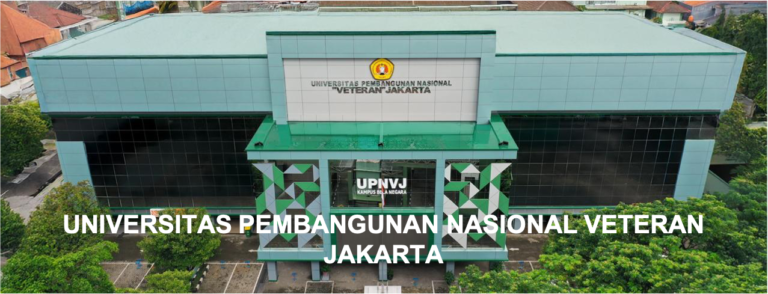





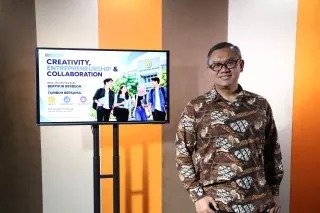
EduAsiaNews, Jakarta — Universitas Pembangunan Nasional “Veteran” Jakarta (UPNVJ) is strengthening students’ skills through its PROSPEKTIV 2026 program, which features a module on Creativity, Entrepreneurship, and Collaboration. The module, highlighting the importance of creativity, entrepreneurship and collaboration, was delivered by Prof. Dr. Amrie Firmansyah, M.M., M.Ak., M.E., a professor at UPNVJ’s Faculty of Economics and Business (FEB).
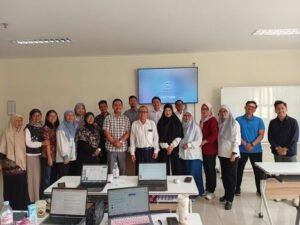
The presentation was recorded during the production of PROSPEKTIV 2026 educational videos at UPNVJ’s Public Relations Studio on Wednesday, Oct. 21, 2026. It forms part of the university’s efforts to prepare students for changes in the workplace and the challenges facing society.
In his presentation, Prof. Amrie explained that mastery of academic knowledge must be accompanied by the ability to apply it to real-world problems. Technological advances, economic shifts and changing workplace dynamics require students to develop an adaptive mindset, the confidence to take initiative, and the ability to work with diverse stakeholders.
He described creativity, entrepreneurship and collaboration as three complementary competencies. Creativity helps students generate ideas and solutions, entrepreneurship enables them to turn opportunities into something valuable, and collaboration brings together different skills and resources to achieve shared goals.
“Creativity is not just about producing something new. It is also the ability to view problems from different perspectives and find better solutions. Students need to cultivate critical thinking, dare to experiment, and continuously refine their ideas so they can benefit the communities around them,” Prof. Amrie said.
He stressed that creativity is not limited to people with artistic talent. It can be developed by regularly identifying problems, questioning assumptions, considering alternative solutions and evaluating the results.
For example, students could apply creative thinking to address long queues for administrative services on campus. Solutions would not necessarily require sophisticated technology; they could begin with simplifying procedures, providing clearer information or developing more efficient digital services.
Developing an Entrepreneurial Mindset in College
Alongside creativity, Prof. Amrie highlighted the importance of developing an entrepreneurial mindset. He explained that entrepreneurship is not limited to establishing businesses and generating profits. It also involves recognizing needs, managing resources, making decisions and creating economic or social value.
Students can develop these abilities through various activities, such as offering creative services, organizing skill-sharing classes, assisting micro, small and medium enterprises (MSMEs), or designing social programs that address community needs.
“An entrepreneurial mindset can be developed while students are still in college. It does not have to begin with substantial capital or the establishment of a company. What matters most is the ability to recognize needs, the courage to take initiative, and the capacity to turn ideas into concrete actions that benefit others,” he explained.
Prof. Amrie added that the willingness to take risks must be accompanied by careful planning and sound judgment. Ideas can be tested on a small scale using available resources and then evaluated to assess their benefits and potential for further development.
This approach is expected to help students become not only capable of generating ideas but also responsible for implementing and developing them.
Cross-Disciplinary Collaboration for Better Solutions
On collaboration, Prof. Amrie emphasized that the ability to work with others is increasingly important when students face problems that require diverse academic perspectives.
Effective collaboration, he said, involves more than simply dividing tasks among group members. Each member must understand the shared objectives, fulfill their responsibilities, communicate openly and respect differing opinions.
“Good collaboration is not merely about working in a group. It is about how each individual contributes, listens to others and brings different perspectives together. Differences in academic backgrounds can be a strength in producing more innovative and impactful solutions,” he said.
To illustrate how the three competencies work together, Prof. Amrie cited the problem of single-use waste on campus. Students could use creativity to identify the causes, apply entrepreneurial thinking to develop valuable alternatives, and collaborate with canteen operators, cleaning staff and relevant campus units.
Through this approach, students are encouraged to understand that solving problems requires a structured process, from observation and idea development to pilot implementation and impact evaluation. Success should not be measured solely by the number of activities conducted but also by the benefits and changes they produce.
Prof. Amrie also encouraged students to develop student agency—the ability to take initiative, actively determine their course of action and create change responsibly.
“Major changes do not always begin with big ideas. Small steps taken consistently, coupled with a willingness to learn and collaborate, can make a meaningful difference. That is why students must have the courage to start by addressing problems in their own surroundings,” he said.
Through PROSPEKTIV 2026, UPNVJ is making creativity, entrepreneurship and collaboration integral to efforts to strengthen students’ competencies beyond academic learning. The educational video module is expected to help students understand and apply these three skills in their studies, organizational activities and community service.(www.upnvj.ac.id)