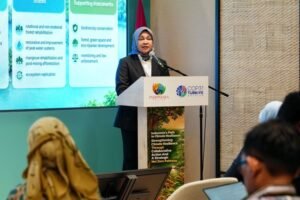





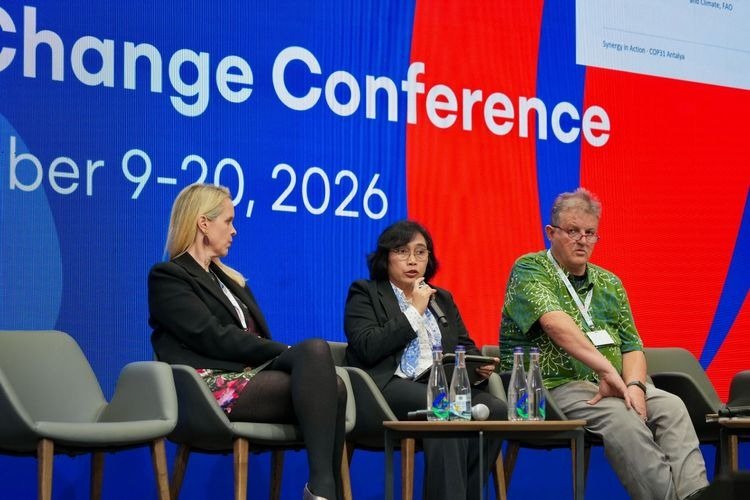
EduAsiaNews, Antalya – The Ministry of Forestry of the Republic of Indonesia emphasizes the importance of sustainable peatland ecosystem management as part of efforts to strengthen the prevention of forest and land fires (karhutla) and to enhance resilience to the increasing risks of extreme fires caused by climate change. This message was conveyed by the Forestry Minister’s Expert Staff for Climate Change, Haruni Krisnawati, during the session “Synergy in Action: Accelerating High-Impact Peatland and Wildfire Solutions” at the UN Climate Change Conference (COP31) in Antalya, Turkey, Tuesday (17/11/2026).
“Indonesia’s experience shows that preventing peat fires must start from ecosystem management, especially by maintaining the hydrological condition of peatlands. Water management management, fire risk monitoring, and community involvement need to run in an integrated manner so that prevention efforts become more effective,” Haruni explained.
The event, organized by Wetlands International, IUCN, and FAO, brought together representatives from various countries and international organizations to share experiences in peatland protection and restoration, integrated fire management, as well as strengthening ecosystem and community resilience against climate change.
In the discussion themed “Peatland Fires and Wildfire Resilience: Protection, Rewetting and Integrated Fire Management,” Haruni explained that peatland forest ecosystem management is one of the key priorities in national forestry policy and climate change control.
Indonesia continues to strengthen peat water management through restoration and rewetting activities, construction of canal blocks, and monitoring groundwater levels. These efforts are also strengthened in peatland areas managed by holders of forest utilization business permits and conservation area management units.
In controlling forest and land fires, Indonesia applies an integrated approach that includes satellite-based monitoring of hotspots, early warning systems, field verification, preparedness, and coordination of firefighting. Community involvement through the Fire Care Community (MPA) is also an important part of supporting early detection and fire prevention.
Although various efforts have been made, the risk of forest and land fires remains a challenge, including the occurrence of fires this year. This situation further emphasizes the need to strengthen preventive measures, especially in facing prolonged dry periods and the increased risk of extreme fires.
The development of national institutions through the establishment of the National Peatland and Mangrove Management Agency (BPGMN) is expected to strengthen coordination in integrated and science-based peatland and mangrove ecosystem management. These various measures also support the achievement of Indonesia’s FOLU Net Sink 2030, particularly through peatland ecosystem protection, restoration, and emission reductions from forest and land fires.
On the same occasion, Indonesia conveyed opportunities to strengthen international cooperation in peatland hydrology management, fire risk monitoring, early warning systems, community-based prevention, and ecosystem restoration, including through the Global Fire Management Hub and the International Tropical Peatlands Center (ITPC).
The forum was opened by Panama’s Minister of Environment and featured several speakers from various countries and international organizations. In the first session, the discussion involved Camila Cosse Braslavsky from the Forest Stewardship Council (FSC), Ewan Andrew from Diageo, and Guma Brian from Uganda’s Ministry of Water and Environment, who shared experiences on landscape management, peatland restoration, and their benefits for communities and the environment.
Meanwhile, in the second session, Haruni was a panelist alongside Amy Duchelle from FAO, discussing integrated fire management and the Global Fire Management Hub; Karen O’Connor of Earth Fire Alliance who introduced FireSat technology for fire monitoring via video presentation; and Faizal Parish from the Global Environment Centre, who highlighted the importance of sustainable land management and regional cooperation in haze prevention in Southeast Asia. The discussion was moderated by Eva Hernández from Wetlands International.
Through this forum, Indonesia reaffirms its commitment to continuously strengthen forest and land fire prevention through sustainable peatland ecosystem management, science-based approaches, strengthened institutional coordination, and community involvement. International cooperation and exchange of experiences are expected to support these efforts while also enhancing the resilience of ecosystems and communities against future fire risks. (*)