




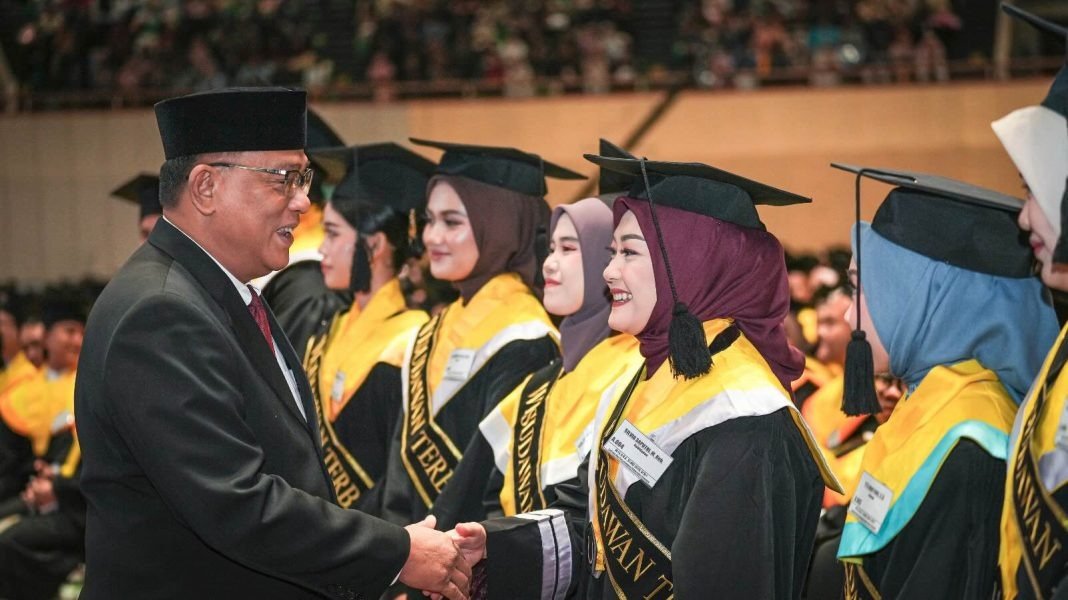
EduAsiaNews, Jakarta – Indonesia’s Minister of Environment and Head of the Environmental Control Agency (KLH/BPLH), Moh Jumhur Hidayat, has called on the younger generation, particularly Generation Z, to take a leading role in the transition toward a green economy, which is projected to create millions of new jobs across the country. He delivered this message while addressing graduates of Universitas Nasional (UNAS).
On the occasion, Jumhur emphasized that the world is currently facing three major environmental crises—commonly known as the triple planetary crisis—namely climate change, biodiversity loss, and environmental pollution. According to him, these challenges have evolved into global issues that directly affect economic development, public health, social welfare, and humanitarian well-being.
Jumhur noted that Indonesia occupies both a strategic and vulnerable position in relation to the impacts of global environmental change. However, he argued that these circumstances also present significant opportunities for Indonesia to contribute to global environmental solutions.
“Indonesia is on the front line of global environmental change risks. However, this is not a reason for pessimism. On the contrary, Indonesia has strong moral legitimacy to become an important part of the global solution,” he said.
The minister stressed that young people are a key driving force for change. Citing a survey conducted by the Indonesian Volunteers for Nature Protection (RIMBA), he stated that more than 80 percent of Indonesia’s Generation Z demonstrates concern for environmental issues.
According to Jumhur, this awareness must be translated into concrete actions capable of generating innovation and sustainable solutions.
“Gen Z is the generation of solutions. Our task now is to transform that concern into real action—from awareness to movement, from concern to innovation, and from discussion to solutions,” he said.
Jumhur further explained that environmental sustainability has been positioned as one of the key pillars of President Prabowo Subianto’s Asta Cita vision for achieving Golden Indonesia 2045. Therefore, the development of a green economy must go hand in hand with the creation of inclusive and equitable employment opportunities.
He highlighted the growing demand for workers in green sectors, including renewable energy, modern waste management, environmental engineering, biodiversity research, sustainable urban planning, carbon analysis, circular economy specialization, and environmentally based entrepreneurship.
“The transition to a green economy is expected to generate millions of new jobs. However, we must also ensure that these green jobs are decent jobs that provide labor protection, prosperity, and fair opportunities for all members of society. The future of the global economy is not only digital—it is also green. Future jobs are green jobs,” he emphasized.
Jumhur also pointed out that Indonesia possesses significant assets that position it as a key player in the global environmental agenda. With the world’s third-largest tropical rainforest, extensive mangrove ecosystems, extraordinary biodiversity, and the second-longest coastline in the world, Indonesia plays a strategic role in maintaining global environmental stability.
“If Indonesia succeeds in protecting its forests, conserving peatlands and mangroves, managing waste effectively, safeguarding rivers and oceans, and developing a circular economy, it will not only protect itself but also make a substantial contribution to the future of the planet,” he stated.
As part of the transition toward a green economy, the government aims to ensure that all national waste is properly managed by 2029 through the strengthening of the circular economy and improvements in material governance. Various waste-processing technologies, including Refuse Derived Fuel (RDF), Waste-to-Energy (WtE) plants, and pyrolysis technology, are being promoted to increase the economic value of waste while reducing environmental pressures.
Through the graduation event, KLH/BPLH encouraged young people not only to become job seekers but also creators of solutions and innovations that support sustainable development and enhance Indonesia’s future competitiveness.