




EduAsiaNews, Antalya Turki – The Indonesian Chamber of Commerce and Industry (Kadin) is promoting regenerative forestry businesses as part of Indonesia’s bioeconomy transformation, supporting climate action, biodiversity conservation and community welfare. Through the Kadin Regenerative Forest Business Hub (RFBH), efforts to strengthen collaboration among the government, businesses, communities and international partners are aimed at expanding the sustainable use of biological resources and increasing added value through innovation, investment and market development.
Kadin Indonesia Deputy Chair for Human Development, Culture and Sustainable Development Shinta Widjaja Kamdani called for the development of forest-based bioeconomy businesses to generate greater economic value while supporting climate action and community welfare.
“Indonesia’s biological wealth needs to be developed into a source of sustainable economic growth through the regenerative and sustainable use of forests in partnership with local communities. To achieve this, businesses need to strengthen partnerships with the government, communities and development partners,” Shinta said.
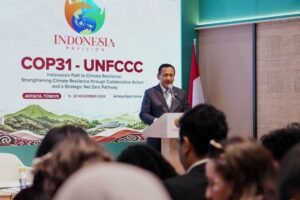
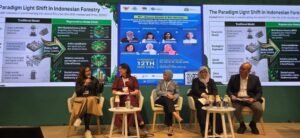
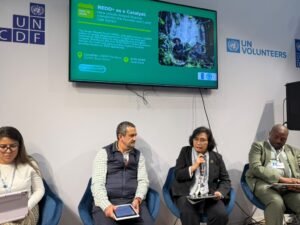
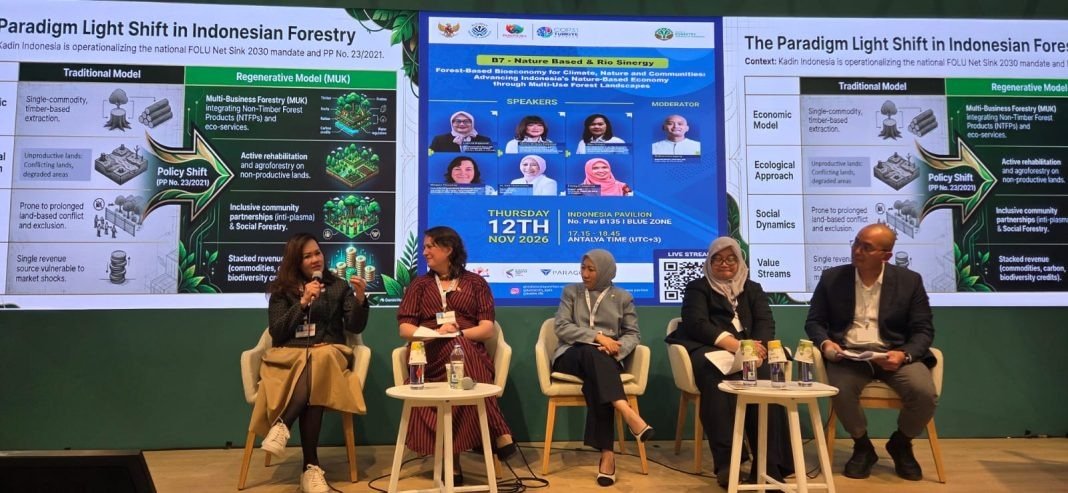
She made the remarks in her closing address at a dialogue titled “Forest-Based Bioeconomy for Climate, Nature and Communities: Advancing Indonesia’s Nature-Based Economy through Multi-Use Forest Landscapes,” organized by the Kadin Regenerative Forest Business Hub (RFBH) at the Indonesia Pavilion during COP31 in Antalya, Türkiye, on Thursday (Nov. 12, 2026).
According to Shinta, efforts to strengthen regenerative forestry businesses need to be linked to industrial innovation, market development and access to investment. Such partnerships are essential to ensuring that the use of biological resources supports business growth while safeguarding ecosystem functions and community livelihoods.
From the government’s perspective, Forestry Ministry Director General of Sustainable Forest Management Laksmi Wijayanti emphasized the importance of sustainable forest utilization in supporting Indonesia’s Nationally Determined Contribution (NDC) targets, the Indonesia’s FOLU Net Sink 2030 agenda and the development of a forest-based bioeconomy.
“Multi-business forestry policies aim to increase the added value of forest products while supporting forest rehabilitation in partnership with communities through Social Forestry schemes, including customary forests. These efforts are developed into value chains so that economic benefits can be distributed more broadly and equitably among stakeholders,” Laksmi said.
She said the development of deforestation-free and traceable forest products across landscapes needed to be supported by business partnerships, including financing. Sustainable landscape management, she added, was fundamental to maintaining these economic benefits over the long term.
Meanwhile, Kadin Indonesia Deputy Chair for Business and Sustainable Governance Elim Sritaba outlined the Kadin RFBH approach to generating added value through productive, inclusive and regenerative landscape-based forestry businesses. The planned expansion of multi-business forestry (MUK) through Kadin RFBH in 2027–2029 is targeted to cover at least 10 Forest Utilization Business Permit (PBPH) units and Social Forestry areas.
This phase will build on efforts to strengthen the foundations during 2022–2025 and the implementation of pilot projects in 2025–2027.
“We are ready to partner in expanding the implementation of regenerative forestry, promoting social inclusion and contributing to global climate and biodiversity targets,” Elim said.
Kadin projects that the development of MUK in non-productive forest areas through agroforestry could cover 1.8 million hectares. The initial phase aims to establish 10 MUK pilot projects during 2025–2029 before moving to full implementation. The projected gross revenue from these targets is Rp814 trillion per production cycle, with the potential to create 1.4 million jobs.
Elim highlighted the need for long-term financing, buyer certainty, policy support and community partnerships with inclusive benefit-sharing arrangements. Pilot locations currently under development include the Bentala landscape in East Kalimantan and Kubu Raya in West Kalimantan, with plans to expand to several other landscapes in Sumatra and Kalimantan.
ParagonCorp Deputy CEO Sari Chairunnisa emphasized the private sector’s role in creating markets for forest-based bioeconomy products through value chains that support environmental sustainability. Research and innovation in raw materials, she said, serve as a bridge between Indonesia’s biological wealth and industrial needs.
“Sustainability underpins our decisions and innovation priorities, shaping how we create long-term value,” Sari said.
She cited Sulawesi patchouli, which is being explored for skincare applications; Kalimantan tengkawang, which is being developed as a local alternative to shea butter; and microalgae research in West Java in collaboration with the National Research and Innovation Agency (BRIN).
For patchouli, efforts to strengthen the value chain connect regenerative cultivation, bioprospecting and research, standardized ingredient extraction, and product formulation. She also stressed the importance of quality, safety and responsible practices at every stage, alongside fairer market access for communities.
Sari’s presentation also addressed the link between corporate decarbonization and Indonesia’s transition to a low-carbon economy, including the role of the Kadin Net Zero Hub.
The development of value chains based on biological resources and efforts to reduce industrial emissions are intended to complement one another in supporting Indonesia’s national climate commitments.
Head of the International Forestry Unit at the United Kingdom’s Foreign, Commonwealth & Development Office (FCDO), Maggie Charnley, highlighted the role of international partnerships and development finance in expanding a sustainable and inclusive forest-based bioeconomy.
“Development finance can help establish viable business models and open up investment opportunities for sustainable forest management. Partnerships need to ensure that economic benefits go hand in hand with biodiversity protection and the empowerment of local and Indigenous communities,” Maggie said.
She noted that exchanges of experience between countries could help develop business models, innovative financing mechanisms and partnerships tailored to the needs of individual landscapes.
Kadin RFBH Coordinator Rukmantara explained that the planned landscape-based MUK pilot projects were aligned with the 2025–2029 National Medium-Term Development Plan (RPJMN), which targets 10 pilot projects with a minimum investment of Rp1.2 trillion.
“Over the next three years, Kadin RFBH will focus more on developing MUK in non-productive forest areas through agroforestry in partnership with communities, while building business ecosystems across landscapes,” Rukmantara said.
In parallel, Kadin RFBH is working with stakeholder initiatives to develop innovations and explore opportunities to use biodiversity credits as a market mechanism for MUK, alongside the existing carbon market.
The dialogue underscored the importance of linking sustainable forest management with industrial needs, long-term financing and market access to expand the forest-based bioeconomy.
Through stronger partnerships, Kadin RFBH aims to promote regenerative forestry businesses that support national climate targets, create jobs and ensure the fair distribution of benefits to local and Indigenous communities.