




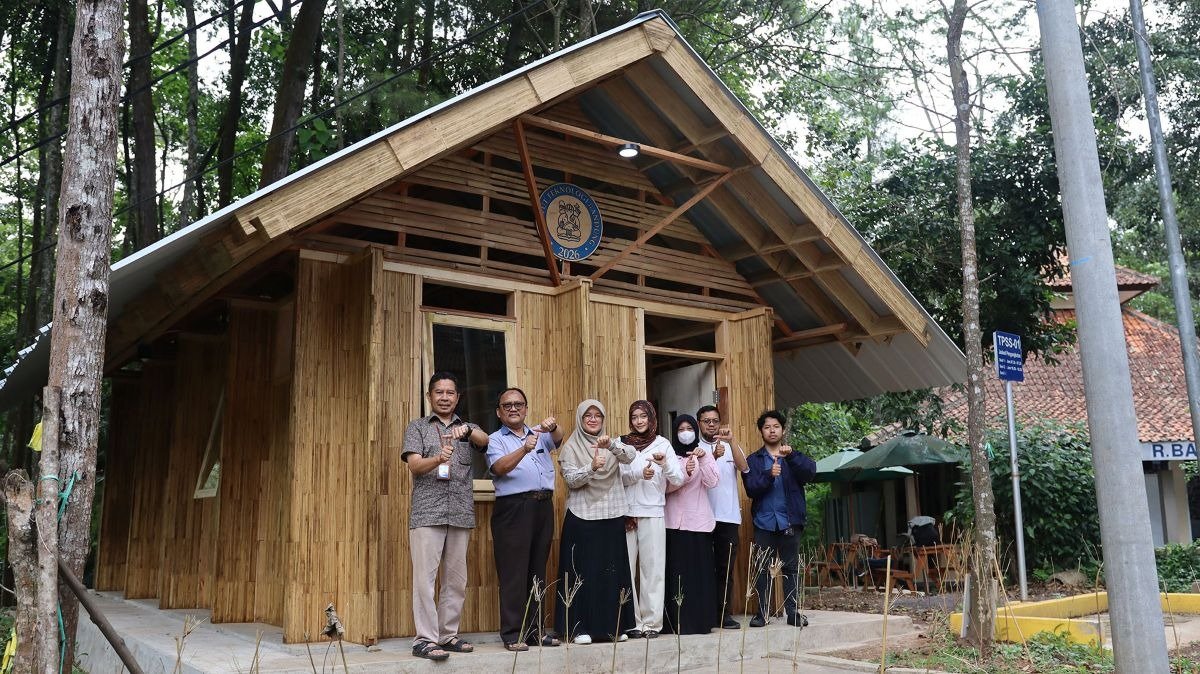
EduAsiaNews, Bandung — Researchers at the Bandung Institute of Technology (ITB) have developed a modular bamboo house featuring a knock-down construction system as an alternative permanent housing solution that is durable, flexible, and environmentally sustainable. The innovation combines engineered bamboo technology with an interlocking connection system resembling Lego bricks, allowing the structure to be assembled more easily while enhancing its ability to withstand seismic activity. A prototype of the Modular Bamboo House has been developed at the ITB Jatinangor Campus.
The project addresses several challenges simultaneously, including the limited use of bamboo as a high-value construction material, the need for safe housing in disaster-prone regions, and the lengthy production and distribution chains associated with conventional building materials. Through a vernacular manufacturing approach, bamboo processing can be carried out closer to communities living near bamboo-producing areas.
The innovation is expected to benefit bamboo landowners and managers, local businesses, and communities in need of decent housing, including disaster-affected populations. In addition to creating economic opportunities based on local resources, the modular bamboo house offers a faster solution for providing permanent housing, reducing the amount of time displaced residents must spend in temporary shelters. The development represents a significant public benefit by integrating structural safety, environmental sustainability, and community economic empowerment into a single housing solution.
Harnessing Indonesia’s Bamboo Potential
The Modular Bamboo House was developed by an interdisciplinary ITB research team led by Permana, S.T., M.T., from the Architecture Study Program at the School of Architecture, Planning, and Policy Development (SAPPK) ITB. The research project, titled “Development of Knock-down System Architecture for Modular House Design Based on Bamboo Engineering Technology,” also involved researchers from the School of Life Sciences and Technology (SITH) ITB.
The innovation was inspired by Indonesia’s vast bamboo resources, which remain underutilized. Despite the country’s rich bamboo diversity, the material is still often perceived as a low-grade building material associated with temporary or emergency structures.
One of the primary challenges in using bamboo is its naturally cylindrical shape, which makes it difficult to directly produce construction components with standardized dimensions, thicknesses, and widths.
Meanwhile, processing bamboo for premium markets can be costly. This prompted the ITB research team to develop a more efficient manufacturing method capable of producing high-quality engineered bamboo components using a wider variety of bamboo species.
Lego-Inspired Interlocking System
To overcome the limitations of bamboo’s natural form, the researchers applied lamination technology. Bamboo culms are cut into narrow strips and bonded together to create structural components with the required dimensions and thickness.
The team explored several bamboo species, including surat bamboo, tali bamboo, ampel bamboo, and mayan bamboo, reducing dependence on betung bamboo, which has traditionally dominated engineered bamboo products.
The laminated material is then fabricated into standardized profile components measuring 30 and 60 centimeters in length. These components are assembled using a knock-down interlocking system, allowing each element to lock securely into place.
The components are installed in an alternating arrangement to create horizontal interlocks, while vertical connections rely on friction between adjoining elements. The resulting combination of solid and hollow spaces produces a structure that is both strong and sufficiently flexible to absorb seismic movement.
This modular concept makes construction comparable to assembling Lego blocks. Beyond simplifying assembly, it also enables components to be manufactured separately, stored, transported, and installed as needed.
Bringing Manufacturing Closer to Local Communities
The ITB Modular Bamboo House was designed not only as an architectural product but also as part of a vernacular manufacturing model that actively involves local communities in producing building components.
Dr. Rudi Dungani, a researcher from SITH ITB, explained that production facilities can be established close to communities located near bamboo forests or plantations. Processing is carried out using lightweight manual machinery that does not require electricity.
This approach enables local communities to move beyond selling raw bamboo by producing permanent building components with significantly higher economic value. Manufacturing near the source of raw materials also shortens supply chains and reduces transportation costs.
The model creates opportunities for bamboo-based local industries, allowing communities to participate in bamboo cultivation, harvesting, processing, component manufacturing, and building assembly. As a result, the benefits of the innovation extend not only to homeowners but also to local producers.
An Alternative for Post-Disaster Housing
The modular system offers significant potential for use as permanent housing that can be prepared before disasters occur. Building components can be manufactured and stockpiled in advance, then transported and assembled rapidly whenever needed.
This approach can accelerate the transition of disaster survivors from temporary shelters to permanent homes, supporting both social recovery and psychological well-being.
Beyond post-disaster applications, the modular bamboo housing system also offers a sustainable solution to Indonesia’s broader housing needs. As a renewable resource, bamboo provides a more environmentally responsible alternative to conventional construction materials that require high levels of energy for production.
Toward a Bamboo Housing Ecosystem
The research team aims to develop a comprehensive bamboo-based housing ecosystem encompassing not only structural components but also household furnishings such as beds, dining tables, and other interior products.
Achieving this vision will require multidisciplinary collaboration across architecture, materials engineering, forestry, product design, civil engineering, manufacturing, economics, and community development.
The researchers also seek to increase the domestic content of the system to 100 percent while advancing the concept of zero-metal housing. Under this concept, structures are assembled using wooden or bamboo joints and pegs rather than metal nails or fasteners.
Through the Modular Bamboo House project, ITB demonstrates that indigenous knowledge and modern engineering can be successfully integrated to produce innovations that address contemporary societal needs. Bamboo is positioned not merely as a traditional building material but as a strategic renewable resource capable of delivering safe, sustainable housing while generating greater economic value for local communities.