




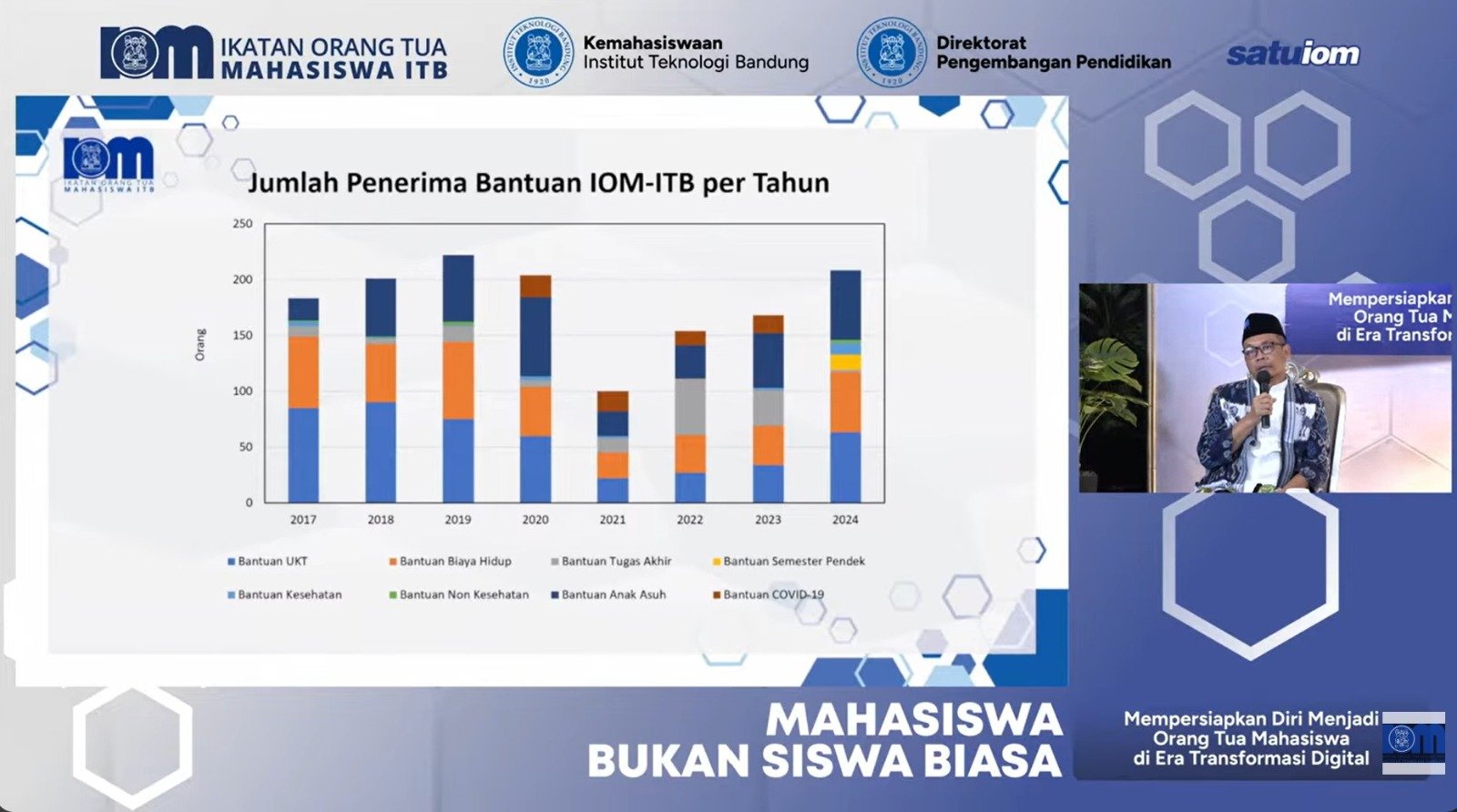
EduAsiaNews, Bandung — The Bandung Institute of Technology Parent Association (IOM-ITB) held a webinar themed “University Students Are Not Ordinary Students: Preparing to Be a Parent of a University Student in the Era of Digital Transformation” on Wednesday (17/6/2026).
The event was conducted in a hybrid format and streamed via Zoom and YouTube.
The speakers featured at the event were Dr Afra Hafny Noer, S.Psi., M.Sc., Psychologist (Head of Study Programme, Vice Dean, and Head of the Student Services Office at Universitas Padjadjaran); Dwi Santoso, S.Sn., widely known as Kang Motul (Communications and Artificial Intelligence Expert Staff at the Ministry of Communication and Digital Affairs of the Republic of Indonesia); and Prof Dr Ir Rinaldi Munir, M.T. (Professor at ITB), who attended as a respondent as well as a parent of an ITB student from the Class of 2025. The event was moderated by Dr Ayi Purbasari, S.T., M.T., serving in his capacity as First Chairman of IOM-ITB.
The webinar aimed to enhance parents’ understanding and readiness in accompanying their children through university life in the era of digital transformation. It was designed to foster healthy communication between parents and students, strengthen the role of parents as supportive partners, and deepen the synergy between higher education institutions and families. The target participants extended beyond parents of new ITB students of the Class of 2026 to include students, academic support staff, education practitioners, and the general public.
In his opening remarks, IOM-ITB Chairman Hendro Setianto emphasised the importance of parents familiarising themselves with ITB’s academic information system, including access to the SIX portal for monitoring their children’s attendance and academic progress. He also noted that IOM-ITB had disbursed more than Rp2.4 billion to over 448 students and 48 student activities in 2025, funded through membership fees and donations from parents.
From Student to University Student: A Critical Transition
Dr Afra Hafny Noer explained that new university students find themselves in a phase of emerging adulthood — a transitional period between adolescence and adulthood characterised by identity exploration, emotional instability, and a strong drive to establish personal autonomy. She cautioned parents against falling into patterns of helicopter parenting, which can impede the development of students’ independence.
“Parents must shift from a pattern of strict instruction and control to one grounded in autonomy and dialogue, because university students must be treated as partners,” said Dr Afra.
Dr Afra also addressed parental concerns surrounding bullying and academic burnout. She argued that parents need to become a safe haven for their children by creating an open space for dialogue — not by offering immediate solutions, but by helping their children manage their emotions constructively.
To bridge the generational gap between parents and their children, she encouraged parents to practise self-disclosure — opening themselves up to topics relevant to their children so that communication remains genuinely two-way.
“It does not mean we have to become like our children, but we do need to have topics that can serve as a bridge for shared discussion,” she said.
Harnessing AI Without Losing Control
Dwi Santoso underscored that today’s generation of university students was born and raised in the digital era, and consequently faces three simultaneous challenges: limited social experience as a result of the Covid-19 pandemic, dependency on the virtual world, and the rapid pace of technological change. He stressed that artificial intelligence will never be capable of replacing distinctly human qualities such as empathy, intuition, conscience, and the human touch.
“Do not pave the road for your children — instead, prepare your children for the road,” said Dwi.
In his view, students need to pass through three phases: knowing (mastering knowledge), doing (building real-world experience), and being (forming character and personal identity). He also highlighted the growing importance of the ability to ask the right questions — not merely to answer them — as a foundational skill for navigating an AI-driven world. “Control must remain with us, not with the machine,” he affirmed.
Realities from the Field
Prof Rinaldi Munir responded to both presentations from the perspective of his experience as a lecturer at ITB’s School of Electrical Engineering and Informatics. In his view, AI may be used as a thinking aid and brainstorming tool, but should not be employed to directly generate academic outputs or assignments.
Prof Rinaldi also drew attention to the issue of gaming addiction, which he has encountered firsthand. In one notable case, he successfully guided an addicted student by redirecting his energy towards writing a blog — an approach that gradually proved effective in reducing the dependency. He further reminded the audience that at ITB there is no such thing as a “soft” or “easy” programme of study, as every discipline equips students with problem-solving skills applicable across a wide range of career paths. “What ITB trains is the ability to think — not merely grades or the choice of major,” he said.