




EduAsiaNews, Jakarta – Indonesia has reaffirmed its position as the driving force of global climate action through evidence-based forestry diplomacy, social justice, and sustainable financing innovations.
In the series of the 31st United Nations Climate Change Conference (COP31 UNFCCC) in Antalya, Türkiye, until mid-November 2026, the Ministry of Forestry (Kemenhut) carries a strategic message that the ambition to save the world must go hand in hand with the welfare of forest stewards and fair global funding support.
At the international forum, the Indonesian delegation presented concrete progress on Indonesia’s FOLU Net Sink 2030 agenda as well as the achievements in reducing emissions from deforestation and forest degradation (REDD+). These efforts are reinforced by calls for the international forest financing architecture to be more accessible through grant and results-based contribution (RBC) schemes, without increasing the debt burden for developing countries.
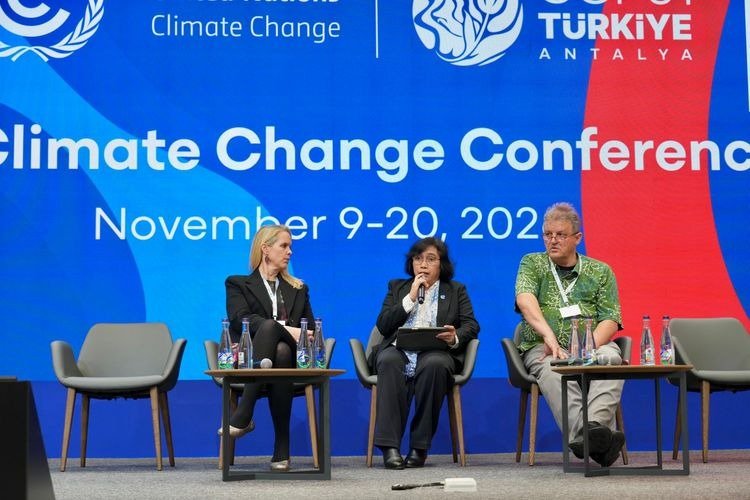
The Expert Staff to the Minister of Forestry for Climate Change, Haruni Krisnawati, emphasized that the measure of success in climate governance should not be seen solely from technical calculations of carbon sequestration, but also from the aspect of equitable benefit distribution at the field level.
“The credibility of climate action is not only measured by the amount of carbon successfully reduced or absorbed, but also by how fairly responsibilities, opportunities, and benefits are shared,” said Haruni at the climate discussion forum at COP31 Antalya.
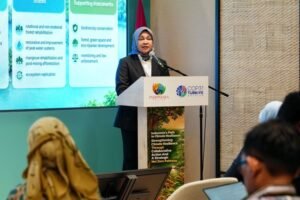
In addition to promoting climate justice, the Ministry of Forestry also places credible science and data as the main foundation for policymaking and green investment. In a panel session at the Finland Pavilion during COP31, Indonesia opened opportunities to strengthen research together with Finland, including through the International Tropical Peatlands Center (ITPC) to deepen transparent and high-integrity monitoring systems for tropical peatland forests and ecosystems.
“Our goal is not just to produce better scientific data, but to ensure that knowledge is used to make more accurate decisions for climate, biodiversity, and society,” said Haruni.
Indonesia’s green leadership in international forums is also supported by support for local communities, women, and customary law communities. Through a dialogue at the ASEAN Pavilion and the UNDP Pavilion at COP31, the Director General of Social Forestry at the Ministry of Forestry, Catur Endah Prasetiani, outlined Indonesia’s steps to elevate social forestry through access to sustainable financing, strengthening business institutions, and expanding market access.
This inclusive commitment is also reflected in the target of accelerating the designation of 1.4 million hectares of customary forest by 2029, which is overseen through the establishment of the Task Force for the Acceleration of Customary Forest Designation (Minister of Forestry Decree Number 121 of 2026). As of October 2026, the government has designated 177 customary forests covering approximately 376,280 hectares as the foundation for protecting community rights as well as strengthening national climate resilience.
“Protecting forests is not just about preserving carbon, but also about empowering the communities that protect it and ensuring the benefits of climate action reach those who need it most,” emphasized Catur Endah.
The international community’s trust in Indonesia’s forestry governance is reflected in the various strategic collaborations that emerged throughout COP31 Antalya. Among them is the announcement of the fifth phase of results-based contribution (RBC) between Indonesia and Norway, which continues the previous four phases totaling 216 million US dollars for verified emission reductions from the launch of the ART TREES Program for nine provinces, as well as Indonesia’s active participation in the Forest and Climate Leaders’ Partnership (FCLP).
Not only on the UN stage, Indonesia also integrates environmental diplomacy at the regional level through the 49th ASEAN Summit in Manila. In these various forums, the Ministry of Forestry presented integrated solution packages ranging from technology-based forest and land fire control (karhutla) and community participation, strict law enforcement against forest area violations, to innovative financing schemes for 13 priority national parks.
Head of the Public Relations and Foreign Cooperation Bureau of the Ministry of Forestry, Ristianto Pribadi, stated that Indonesia’s diplomatic strength relies on consistent real work domestically.
“This active diplomatic step is supported by concrete evidence of successful domestic firefighting operations, firm law enforcement against violating corporations, and innovations in large-scale conservation and ecosystem restoration financing,” said Ristianto.
He added that the transformation of conservation financing is one of the main breakthroughs Indonesia offers to development partners and global investors.
“Under the leadership of Minister of Forestry Raja Juli Antoni, the Ministry of Forestry is promoting innovative conservation financing schemes through the National Park Management Financing Innovation Task Force at COP31,” he added.