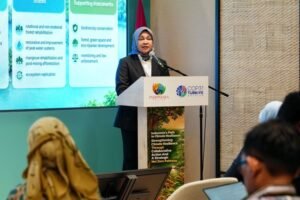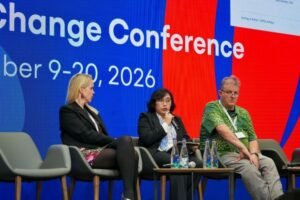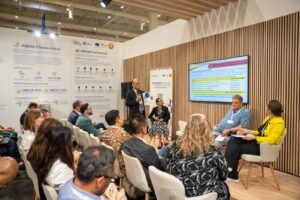





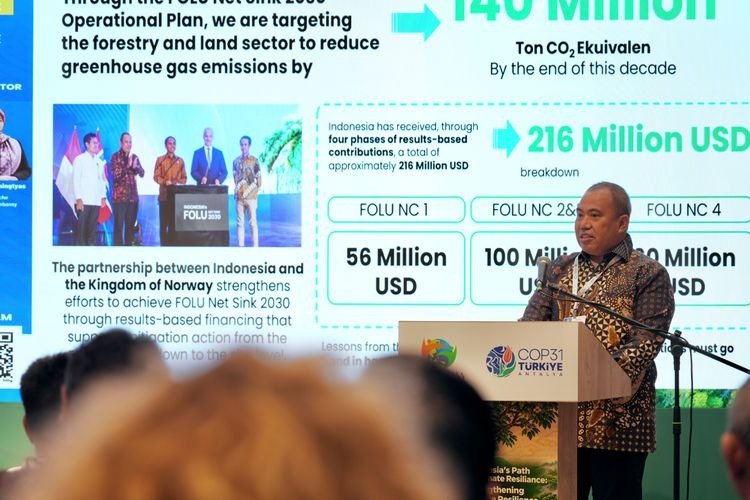
EduAsiaNews, Antalya – Indonesia has demonstrated tangible results in utilizing performance-based climate finance in supporting forest protection, ecosystem restoration, and community empowerment. These achievements were discussed in the session “Sustaining Forests, Empowering People: Climate Finance at the Grassroots – Lessons Learned from FOLU Norway’s Contribution” at the Indonesia Pavilion at the 31st United Nations Climate Change Conference (COP31 UNFCCC), Antalya, Türkiye, Tuesday (11/17).
The Secretary General of the Ministry of Forestry, Mahfudz, in his opening remarks emphasized Indonesia’s commitment to achieving Indonesia’s FOLU Net Sink 2030, targeting the forestry sector and land use to become net carbon sinks of around 140 million tons of carbon dioxide equivalent (CO₂e) by 2030. These efforts are carried out through forest protection, reducing deforestation and forest degradation, sustainable forest management, as well as ecosystem rehabilitation and restoration.
The Indonesia–Norway partnership through the Results-Based Contribution (RBC) mechanism is one form of international support for this achievement. Indonesia previously received a contribution of US$216 million, which was later reinforced by the announcement of the fifth phase contribution of US$100 million at COP31. This support is recognition of Indonesia’s emission reduction achievements while strengthening the implementation of measurable and sustainable forestry actions.
Director of Norway’s International Climate and Forest Initiative (NICFI), Dyveke Rogan, emphasized that successful climate finance requires strong national ownership, effective institutions, as well as credible monitoring, reporting, and verification systems for emission reductions. Norway also highlighted the importance of long-term partnerships and predictable financing, integrating mitigation, adaptation, biodiversity protection, and community resilience.
From Indonesia’s experience, the Director of the FOLU Norway’s Contribution Phase 1 Project, Agus Justianto, presented various achievements in strengthening forest governance and implementing FOLU Net Sink 2030 at the national and regional levels. The program has facilitated planting activities covering approximately 19,000 hectares with an estimated carbon absorption of 45,000 tons of CO₂, supported the conservation of around 10,000 hectares of watershed areas, and facilitated more than 1,500 policies and resolved 20 tenure conflicts. This achievement shows that results-based financing not only supports rehabilitation activities but also strengthens forestry institutions and governance.
Meanwhile, the Director of FOLU Norway’s Contribution Phase 2, 3, and 4 Projects, Edi Sulistyo Heri Susetyo, explained that the financing support is also directed to directly reach the community through the Small Grant Program (SGP). Over four funding periods, the program has supported around 863 beneficiary groups across 31 provinces, including grassroots communities, the younger generation, and vulnerable groups. Supported activities include planting on around 891 hectares of land with 948,916 trees, environmental education, and community-based ecosystem management.
Indonesia’s experience received attention in discussions as an example of the importance of financing mechanisms that are easily accessible, inclusive, and transparent. Through a digital proposal submission system, community organizations can access funding opportunities for activities aligned with the FOLU Net Sink 2030 target. This support is expected not only to generate ecological benefits but also to strengthen institutional capacity and community livelihoods.
As a comparison, the Director of the Environmental Department of the Brazilian National Development Bank (BNDES), Marcus Cardoso, presented Brazil’s experience through the Amazon Fund, which has been developed since 2008. This mechanism has supported around 100 projects involving 900 institutions, focusing on forest monitoring and control, sustainable production, land use management, as well as the development of science and innovation. Brazil’s experience highlights the importance of technology, strengthening monitoring, long-term partnerships, and community empowerment in optimizing forest conservation financing.
One of the strategic discussions in the dialogue was the opportunity to establish a Centre of Excellence (CoE) for results-based climate finance in Indonesia. The panelists responded positively to the idea as a platform for knowledge exchange, capacity building, research, and development of financing models that other developing countries can learn. This initiative is seen as an opportunity for Indonesia to grow from a recipient and implementer of climate finance into a knowledge provider and international learning partner, while still leveraging the existing global cooperation network.
The dialogue, moderated by the Forestry Attaché of the Embassy of the Republic of Indonesia in Tokyo, Ima Yudin Rayaningtyas, also featured an exchange of experiences from international and regional participants. Representatives from Ghana and Cameroon highlighted the importance of access to financing for African communities and countries, while experiences from Lampung demonstrated the benefits of program support in developing community businesses, including cocoa commodities in East Lampung, through capacity building and market access.
Through this forum, the Ministry of Forestry emphasized the importance of ensuring climate finance truly produces change at the grassroots level. Lessons from Indonesia, Norway, and Brazil show that the success of forestry funding is measured not only by the amount of funds collected, but also by protected forests, restored ecosystems, stronger institutions, and sustainable economic and social benefits for communities. (*)