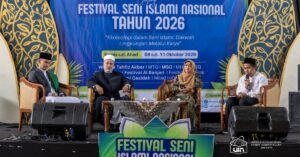





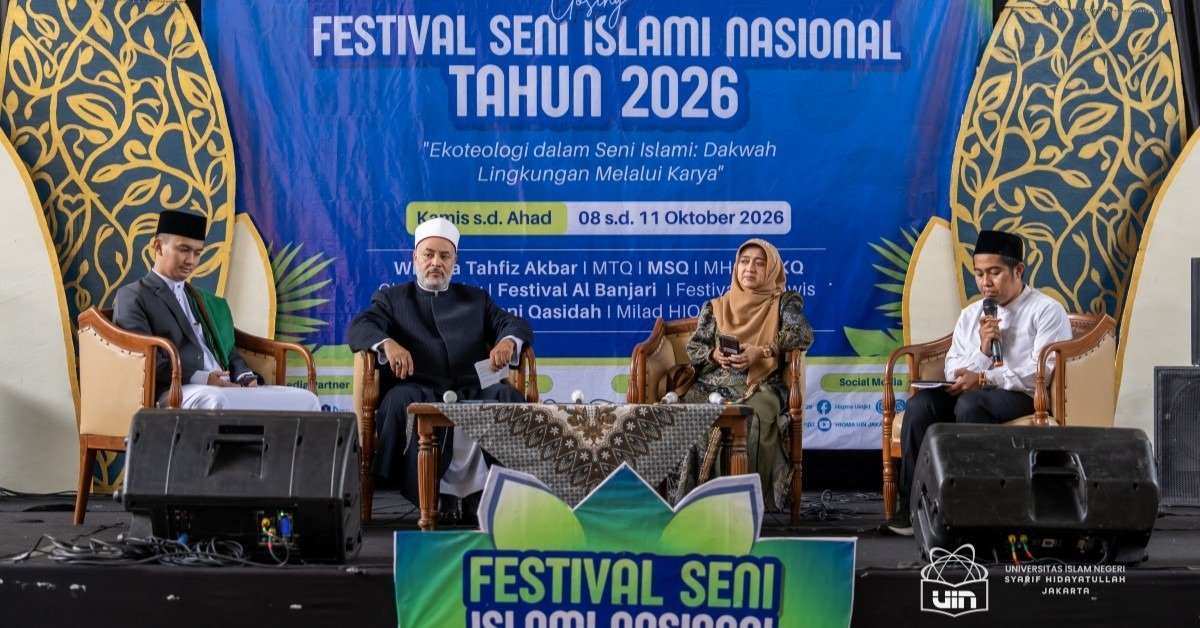
EduAsiaNews, Jakarta – The Student Activity Unit of the Association of Qari and Qariah Students (HIQMA) at Syarif Hidayatullah State Islamic University (UIN Jakarta) held its Grand Tahfidz Graduation alongside the closing ceremony of the 2026 National Islamic Arts Festival, themed “Ecotheology in Islamic Art: Promoting Environmental Awareness Through Creative Works.” The event honored 57 students who had memorized all 30 juz of the Qur’an and featured a talk show highlighting the university’s Islamic identity and its commitment to fostering ecotheological literacy. It took place at the UIN Jakarta Student Center Hall on Sunday (Oct. 11, 2026).
The event was attended by Vice Rector for Academic Affairs and HIQMA adviser Prof. Dr. Ahmad Tholabi, S.Ag., S.H., M.H., M.A., as well as two talk show speakers: Prof. Dr. Sholah Mahmud Al-Bajuri, Vice Dean of the Faculty of Islamic Da’wah and an active researcher at Al-Azhar University in Cairo, Egypt; and Prof. Dr. Lilik Ummi Kultsum, M.A., Vice Dean II for General Administration and a professor of Qur’anic exegesis methodology. Other attendees included Faculty of Education and Teacher Training (FITK) Vice Dean II for General Administration Yudhi Munadi, S.Ag., M.Ag.; Ust. Ahmad Roji; organizing committee chair M. Abdul Jawad; HIQMA UIN Jakarta Chair M. Haikal Hibrizi; and HIQMA UIN Jakarta DPO coordinator Wildan Miftahuddin. The 57 tahfidz graduates and members of the UIN Jakarta academic community were also present.
Before the main event, the 2026 National Islamic Arts Festival featured a tree-planting activity themed around ecotheology in collaboration with UIN Jakarta’s Green Campus initiative. HIQMA UIN Jakarta also provided donations to dozens of orphaned children living near the campus. In his remarks, Vice Rector for Academic Affairs and HIQMA adviser Prof. Dr. Ahmad Tholabi expressed his appreciation to the graduates and hoped they would continue to uphold and build on their achievements, bringing them to wider recognition.
“This is no easy feat. Therefore, we must truly appreciate this remarkable achievement. Hafiz and hafizah—the men and women who have memorized the Qur’an—deserve recognition everywhere, both on campus and at the national level. We hold Qur’an memorizers in the highest regard,” he said.
During the talk show, Prof. Dr. Sholah Mahmud Al-Bajuri, Vice Dean of the Faculty of Islamic Da’wah and an active researcher at Al-Azhar University in Cairo who has developed works in Islamic preaching, reminded participants that memorizing the Qur’an does not end with recitation. He said the verses committed to memory must also be reflected upon and put into practice in everyday life.
“The Qur’an is not enough to be memorized by the tongue alone. Its meaning must be internalized and practiced in daily life,” he said.
Prof. Sholah Mahmud also linked Qur’an memorization to humanity’s responsibility toward nature. Referring to Surah Hud, verse 61, which calls on people to worship God and cultivate the Earth, he emphasized that humanity’s role as khalifah (steward) requires people to use natural resources responsibly and in a manner that preserves the environment.
“The universe was created for humanity to benefit from, not to be consumed for personal gain. Those who treat the universe as their own private resource fail to follow the teachings of Allah and the Prophet Muhammad (peace be upon him) to cultivate the Earth and protect the universe. They have strayed from God’s path and will cause destruction on Earth. Meanwhile, those who memorize and recite the Qur’an have a particularly important role in safeguarding Islam and the universe,” he explained.
He added that young people could contribute to environmental protection through Islamic arts that embody beauty, including calligraphy, the Musabaqah Syarhil Qur’an (MSQ) competition and other contests. He explained that promoting a culture of beauty was part of the environmental stewardship encouraged by Islam.
“The beauty of art is a profound Islamic value and part of the divine creation that Allah places in His creatures and the universe. If we call for environmental protection, promoting a culture of beauty is part of that effort. We must uphold these values and bring them to life in society. May we ask Allah to fill our lives with beauty, mercy, sustenance and justice,” he concluded.
Meanwhile, Prof. Dr. Lilik Ummi Kultsum, M.A., Vice Dean II for General Administration and a professor of Qur’anic exegesis methodology, discussed the interconnectedness of tawhid (the oneness of God), humanity’s role as steward of the Earth, and the role of art and aesthetic sensitivity, as demonstrated by painters and Qur’an reciters. She also emphasized the moral responsibility to preserve, study and practice the teachings of the Qur’an so that it does not remain mere memorization that is eventually forgotten.
“If tawhid teaches us that Allah is the Creator of the entire universe, then our role as stewards reminds us of our responsibility. Art cultivates sensitivity to beauty. These three elements can come together in an ethic of service,” she said.
Prof. Lilik Ummi also shared three tips for those who wish to devote themselves seriously to the Qur’an. First, begin without delay or hesitation. Second, make a sincere intention for the sake of Allah. Third, remain steadfast and make the Qur’an a constant part of life. She said that fear and anxiety could be overcome through sincere intention.
“Even when fear and anxiety arise, what is needed to overcome them is an-niyyah ash-shadiqah—a truly sincere and genuine intention to ask Allah to make the path easier. Begin, do not hesitate, purify your intention, and always feel that you are living alongside the Noble Qur’an,” she said.
Concluding the talk show, Prof. Lilik Ummi stressed that Satan’s temptations continually confront humanity. She underscored the importance of protecting oneself through sincere prayers for deliverance from Satan, the accursed, and maintaining a close relationship with the Qur’an with every breath as a key to preserving one’s faith.
“Satan within us continually tempts us according to our respective professions. If we are hafiz or hafizah, Satan tempts us through our memorization and our reluctance to put what we have learned into practice. The key is sincere prayer, asking to be kept away from Satan, the accursed, and remaining close to the Qur’an with every breath,” she concluded.