





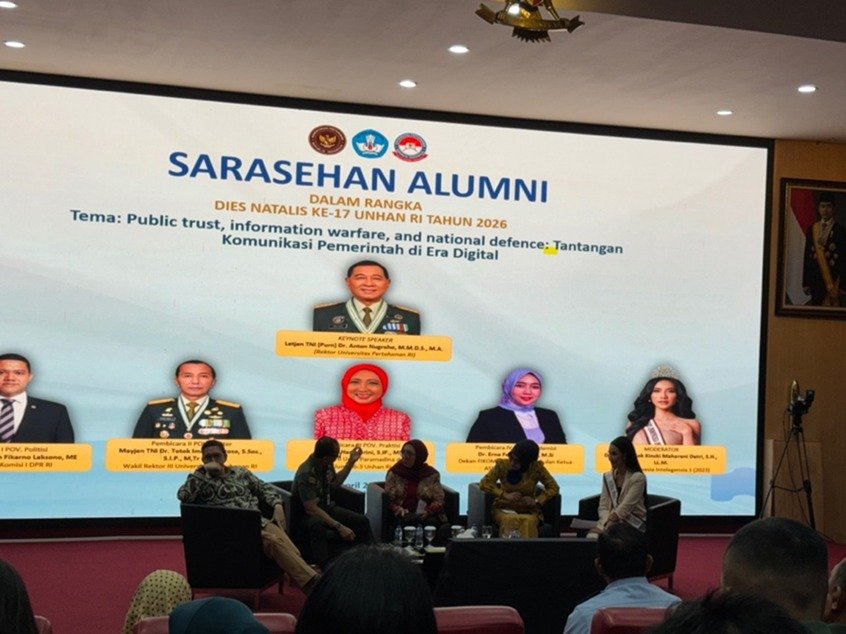
EduAsiaNews, Jakarta – The Indonesian Defense University (Unhan RI), through its 2026 alumni cohort, held a seminar titled “Public Trust, Information Warfare, and National Defense” at the Theater Room of the Bela Negara Campus, Unhan RI, Sentul, on Monday, April 6, 2026. The event took place from 08:30 a.m. until the afternoon and was attended by alumni, academics, communication practitioners, and government officials.
The seminar featured several experts in the fields of defense, communication, and public policy, including Dr. Dave Akbar Syafikarno Laksono, M.E. (Vice Chair of Commission I of the Indonesian House of Representatives), Major General TNI Dr. Toto Imam Satoso (Vice Rector III of Unhan RI), Dr. Penny Hanggarini, S.IP., M.Si. (Director of Cooperation and Marketing at Paramadina University), and Dr. Erna Febriani, S.Si., M.Si. (Dean of the Faculty of Communication Sciences at Esa Unggul University). Also present as a representative of Universitas Pembangunan Nasional Veteran Jakarta was Dr. Yudie Aprianto.
Information Warfare in the Digital Space
In his opening remarks, the Rector of Unhan, Lieutenant General (Ret.) Dr. Anton Nugroho, M.M.D.S., M.A., emphasized that modern warfare no longer occurs solely on physical battlefields but has shifted into the realm of communication—within the minds and hearts of citizens. He highlighted how propaganda on digital platforms such as TikTok and Instagram often makes it difficult for the public to distinguish between accurate and false information.
“We, as users, must be vigilant, verify, and fact-check information so as not to be carried away or influenced by news that can trigger emotional responses and stress,” he stated, citing the Global Disinformation Index, which ranks Indonesia among the countries with the highest levels of disinformation in Asia.
Navigating Information Flows and Cognitive Resilience
Dr. Dave Akbar Syafikarno presented a paper titled “Navigating Information Flows to Strengthen Cognitive Resilience in Indonesia’s Digital Democratic Space.” He stressed that the digital sphere is no longer merely a social platform but has become an arena of cognitive warfare.
“In the post-truth era, global platform algorithms hold immense power in shaping public perception. The result is severe public fragmentation and an erosion of trust in institutions,” he explained.
He further noted that cyberattacks targeting Indonesia are real and ongoing, occurring through both social media platforms and attacks on banking and government institutions. As recommendations, he proposed the development of a national cognitive resilience roadmap, strengthening transparent algorithmic regulations, and enhancing digital literacy grounded in Pancasila values.
Effective Defense Communication Strategies
Major General TNI Dr. Toto Imam Satoso emphasized the importance of defense communication strategies that safeguard state secrets while remaining comprehensible to the public. He proposed the establishment of a National Communication Agency to synchronize communication among institutions such as the Ministry of Communication and Digital Affairs, the Indonesian National Armed Forces (TNI), the National Police (Polri), and cybersecurity agencies.
“Defense communication must be delivered while maintaining control over state secrets. However, the essence must still be conveyed—not entirely concealed—for the sake of the nation and the state,” he asserted.
He also reminded the audience that Indonesia adopts a total people’s defense system, meaning that all citizens share responsibility for national defense.
The #KaburAjaDulu Case Study and the Importance of Empathy
Dr. Penny Hanggarini presented findings from her research on the viral phenomenon #KaburAjaDulu, which had stirred public discourse. Out of 180,150 conversations on the platform X (formerly Twitter) between December 2024 and March 2025, only 42.7 percent reflected genuine intentions to move abroad, driven by economic and educational factors. The remainder consisted of information sharing or opposition to the idea.
She criticized the government’s delayed response to the issue. “The peak of the conversation occurred on February 6, yet the government only began responding extensively during the second peak, when the critical period had nearly passed,” she noted.
Penny emphasized that communication strategies in the post-truth era must prioritize acknowledgment and empathy before conveying policy decisions.
Algorithmic Challenges and the Filter Bubble
Dr. Erna Febriani began her presentation by showing a video of President Prabowo Subianto on April 8, 2025, acknowledging shortcomings in government communication and taking responsibility for them. She then outlined several challenges in government communication, including information overload, inter-agency inconsistency, and the phenomena of filter bubbles and echo chambers reinforced by digital platform algorithms.
“No matter how well-designed a government policy may be, if its communication is ineffective and fails to address the filter bubble phenomenon, public trust will remain low,” she stated.
She recommended five key elements of effective government communication: consistency, active listening, empathy, clarity (acceptability), and rapid response.
The event concluded with a group photo session and a call to build a healthy communication ecosystem, restore public trust, and safeguard information sovereignty as an integral part of national defense. In its relevance to FISIP UPNVJ, particularly the Communication Studies program, Dr. Yudie stated that this serves as “a wake-up call that digital literacy, cognitive resilience, and empathetic public communication have become the new frontlines of non-military defense.” The spirit of national defense must be translated into concrete actions in the digital space, ensuring that communication students not only learn to create content but also understand how content can serve as a tool for defense—or conversely, as a weapon that undermines trust—while becoming communicators who are critical, ethical, and constructive.(www.upnvj.ac.id)