





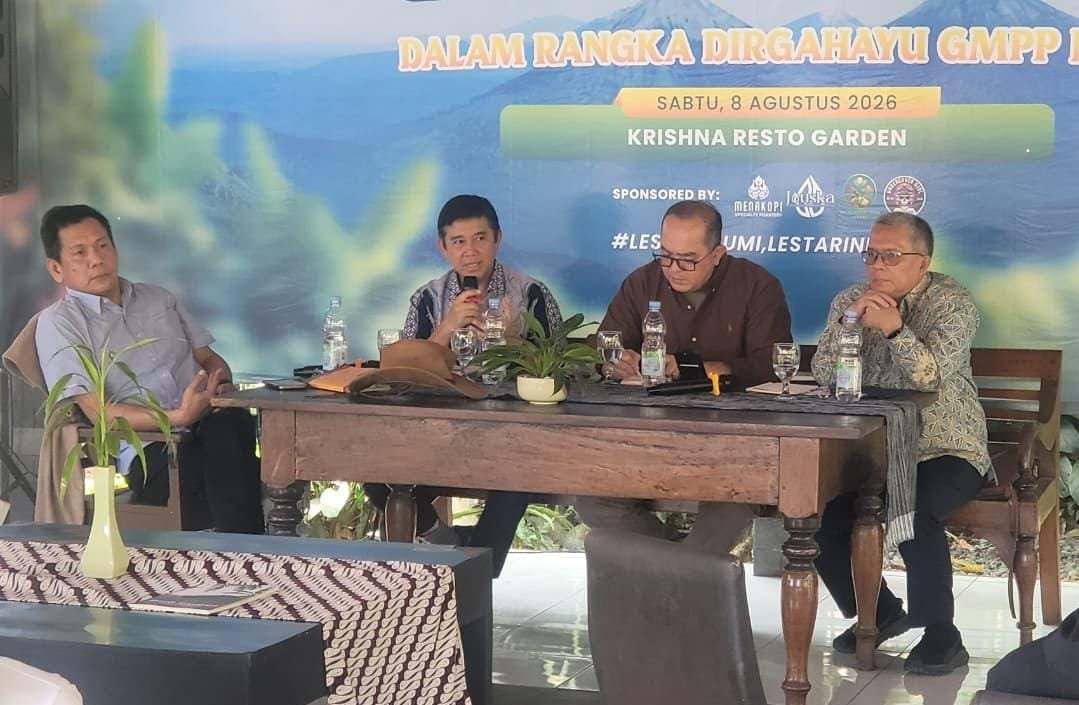
EduAsiaNews, Wonosobo — The noble objectives behind the establishment of the Red-and-White Village/Sub-district Cooperatives (Koperasi Desa/Kelurahan Merah Putih, or KDMP) have not been fully grasped by the public, a rector has said, even though the cooperatives could serve as a powerful tool for strengthening grassroots economies at the village level if managed properly.
The assessment was delivered by Anter Venus, rector of the National Development University “Veteran” Jakarta (UPNVJ), during a National Agriculture Workshop held by the Gerakan Mantap Pilih Prabowo (GMPP) movement together with the Jaga Tunas Bumi community organization in Wonosobo, Central Java, on Saturday. The discussion was also attended by Agrinas president director Joao Angela Mota and former State Apparatus Reform Minister Yuddy Chrisnandi, with Indra Jaya Piliang serving as moderator.
Venus asserted that the KDMP concept aligns with Indonesia’s economic ideals of collectivism and mutual cooperation, as enshrined in Article 33 of the 1945 Constitution.
“The goal of the Red-and-White Village Cooperatives is actually very ideal. These cooperatives are designed to build strong, affordable and self-reliant village economies backed by solid capital, governance and networks. This will certainly strengthen the grassroots economy at the village level,” Venus said.
He explained that the KDMP should not be understood merely as a retail outlet, but rather as a hub connecting various village economic activities—ranging from an economic service center to a provider of financing access for micro, small and medium enterprises (MSMEs) and farmers.
One of the KDMP’s key functions, he said, is to shorten the trade supply chain: farmers sell their harvests through the cooperative, while residents obtain goods through a more direct distribution channel. “If the supply chain can be trimmed, the benefits can be felt on both ends. Farmers gain better market access, while the public has the opportunity to obtain necessities at more affordable prices,” Venus said. He added that the cooperative could also serve as an offtaker for agricultural products and MSME goods, giving small producers a more reliable marketing channel.
- Venus cautioned that the rollout of KDMPs must take into account existing, well-functioning cooperatives and village-owned enterprises (BUMDes) to avoid overlapping roles. “If a village already has a BUMDes or cooperative that is running well, the presence of a Kopdes should not be seen as a competitor. There needs to be a pattern of integration and division of roles,” he said. According to him, BUMDes could continue focusing on sectors they have already developed, such as local tourism, while KDMPs take on roles in food distribution and financing.
Venus stressed that the success of the KDMP program must be measured by its tangible impact on communities, not simply by the number of cooperatives established. “In the end, the public needs proof. Have prices improved? Have farmers been helped? Have MSMEs gained access to markets? Is the cooperative financially healthy? Concrete achievements like these are what will build public trust,” he said. He added that the noble goals of the KDMP program need to be communicated continuously in accessible language, so that the cooperatives genuinely strengthen village communities rather than simply becoming another new institution. (**)