





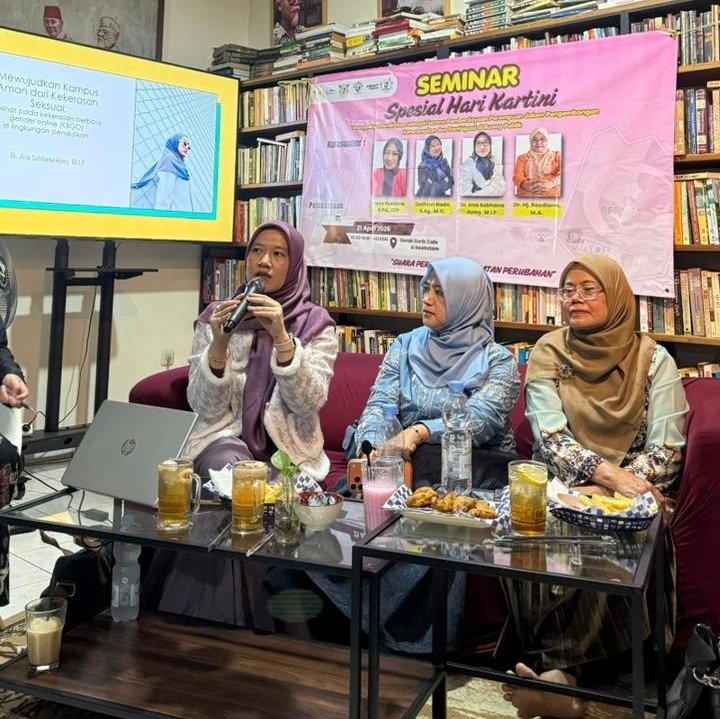
EduAsiaNews, Jakarta — Dr. Ana Sabhana Azmy, a lecturer and Coordinator of the Master’s Program in Political Science at the Faculty of Social and Political Sciences (FISIP), Universitas Pembangunan Nasional “Veteran” Jakarta (UPNVJ), served as a speaker at a special Kartini Day seminar themed “Realizing Education as a Means of Women’s Empowerment in Developing Skills and Participation in Public Spaces.” The event was organized by KOHATI Commissariat within the HMI Ciputat Branch on Tuesday (April 21) at Gerak Gerik Cafe & Bookstore, South Tangerang.
During the seminar, Ana emphasized the importance of understanding Online Gender-Based Violence (OGBV) as a form of sexual violence that has become an increasingly prominent issue. According to her, incidents of OGBV are entirely inappropriate, particularly within academic communities. Therefore, a shared understanding of gender justice perspectives across university campuses is essential.
“Online Gender-Based Violence (OGBV), facilitated by today’s technological advancements, is fundamentally no different from gender-based violence in the physical world. Such violence is committed with the intention of harassing or harming victims based on their gender or sexuality,” she asserted.
She further stressed that efforts to address OGBV should not be limited to legal enforcement alone. In her view, meaningful interventions are needed to transform perpetrators’ perspectives on gender and sexual relations.
“Without intervention addressing OGBV, perpetrators who have completed their sentences are unlikely to experience significant changes in their views on gender and sexuality. This means they may continue to hold biased perspectives regarding gender and sexual relations,” she explained.
Ana also underscored the importance of integrating gender perspectives into academic activities as a preventive measure against OGBV within educational institutions, including universities.
“Every teaching and learning activity should not only discuss topics such as gender and politics but should also incorporate gender-equitable perspectives. In addition, providing greater opportunities for equality within campus life and academic agendas is a concrete step toward reducing the incidence of OGBV in academic environments,” Ana concluded.(www.upnvj.ac.id)