




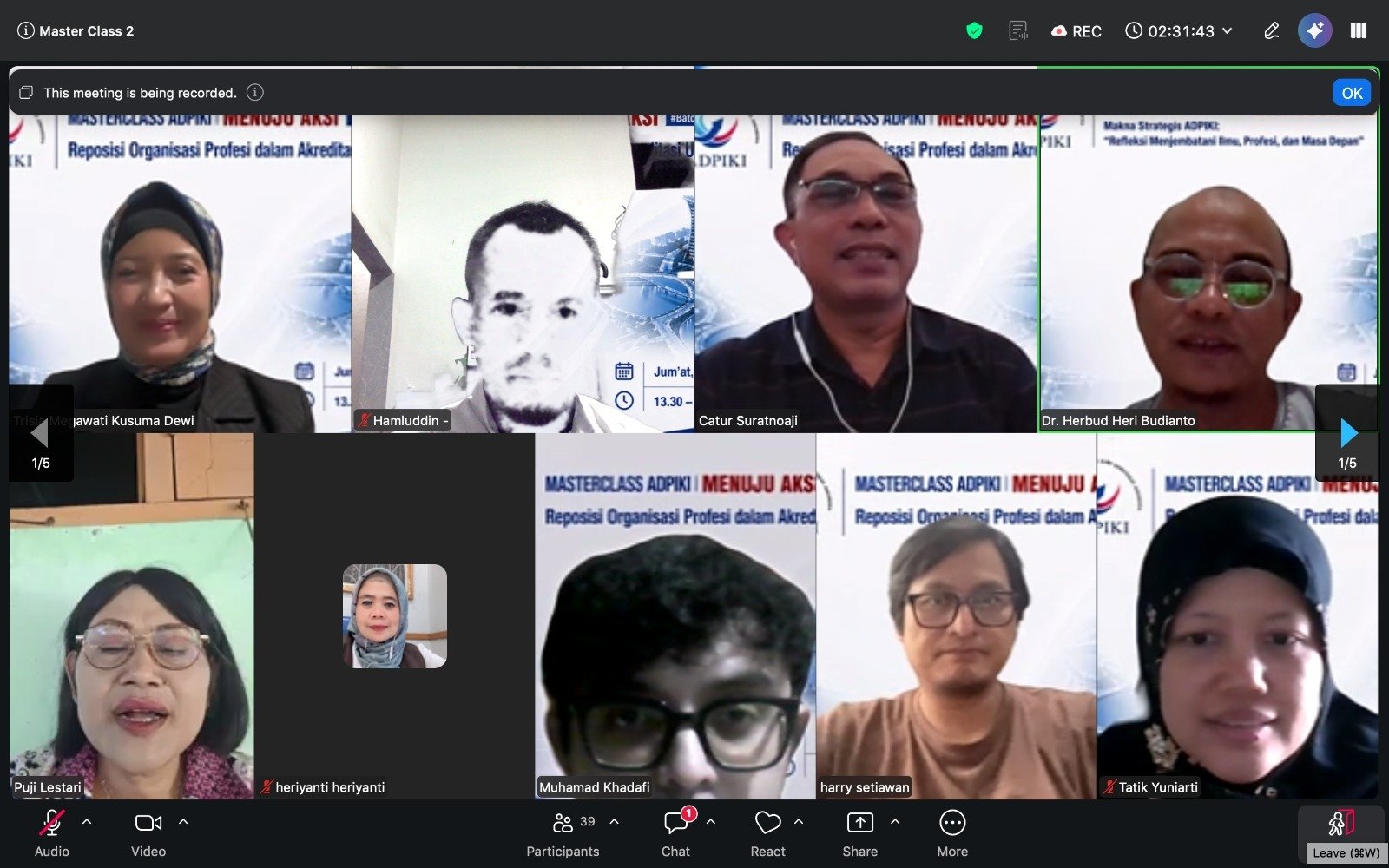
EduAsiaNews, Jakarta – The Masterclass Discussion Batch 2, organized by the Indonesian Association of Communication Science Lecturers and Researchers (ADPIKI), served as a strategic platform to examine the strengthening of professional organizations’ roles in supporting superior accreditation in higher education institutions. Conducted virtually on Friday (May 1, 2026), the event highlighted a critical issue: the persistent tendency to position professional organizations merely as administrative requirements. This condition calls for a repositioning so that such organizations can function more substantively in improving educational quality, including curriculum development, enhancement of graduate competencies, and strengthening linkages between academia and industry.
The Chairperson of ADPIKI emphasized the importance of reinforcing synergy and coordination among all stakeholders in advancing communication studies in Indonesia, including the active involvement of graduate users or the industrial sector. “The advancement of communication science cannot occur in isolation; it must be supported by close collaboration among higher education institutions, professional organizations, government, and industry as users of graduates,” he stated. He added that ADPIKI serves as a strategic platform for lecturers and researchers to continuously develop their academic capacity and professionalism, enabling them to contribute meaningfully to institutional quality improvement and the alignment of graduates with labor market demands.
Prof. Catur Suratnoaji, a Professor in Political Communication and Big Data at UPN Veteran East Java, underscored that communication professional organizations must transform from mere knowledge communities into strategic actors capable of influencing policy, the labor market, and the broader professional ecosystem. He noted that such transformation is essential to strengthening the position of professional organizations in enhancing educational quality and graduate competitiveness.
“Professional organizations need to function as external quality assurance bodies, mediators between universities and industry, and developers of competency standards that are adaptive to technological advancements such as artificial intelligence and big data,” Catur explained. He argued that without such strategic roles, professional organizations would struggle to create meaningful impact within the higher education system and meet industry needs.
Furthermore, Catur stated that within the paradigm of impact-driven universities, professional organizations should be repositioned as social impact hubs that connect academia, industry, government, and society. This role includes developing digital platforms for competency mapping, providing labor market data based on big data, and facilitating professional incubation to strengthen the relevance of graduates to industry requirements.
Meanwhile, Dr. Irwansyah, an academic and researcher in Communication Science at the Faculty of Social and Political Sciences, Universitas Indonesia, highlighted the persistence of “tokenism” in the placement of professional organizations, where they are treated merely as supplementary elements in administrative documentation. He argued that this condition indicates that professional organizations have not yet made substantive contributions to higher education quality assurance processes.
“Superior accreditation requires evidence that professional organizations actively shape quality, not merely appear in documentation,” he remarked. He emphasized that professional organizations must be repositioned as co-producers of quality, playing roles in standard-setting, curriculum validation, and the recognition of graduate competencies.
Irwansyah further added that the quality of study programs is the result of collaboration among multiple stakeholders within a single ecosystem, including study programs, lecturers, students, alumni, graduate users, and professional organizations. Therefore, the involvement of professional organizations must be reflected in curriculum decisions, certification processes, and measurable, verifiable learning outcomes as part of a continuous quality improvement cycle.
ADPIKI concludes that strengthening the role of professional organizations as strategic actors within the higher education ecosystem is key to advancing sustainable superior accreditation. Through integrated multi-stakeholder collaboration and the utilization of data and technology, professional organizations are expected to move beyond administrative formality and deliver tangible contributions to quality improvement, graduate relevance, and the global competitiveness of Indonesian higher education institutions.