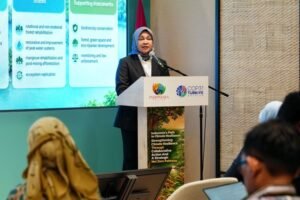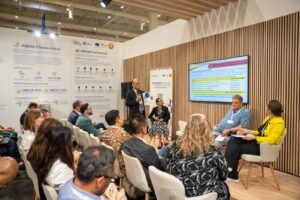





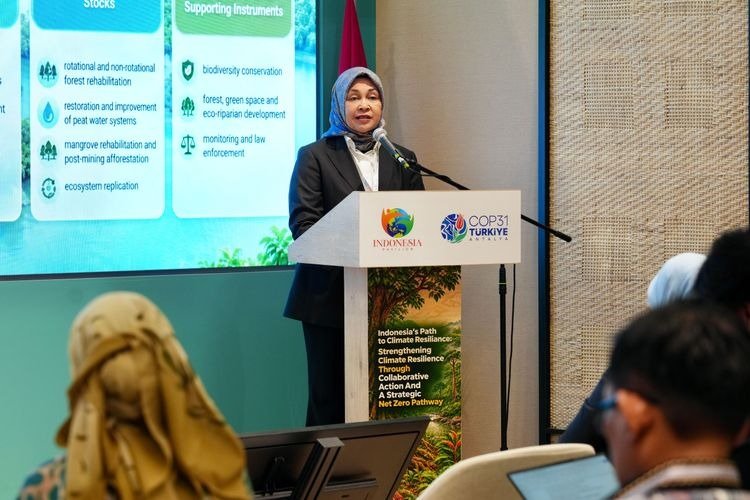
EduAsiaNews, Antalya – The Ministry of Forestry is promoting the transformation of forest and land rehabilitation from a tree-planting-oriented approach towards comprehensive and sustainable restoration of ecosystem functions. This approach integrates watershed (DAS) management, forest and land rehabilitation, and mangrove ecosystem restoration to strengthen landscape resilience to climate change. This was discussed in the session “Beyond Planting: From Watersheds to Mangroves for Climate-Resilient Landscapes” at the Indonesia Pavilion at the 31st United Nations Climate Change Conference (COP31 UNFCCC), Antalya, Türkiye, Tuesday (11/17).
The Director General of Watershed Management and Forest Rehabilitation (PDASRH) of the Ministry of Forestry, Dyah Murtiningsih, in her keynote remarks emphasized the importance of expanding landscape-based rehabilitation to support the achievement of Indonesia’s FOLU Net Sink 2030. This strategy combines emission reduction efforts through forest protection with increased carbon absorption through forest rehabilitation, peatland restoration, mangrove restoration, and other degraded ecosystems.
Indonesia faces the challenge of recovering around 12 million hectares of critical land with financing needs estimated at US$42 billion. To address these challenges, the Ministry of Forestry encourages strengthening funding through government budgets, international cooperation, results-based payments, private investment, and philanthropy. The development of carbon financing and sustainable investment instruments also presents opportunities to support long-term rehabilitation, including maintenance and monitoring of its success.
In the forum, the Ministry of Forestry emphasized that the success of rehabilitation is not solely measured by the number of trees planted or the area being rehabilitated. The results must be seen from the restoration of water management functions, increased vegetation cover, biodiversity protection, strengthening carbon stocks, as well as economic and social benefits felt by the community. Therefore, the management of upstream, middle, and downstream watershed areas needs to be carried out in an integrated manner with coastal ecosystems.
From a scientific perspective, watershed management expert from Padjadjaran University, Chay Asdak, explained that landscape restoration can be a joint approach to support the climate change agenda, land degradation control, and biodiversity conservation. He emphasized the importance of economic incentives for land management communities, including through agroforestry, environmental service payments, and nature-based business financing, so that ecosystem protection can run alongside improving community livelihoods.
The Director of Mangrove Rehabilitation at the Ministry of Forestry, Nikolas N. Surjobasuindro, explained that Indonesia’s mangrove ecosystem area reaches around 3.44 million hectares. Through the National Mangrove Rehabilitation Roadmap 2021–2030, Indonesia targets rehabilitating 600,000 hectares of mangroves by prioritizing strengthening community livelihoods, multi-stakeholder collaboration, climate change mitigation, and diversification of financing sources. The Ministry of Forestry also continues to develop the World Mangrove Center as a platform for international cooperation for knowledge exchange and capacity building in mangrove management.
The experience of rehabilitation at the site level was shared by the Head of the Serayu Opak Progo Watershed Management Center, Rochimah Nugrahini, through a collaborative approach between the government, business world, and farmer groups. In the Menoreh area, the rehabilitation cooperation has resulted in the planting of around 1,656 hectares with more than 901 thousand multipurpose trees, as well as creating around 87 thousand man-days. These experiences show that landscape-based rehabilitation can provide ecological benefits while opening economic opportunities for the community.
From the financing side, Kyu-uk Lee from the Global Green Growth Institute (GGGI) emphasized that restoration funding should not only focus on planting activities but also include maintenance, monitoring, and proof of results. Carbon financing and blended funding schemes can be alternatives to support the entire restoration cycle, while ensuring environmental integrity, certainty of outcome calculations, and fair benefit sharing for communities.
Meanwhile, Noriaki Sakaguchi from the Japan International Cooperation Agency (JICA) shared experience from more than three decades of Indonesia–Japan mangrove rehabilitation cooperation, including the implementation of silvofishery that integrates pond utilization with mangrove protection. The Regent of Mempawah, West Kalimantan, Erlina, also presented the practices of mangrove protection and restoration through Mempawah Mangrove Park, which connects conservation, environmental education, ecotourism, and community involvement.
The session, moderated by Nur Azis from the Directorate General of PDASRH Kemenhut, also featured discussions with international participants about the development of the World Mangrove Center, experiences in Indonesia’s mangrove management that other countries can learn, as well as opportunities for rehabilitation cooperation with Bangladesh. The speakers agreed that expanding restoration requires integrated policies, sustainable financing, scientific support, and active community participation.
Through the COP31 forum, the Ministry of Forestry emphasized that forest and land rehabilitation must move beyond planting targets toward measurable and sustainable ecosystem recovery. The integration of watershed management, forest rehabilitation, and mangrove restoration is expected to strengthen climate resilience, support the achievement of Indonesia’s FOLU Net Sink 2030, and ensure that forests and coastal ecosystems continue to provide benefits to the environment and community welfare. (*)