




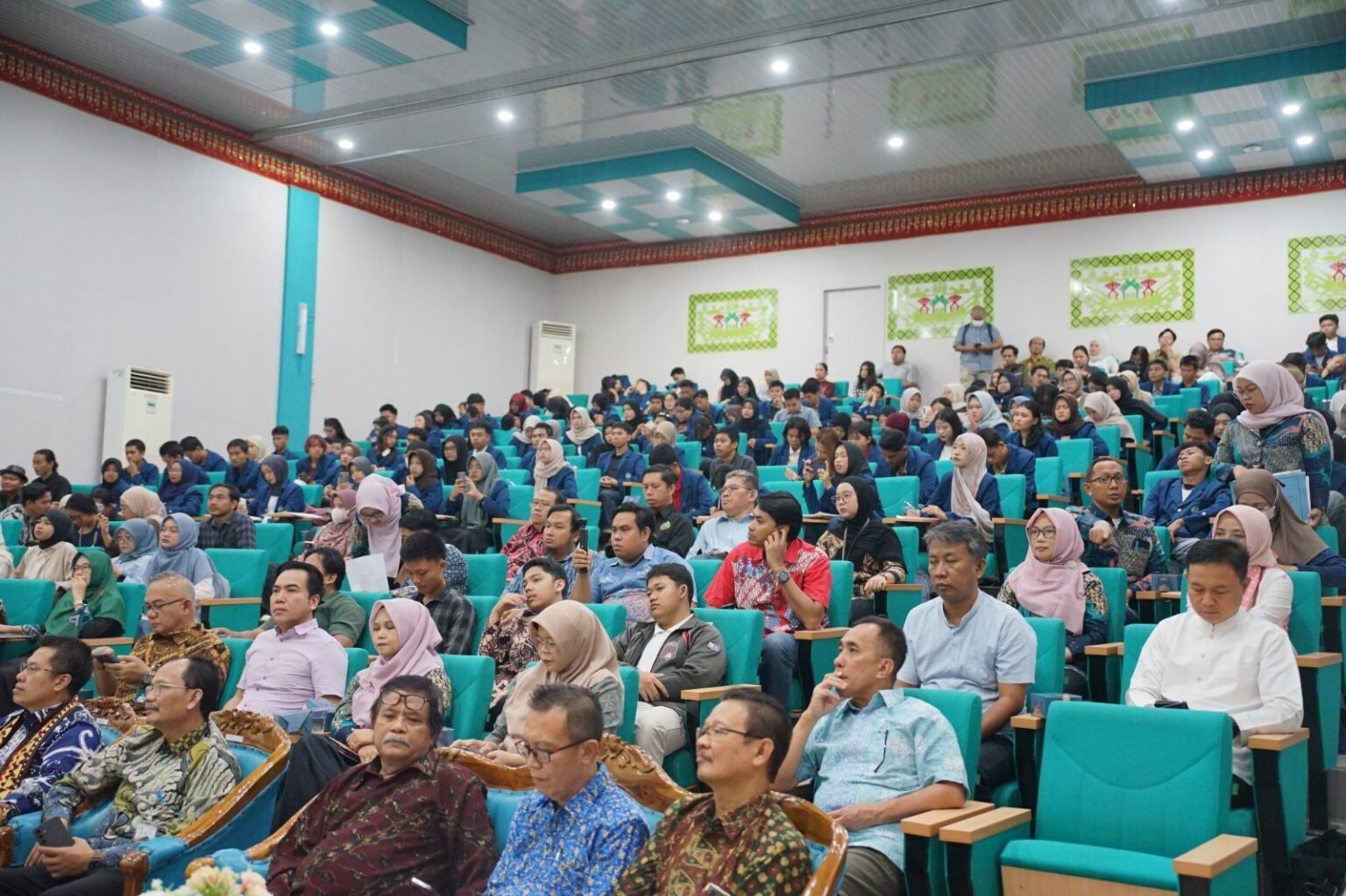
EduAsiaNews, Lampung – The Institute for Research and Community Service (LPPM) of the University of Lampung (Unila) held a National Seminar on Sustainable Development under the theme “Strengthening Carbon Economic Value Governance Toward Indonesia’s Net-Zero Emissions Target by 2060” on Friday, Oct. 9, 2026. The event took place at the Dean’s Hall of Unila’s Faculty of Agriculture.
The seminar was officially opened by Vice Rector for Academic Affairs Prof. Dr. Eng. Suripto Dwi Yuwono, S.Si., M.T., who attended on behalf of the rector. In his remarks, he said the event served as an academic forum to strengthen synergies among the government, forestry technical implementation units, academics and other stakeholders in support of sustainable development.
The national seminar provided an important opportunity for various parties to come together to deepen their understanding and formulate ideas on the governance of Carbon Economic Value (NEK), sustainable forest management and collaborative watershed management.
He emphasized that stakeholder involvement was essential to promoting sustainable natural resource management while supporting efforts to achieve Indonesia’s net-zero emissions target by 2060.
The seminar featured Secretary General of the Ministry of Forestry of the Republic of Indonesia Dr. Ir. Mahfudz, M.P., as the keynote speaker. The speakers included Head of the Ministry of Forestry’s Planning Bureau Dr. Edi Sulistyo Heri Susetyo, S.Hut., M.Si.; Head of the Sustainable Forest Management Office (BPHL) Region VI Dr. Dudi Iskandar, S.E., M.H.; and Unila Faculty of Agriculture professor Prof. Dr. Ir. Slamet Budi Yuwono, M.S.
The discussion was moderated by Unila Faculty of Agriculture professor Prof. Dr. Ir. Samsul Bakri, M.Si. The participation of government officials and academics was expected to broaden perspectives and encourage the exchange of ideas on strengthening carbon economic value governance and promoting sustainable environmental management.
The event was also attended by the head of the Lampung Provincial Forestry Office; the head of the Way Seputih–Way Sekampung Watershed Management Office (BPDAS); the head of the Bandar Lampung-based Forest Area Consolidation and Environmental Planning Office (BPKHTL) Region XX; the head of Bukit Barisan Selatan National Park; the head of Way Kambas National Park; as well as deans, heads of institutions, professors, lecturers and students from Unila’s Department of Forestry, Faculty of Agriculture.
Discussions on carbon economic value governance highlighted the potential of forests to absorb carbon through forest protection, land rehabilitation and ecosystem restoration. Carbon Economic Value is an instrument for assigning economic value to efforts to reduce greenhouse gas emissions and increase carbon absorption.
Its implementation requires transparent governance, accountable measurement and reporting, and effective oversight to ensure that the resulting environmental benefits are realized. Carbon trading is also an important component of efforts to strengthen Carbon Economic Value governance.
In general, carbon trading can be conducted through two mechanisms: emissions trading and emissions offsetting. Emissions trading involves transactions involving emission allowance units between parties subject to specific emissions obligations or limits. Emissions offsetting, meanwhile, involves transactions in carbon units generated through activities that reduce greenhouse gas emissions or increase carbon absorption.
In the forestry sector, carbon trading has the potential to support funding for forest protection, land rehabilitation, ecosystem restoration and efforts to increase carbon stocks. However, its implementation requires credible measurement, reporting and verification to ensure that emission reductions or increased carbon absorption actually occur, can be properly accounted for and are not claimed more than once.
With transparent and accountable governance, carbon trading is expected to serve as one of the instruments supporting low-carbon development and Indonesia’s net-zero emissions target for 2060.
Through the national seminar, Unila’s LPPM sought to strengthen collaboration among the government, universities and stakeholders in formulating sustainable development strategies. The forum is expected to provide a platform for exchanging knowledge and ideas to support carbon economic value governance, forest conservation and watershed management as part of efforts to achieve Indonesia’s net-zero emissions target by 2060.