




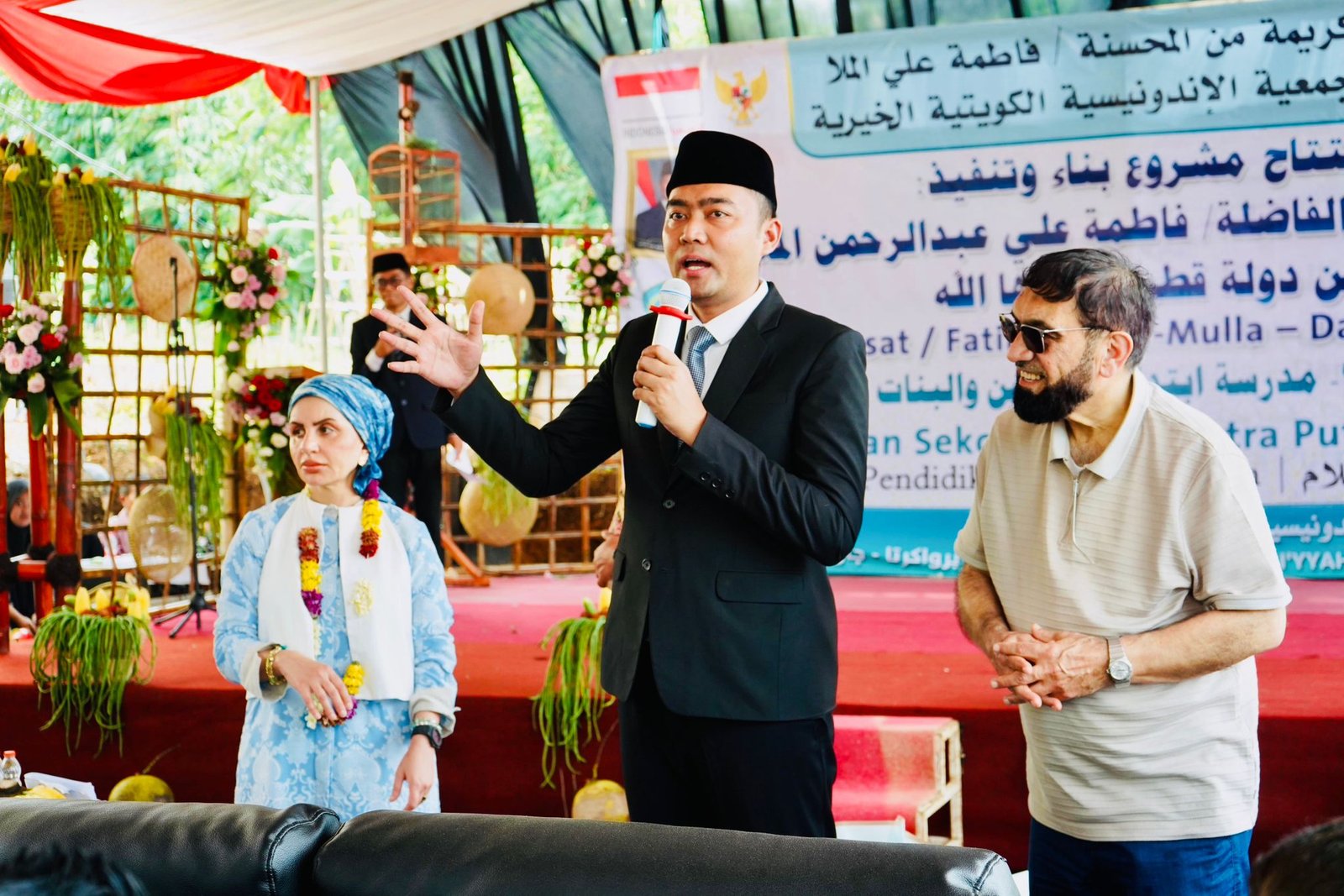
EduAsiaNews, Jakarta – In the quiet heart of Purwakarta, West Java, on April 20, 1989, a boy was born whose destiny would one day cross continents, faiths, and disciplines.
His name: Gugun Gumilar.
He was the youngest of four children, raised by Tajudin Al Ansori and Siti Mariam, a humble couple whose hands were calloused from tending rice fields — but whose dreams for their son reached far beyond the horizon.
He wasn’t born of blue blood, but somehow, blue blood was born within him — a deep, noble spirit bound not to wealth or status, but to faith, learning, and service.
Life in Purwakarta was simple, even harsh. The rhythm of Gugun’s childhood was shaped by the land — planting, harvesting, feeding goats and chickens. Yet amid the struggles, his parents instilled in him an unshakable belief: education is sacred, and faith must guide every step of it.
While other children woke to the school bell, Gugun woke before dawn, performing Subuh prayers before walking to school an hour ahead of his classmates. His journey to knowledge was not about competition, but about devotion — to his family, his faith, and his people.
“Never let poverty be your excuse,” his father would remind him. “Let it be your purpose.”
At a young age, Gugun entered a pesantren, a traditional Islamic boarding school where he would spend six years immersed in religion, discipline, and community life.
The nights were long — filled with Qur’an recitation under the flicker of oil lamps. But those years formed the core of his spirit: humble, patient, and unwavering.
His teachers saw something rare. “He didn’t just learn religion,” one of them recalls. “He lived it — in the way he served others, in his quiet strength, in his kindness.”
Gugun’s journey did not end in the pesantren. It only began there. His thirst for learning brought him to UIN (Universitas Islam Negeri) in Indonesia, where he deepened his grounding in Islamic thought, before traveling abroad to continue his studies.
At Hartford Seminary in the United States, he studied Theology, exploring the intersections of faith, dialogue, and humanity. Later, he pursued his Ph.D. in Theology, Philosophy, and Music at Dublin City University (DCU) in Ireland — a rare combination that reflected his belief that faith and art are twin expressions of divine beauty.
“Music,” Gugun once said, “is how the soul remembers what words cannot explain.”
Upon returning to Indonesia, Gugun transformed his knowledge into service. He joined the Senate of the Republic of Indonesia as an expert staff, contributing to discussions that bridged policy, education, and religion.
His academic journey continued as he began teaching at PKU Istiqlal — the higher education institution under the Istiqlal National Mosque, the largest mosque in Southeast Asia. There, he inspired a new generation of thinkers and reformers who saw in him a model of modern Islamic intellect rooted in compassion and humility.
Today, he serves as Deputy Director of Voice of Istiqlal, a global platform under the mosque dedicated to interfaith dialogue, cultural exchange, and peacebuilding.
At the same time, he holds the position of Executive Assistant to the Grand Imam at the Ministry of Religious Affairs, where he supports initiatives that strengthen religious harmony and education across Indonesia.
Through every role — from lecturer to policymaker, from servant to leader — Gugun remains grounded in his mission: to be useful for the glory of Allah, and for the betterment of humanity.
Gugun’s story is not one of privilege, but of perseverance. From rice fields to university halls, from the mosque to the ministry, he embodies a truth his parents planted long ago — that greatness is not inherited, but cultivated through faith, hard work, and love for others.
Despite his achievements, Gugun remains grounded in the soil of his childhood — the rice fields of Purwakarta. He often returns to his hometown to visit his family, to pray, and to give back to the community that raised him.
He carries forward the legacy of his parents, who taught him that faith without service is incomplete, and that education without compassion is hollow.
Now, his vision extends beyond Indonesia — to a world where religion unites rather than divides, where music and philosophy can heal, and where leadership is not about fame, but faith.
He often visits orphans and communities in need, reminding himself of where he came from. “When I look into their eyes,” he once shared, “I see myself — a child with dreams, and a heart that still believes.”
To his students, he is more than a teacher. To his colleagues, more than an aide. To his community, more than a leader. He is a reminder — that sincerity, not status, defines nobility.
In a world often dazzled by titles and wealth, Gugun Gumilar stands as a quiet testament to a different kind of power — the kind that comes from faith, knowledge, and service.
He may not have been born into blue blood, but blue blood runs in his spirit — in every act of kindness, in every word of wisdom, in every dream he carries for Indonesia and the world.
“I wasn’t born to rule,” Gugun says softly. “I was born to serve.
And through service, we find the glory of Allah.”
A story of devotion, destiny, and the enduring light of one man’s faith.
From the rice fields of Purwakarta to the halls of theology, Gugun Gumilar’s journey reminds us all that nobility is not in the bloodline…
It is in the soul.
But to those who know him, Gugun’s true ministry is not confined to offices or titles. It lives in his compassion — in his visits to orphanages, his teaching at mosques, and his efforts to promote interfaith understanding and education.
“Knowledge,” he often says, “is only sacred when it uplifts others.”