




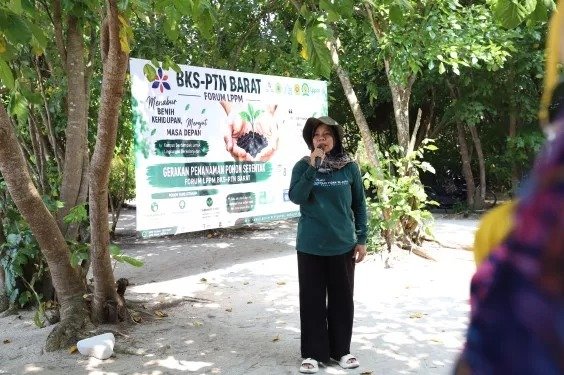
EduAsiaNews, Jakarta — For the people of Pulau Pari in the Thousand Islands, planting mangroves is more than simply a reforestation activity. Mangroves serve as a natural barrier that protects their homes from coastal erosion, provides habitat for marine life, and helps sustain the livelihoods of coastal communities.
This message was conveyed by Asmania, a fisherwoman and Chairperson of the Pulau Pari Women’s Group, during a mangrove planting activity involving 500 mangrove seedlings alongside students from Universitas Pembangunan Nasional “Veteran” Jakarta (UPNVJ) at Rengge Beach, Pulau Pari, on Monday (June 8, 2026).
Asmania, affectionately known as Teh AA, is the mother of three children. Together with her husband, who also works as a fisherman, she depends on the preservation of Pulau Pari’s marine and coastal environment to support her family’s livelihood.
According to her, the mangrove planting activity involving UPNVJ students proceeded smoothly. The high tide conditions on that day were particularly favorable for planting seedlings along the coastal area.
“Alhamdulillah, the mangrove planting activity went smoothly. Today’s high tide conditions were very supportive and ideal for planting,” said Asmania.
She also expressed her appreciation to the UPNVJ students who came and worked directly alongside the women’s group in safeguarding the coastal environment.
“We would like to thank the students from UPN Veteran Jakarta for contributing to mangrove planting efforts together with us, the women of Pulau Pari,” she remarked.
Mangrove planting initiatives on Pulau Pari have been carried out continuously by the local community. Asmania explained that thousands of mangrove trees have already been planted across various locations, stretching from the western to the eastern parts of the island cluster.
“In total, we have planted thousands of mangroves throughout the Pulau Pari archipelago. We have planted them across both the western and eastern areas,” she explained.
Planting activities are conducted not only at Rengge Beach but also in several community-managed coastal areas, including Perawan Beach and Bintang Beach. These efforts are aimed at strengthening the island’s natural protection against coastal erosion and changing environmental conditions.
Asmania emphasized that mangroves hold significant importance for communities living on small islands. Their root systems help retain sediment and reduce the impact of ocean waves on the shoreline.
“Mangroves have an extremely important function for those of us who live in coastal areas. They serve as a sea fence for communities living on islands,” she stated.
For the people of Pulau Pari, mangroves are also directly linked to the sustainability of fishermen’s livelihoods. As mangrove forests mature, they become shelter, breeding grounds, and feeding areas for fish and various marine species.
“In the future, once the mangroves have fully grown, this area will become a home for fish and an integral part of Pulau Pari’s marine ecosystem,” she said.
In addition to protecting coastlines and providing habitat for marine life, mangroves also play a crucial role in carbon sequestration. This capability makes mangrove ecosystems essential in addressing climate change while maintaining the ecological balance of coastal environments.
The active involvement of the Pulau Pari Women’s Group demonstrates the significant role of coastal women in promoting environmental sustainability. Beyond supporting their fishing families, they stand at the forefront of mangrove planting, maintenance, and conservation efforts.
For Asmania, protecting both the sea and land of Pulau Pari is a shared responsibility. A well-preserved environment will determine the sustainability of local livelihoods and the future of the children who will continue to live on the island.
She also encouraged younger generations to remain committed to environmental stewardship.
“To young people and everyone out there who cares about the environment, let us continue to protect our environment, our seas, and our land for future generations,” she urged.
According to her, environmental conservation efforts must begin now to ensure that future generations can enjoy better living conditions and more sustainable livelihoods.
“Future generations deserve a better quality of life. Therefore, we must continue to protect both our seas and our land together,” she added.
The collaboration between UPNVJ students and the Pulau Pari community illustrates that environmental conservation requires the participation of multiple stakeholders. The students’ presence not only contributed to increasing the number of mangrove trees planted but also strengthened the community’s commitment to protecting their living environment.
Through mangrove planting, students and local residents planted more than just tree seedlings. They planted protection for the island, a habitat for marine life, and hope that future generations will continue to live and earn their livelihoods from a sustainable coastal environment.(www.upnvj.ac.id)