




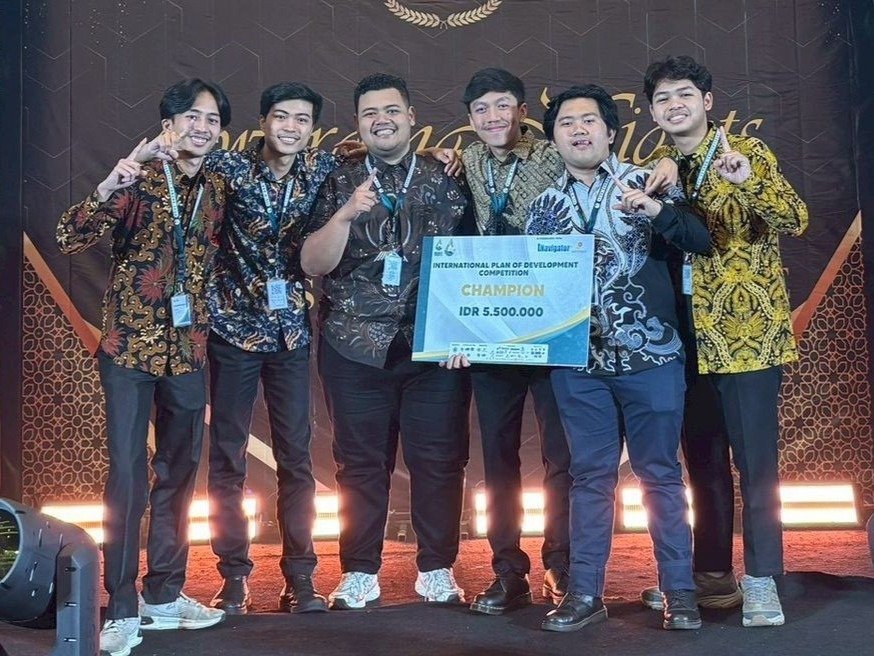
EduAsiaNews, Bandung – Students from the Petroleum Engineering Study Program, Faculty of Mining and Petroleum Engineering, Institut Teknologi Bandung (FTTM ITB), who are members of the PATRON Team, secured first place in the International Plan of Development Competition OGIP 2026, organized by Universitas Pembangunan Nasional “Veteran” Yogyakarta. The competition culminated in Yogyakarta on Sunday, 3 May 2026.
The PATRON Team consists of Michael Derent Anjar S (Team Leader and Pipeline Engineer), Al Farrel Putra Ramadhani (Surface Facility Engineer), Firzan Annas As Shidiq (Reservoir Engineer), Muhammad Fadhil Sias (Economic Analyst), Muhammad Vianda Pratama (Drilling Engineer), and Zulyadi Awwab (GGR Engineer). The team was supervised by Dr. Dedy Irawan, S.T., M.T.
In this competition, participants were challenged to develop a comprehensive oil and gas field development plan through a Plan of Development (PoD) approach. The analysis encompassed reservoir engineering, drilling, production, surface facilities, and economic aspects, while also incorporating sustainability considerations through the implementation of Carbon Capture, Utilization, and Storage (CCUS).
The team presented a proposal entitled “Integrated CCUS Optimization in the OGIP Field: A Strategy for Sustainable Energy Resilience,” focusing on the redevelopment of the OGIP Field, a mature offshore oil and gas field in the Norwegian North Sea. The concept integrates hydrocarbon production, CO₂ injection, long-term carbon storage, and project economic optimization.
“Through PATRON, we sought to develop a field development plan that not only prioritizes production but also addresses sustainability through the integration of CCUS and long-term CO₂ storage,” said Michael Derent Anjar S.
Selected Development Scenario
The team evaluated four field development scenarios before selecting the most optimal option. The chosen scenario combines the base case with one infill well, one CO₂ injection well, and a completion strategy designed to enhance production and field efficiency. CO₂ injection is utilized for pressure maintenance and the mobilization of remaining oil, while a water shut-off completion strategy is employed to reduce water production.
The selected scenario is projected to generate a cumulative oil production of 69.06 MMSTB, with a recovery factor of 67.91 percent. In terms of carbon storage, the project targets the injection and permanent storage of 86.62 BSCF of CO₂, equivalent to approximately 4.59 million tonnes of CO₂. The field’s storage capacity is estimated at 15.4 million tonnes based on the P50 estimate.
Technical Challenges
One of the primary challenges faced by the team was conducting history matching using relatively old field production data while ensuring that the injected CO₂ could be permanently stored through a 100-year storage simulation. The team also had to assess risks related to fault reactivation, caprock integrity, and potential long-term CO₂ leakage.
“The greatest challenge in this study was ensuring the safe and permanent storage of CO₂ through a 100-year plume simulation and designing wells capable of withstanding the highly extreme reservoir conditions of the North Sea,” explained Muhammad Vianda Pratama.
From the surface facilities perspective, the injected CO₂ was designed to achieve approximately 99 percent purity through a Gas Sweetening Unit utilizing an MDEA-PZ amine system and a TEG Dehydration Unit before entering the compression and injection stages. This process plays a crucial role in PATRON’s CCUS strategy, as high-purity CO₂ is essential for maintaining injection efficiency, minimizing corrosion risks, and ensuring the safety of long-term carbon storage.
Economic Feasibility
The project also demonstrated strong economic viability. The selected scenario achieved a Net Present Value (NPV) of USD 597.41 million at a 10 percent discount rate and USD 447.33 million at a 15 percent discount rate. The project recorded an Internal Rate of Return (IRR) of 39.86 percent and a payout period of 2.67 years.
For the PATRON Team, this achievement demonstrates that integrating reservoir engineering, drilling, pipeline systems, surface facilities, HSSE, and economic considerations into a single development plan aligned with the energy transition agenda is an attainable goal for university students.
“The key strength of PATRON’s solution lies in its integration of reservoir, drilling, pipeline, surface facility, HSE, and economic aspects into a comprehensive development plan that remains consistent with the direction of the global energy transition,” said Dr. Dedy Irawan, S.T., M.T., the team’s faculty advisor.
Through this achievement, the PATRON Team hopes that its proposed concept can serve as a meaningful contribution to the advancement of CCUS technology and support Indonesia’s pathway toward achieving net-zero emissions.