




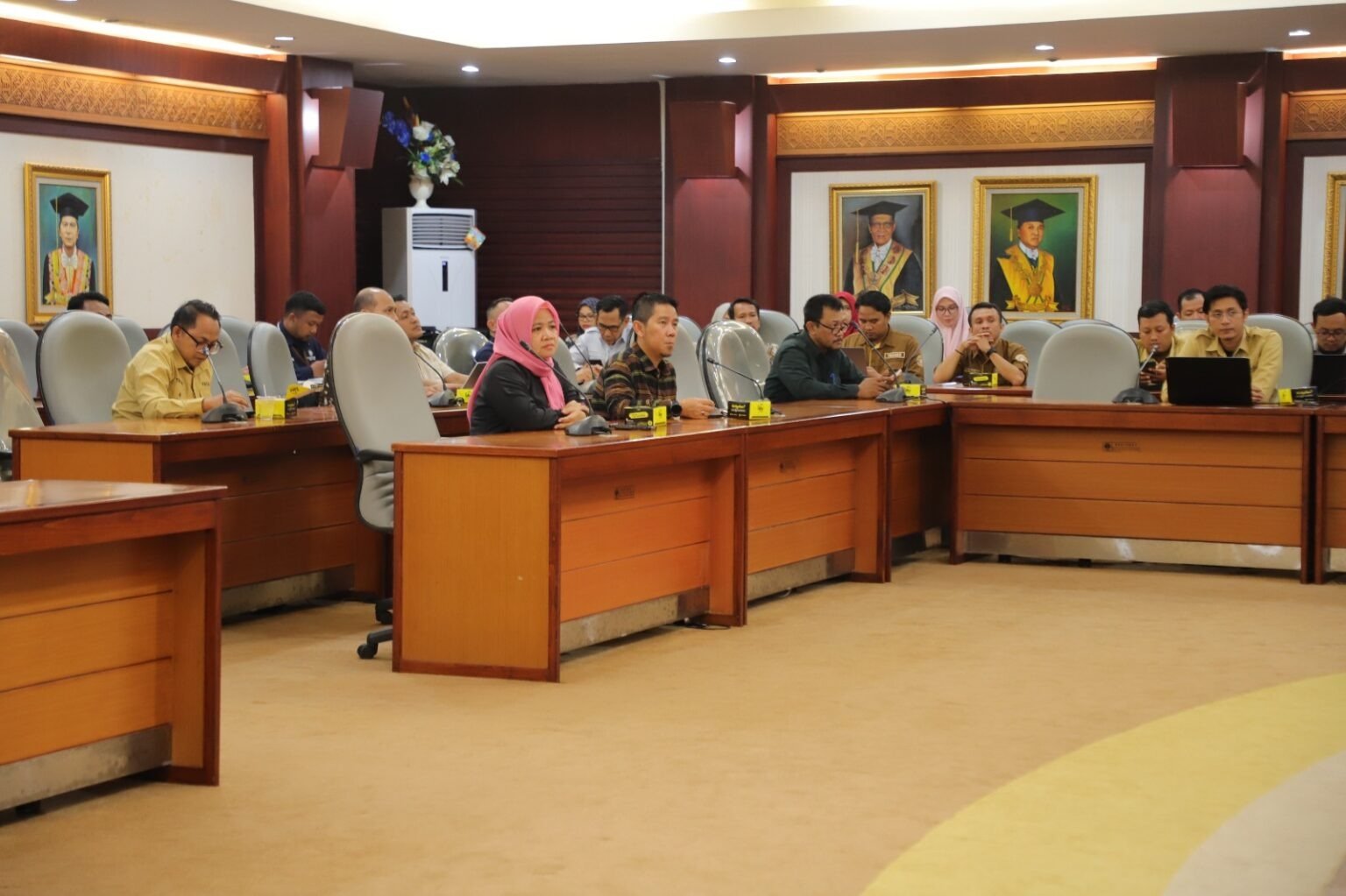
EduAsiaNews, Lampung – University of Lampung (Unila) conducted a socialization session on the remuneration system for educational support staff (tendik). The event took place in the Unila Rectorate Meeting Room on Tuesday, 2 June 2026, as part of a simulation for implementing a new performance evaluation system within the university.
The session was attended by the Vice Rector for Finance and General Affairs, Dr. Habibullah Jimad, S.E., M.Si., members of the remuneration team represented by Dr. Fitra Dharma, S.E., M.Si., and Bayu Wicaksono, S.Kom., division heads, subdivision heads, and representatives of educational support staff from each work unit.
The socialization program was organized to provide technical understanding of performance data entry mechanisms as well as the implementation of a remuneration system based on both organizational and individual achievements.
In his presentation, Dr. Fitra explained that the system was developed to support a more measurable, objective, and institutionally aligned performance evaluation process.
Whereas previous assessments focused primarily on individual achievements—which were considered insufficient in fully reflecting contributions to the university’s overall performance—the new scheme integrates individual achievements, organizational unit performance, and other institutional indicators.
For educational support staff, work activities are recorded through daily journals as the basis for performance evaluation, while lecturers continue to complete the Lecturer Performance Workload (BKD), which is subsequently assessed by appointed evaluators. In addition, the remuneration component is capped at a maximum of 40 percent and is calculated using organizational indices and work-unit performance achievements.
“In academic units, organizational indicators take into account several components, including the achievement of Non-Tax State Revenue (PNBP), remuneration expenditure effectiveness, on-time student graduation rates, partnerships, accreditation status, and international rankings, particularly at the faculty and postgraduate levels,” he explained.
Meanwhile, in non-academic units, evaluations will be adjusted according to the performance targets of each respective organization. Through this scheme, lecturers and educational support staff are expected to collaborate in achieving institutional targets through a more integrated system based on shared accomplishments.
During the simulation session, Bayu Wicaksono presented a tutorial on the use of the remuneration platform, including procedures for completing daily journals and the ongoing development of the Employee Performance Targets (SKP) feature.
He explained that individual performance achievements carry a weight of 70 percent, derived from daily activity logs, while the remaining 30 percent is determined by the performance of the respective work unit, including indicators such as on-time graduation rates, accreditation outcomes, and other organizational targets.
If a unit successfully achieves its targets, employees may receive the incentive component in accordance with applicable regulations. The system is also equipped with daily statistical features and user profiles to support more transparent and measurable performance monitoring.
Each recorded performance activity must be accompanied by supporting documentation. All submitted activities must include complete document uploads or links to documents previously uploaded to Google Drive.
“If the documents are successfully uploaded, they will appear in the document list and undergo an evaluation process based on the performance data entered. Subsequently, this performance data will serve as one of the considerations in determining incentive allocations for employees,” Bayu explained.
The event concluded with a discussion and question-and-answer session, providing participants with an opportunity to seek clarification and deepen their understanding of the mechanisms and procedures of the remuneration system presented.
Through this socialization program, Unila seeks to strengthen a performance governance system for educational support staff that is more transparent, measurable, and aligned with institutional objectives.
The implementation of a remuneration system based on individual and organizational unit achievements is expected to enhance productivity, strengthen inter-unit collaboration, and foster a more accountable work culture in support of the university’s sustainable performance improvement.
Source: Internship Contributor – Asnia Sundari