




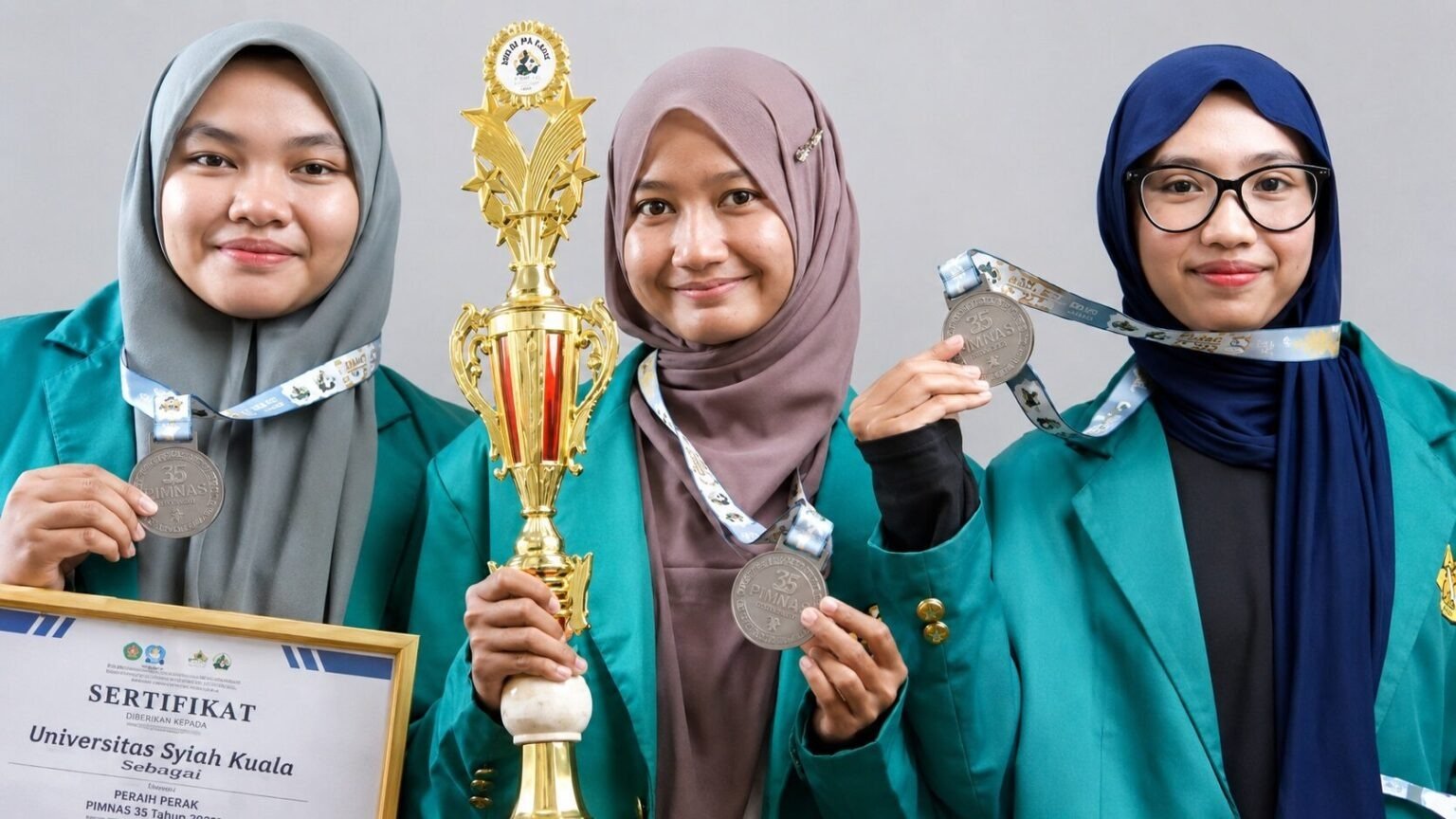
EduAsiaNews, Aceh – Innovation based on local resources has once again propelled students of Syiah Kuala University to the national stage of achievement. Three students from the Biology Study Program, Faculty of Mathematics and Natural Sciences (FMIPA), USK, secured Second Place in the Biology Science Competition organized by Mulawarman University recently.
The team, led by Sarah Salsabil and comprising Cut Dhinie Decita and Naja Luthfia Nuha, presented a scientific project entitled “Bio-Responsive Smart Hydrogel Based on Local Seaweed Polysaccharides with an Early Visual Infection Indicator for Diabetic Wound Healing.”
Sarah Salsabil, the team leader, explained that the innovation was developed to optimize the potential of locally sourced seaweed as a health biomaterial. The hydrogel they created not only accelerates wound healing in diabetic patients but also possesses a unique capability to detect infections at an early stage through visible changes.
“We integrated health biotechnology principles into a bio-responsive system. The mechanism enables a visual indicator to react to wound conditions, allowing infections to be identified at an earlier stage,” Sarah said.
The research involved a specialized division of responsibilities to ensure an in-depth study. Cut Dhinie Decita focused on investigating the characteristics of seaweed polysaccharides as the primary material, while Naja Luthfia Nuha examined the hydrogel system’s sensing mechanism for detecting infected wounds.
The achievement received positive recognition from the faculty. It was regarded as tangible evidence that FMIPA USK students are capable of transforming fundamental scientific theories into applied research that addresses future medical needs.
Separately, FMIPA USK reaffirmed its commitment to strengthening laboratory research and technological development across various fields, ranging from environmental sciences to health biotechnology. The smart hydrogel innovation is expected to become a pioneering example of how Indonesia’s local resources can be utilized as high-value, innovative medical materials with potential applications at both the national and international levels