




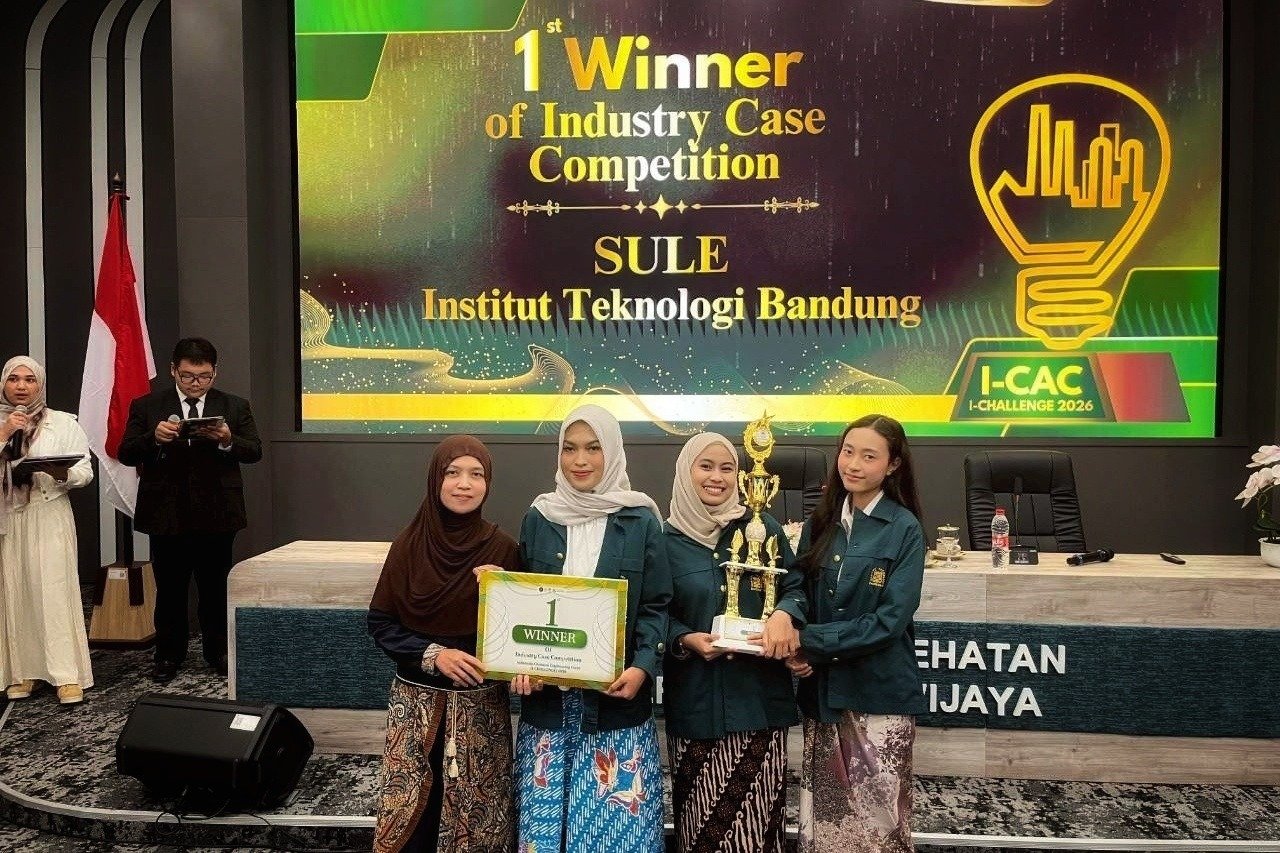
EduAsiaNews, Bandung – Three students from the Microbiology program, Class of 2022, at the Bandung Institute of Technology (ITB) have achieved first place in the national Industry Case Analysis Competition (I-CAC) at I-CHALLENGE 2026, held at Universitas Brawijaya, Malang. The team presented an innovation that utilizes coal solid waste as a raw material for producing high-capacity silicon-carbon anodes and alpha-alumina ceramic coatings for lithium-ion batteries.
The three students are part of a team called “SULE,” consisting of Malika Fatima Lawe (team leader), Rufaida Khairina, and I Dewa Ayu Andina Angelia. In addition to the team achievement, Malika also received the Best Presenter award in the competition.
I-CHALLENGE 2026 carried the theme “Optimization of Green Process through Circular Resources towards Regenerative Future.” The competition challenged participants to propose innovative solutions to real industrial chemical engineering problems. Out of approximately 300 registered teams, only 10 finalists were selected to present their solutions in the final round.
The SULE team presented their innovation titled “FABA-Derived Silica and Alumina for Lithium-Ion Battery Anode and Separator Coating as a Renewable Energy Storage Solution in Indonesia.” The project utilizes coal combustion waste (Fly Ash and Bottom Ash/FABA) from PT PLN NP UP Paiton as raw material to produce high-capacity silicon-carbon anodes and alpha-alumina ceramic coatings for lithium-ion batteries. Through an integrated circular manufacturing method, the team proposes an environmentally friendly, cost-efficient, and thermally safe solution to support Indonesia’s energy transition toward Net Zero Emissions 2060.
“We chose this topic because it connects the upstream industrial waste crisis with the urgency of energy independence in renewable energy downstream. FABA contains 20–24% silica and 19–28% alumina, making it a potential substitute for imported materials,” said Malika Fatima Lawe.
The final round of the competition lasted three days, beginning with a Pitching Day where teams presented their solutions and participated in Q&A sessions with judges from academia and industry practitioners. On the second day, teams showcased posters and infographics while interacting with other participants and visitors during the exhibition.
The team noted that the Q&A session was the most memorable part of the experience, as they had to defend their arguments based on data in front of the judges.
The research and development process required the team to balance scientific idealism with industrial business feasibility. They used methods such as direct alkaline leaching, nano-silicon anode synthesis, and ammonium sulfate roasting to extract silica and alumina from FABA. The resulting FABA-based anode achieved a high capacity of up to 1450.3 mAh/g, while the alpha-alumina separator remained stable up to 200°C, far exceeding conventional plastic standards.
The team also highlighted the broader impact of the innovation for Indonesia. The circular FABA solution has the potential to process 1 million tons of PLN NP waste, reduce dependence on imported battery materials by up to 100%, and lower annual carbon emissions by 52.46%. For society, this technology could improve access to clean, safe, stable, and affordable electricity, particularly in underdeveloped, frontier, and outermost regions (3T areas).
“We hope this innovation will not only remain a competition output, but that its implementation roadmap—from MVP research in 2026 to potential commercialization in 2027—can be realized by PLN Nusantara Power and Indonesia Battery Corporation (IBC) as a high-value import substitution solution,” said Rufaida.
Reporter: Rasya Ihza Ramadhan (Physics Engineering, 2023)