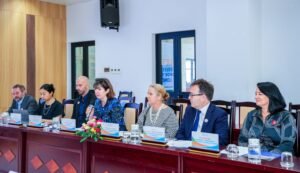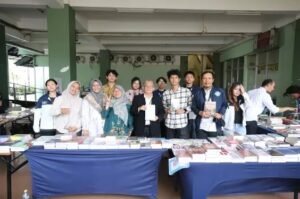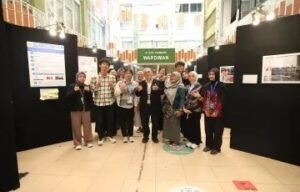





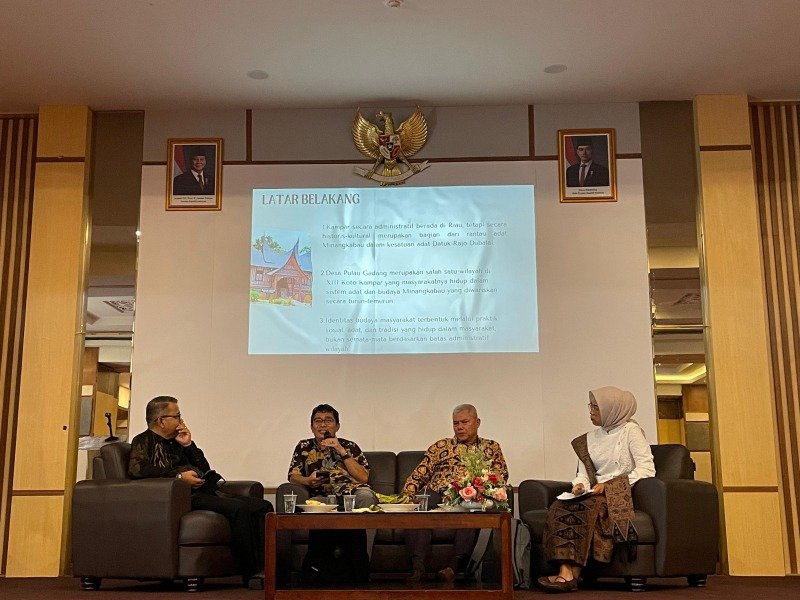
EduAsiaNews, Padang – The History Education Study Program of Universitas Negeri Padang (UNP) held a National Seminar titled “Historical and Cultural Relations between Minangkabau and Kampar” at the Hall of the Faculty of Social Sciences (FIS) on Saturday, April 25, 2026.
In her opening remarks, Dr. Aisiah, M.Pd., Head of the History Department, stated that the seminar was a follow-up to the Field Study Program (Kuliah Kerja Lapangan/KKL) for the course on Minangkabau History and Culture, which was conducted in Pulau Gadang Village, XIII Koto Kampar District, from January 16–18, 2026. The event also included the signing of an implementation agreement based on a prior collaboration established in 2025 between the History Education Study Program and the Pulau Gadang Village Government.
This collaboration is expected to serve as a gateway for history students to conduct more in-depth research, engage in community service, and contribute to the preservation of local wisdom in the future.
The event was officially opened by the Vice Dean for Academic and Student Affairs of FIS UNP, Dr. Hasrul Piliang, M.Si., who expressed appreciation for the academic initiative and emphasized the importance of collaboration between academics and traditional practitioners in enriching students’ scholarly perspectives.
The seminar featured a keynote speaker from Kampar, the Head of Pulau Gadang Village, Syofian, S.H., M.H., N.LP., Dt. Majosati. His presence as both a traditional leader and a government practitioner aimed to provide an authentic perspective on the emotional and cultural ties between the two regions. UNP also presented academic speakers, including history lecturers Dr. Hendra Naldi, S.S., M.Hum., and Dr. Rusdi, M.Hum.
Dr. Rusdi examined the transformation of leadership in Pulau Gadang Village, highlighting a shift from an autonomous leadership system to a more collaborative model with formal village governance. Although the village head is democratically elected, his legitimacy still requires endorsement from traditional leaders.
Meanwhile, Dr. Hendra Naldi provided a historical overview of Kampar as an integral part of the Pucuak Rantau of Minangkabau, which was historically connected through river transportation routes. He also discussed spatial changes in Pulau Gadang Village resulting from the construction of the Koto Panjang Hydroelectric Power Plant, which altered settlement patterns. Nevertheless, he emphasized that cultural identity and collective memory remain firmly preserved as part of the Minangkabau cultural entity.
The Head of Pulau Gadang Village, Syofian Dt. Majosati, reinforced this perspective by asserting that Kampar and Minangkabau share an inseparable unity of customary values. This relationship is rooted in similarities in the matrilineal kinship system, shared customs and traditions, and the role of ninik mamak (traditional elders). It is further grounded in the philosophy Adat Basandi Syarak, Syarak Basandi Kitabullah, as well as historical records indicating that Kampar was once part of the West Sumatra Residency during the Dutch colonial period.
The three speakers comprehensively explored the relationship between Minangkabau and Kampar, ranging from historical connections to the continued relevance of customary values in contemporary society. The presence of both village government representatives and academics provided students with a well-rounded understanding of the cultural roots they had studied during their fieldwork.
Also in attendance were former Rector of UIN Suska, Prof. Dr. H. Munzir Hutami, Dr. Khairil Ilyas, and Kampar cultural figure Drs. Latif Khasim. Participants demonstrated strong enthusiasm, as reflected in the highly interactive discussion session. Students actively explored topics such as migration patterns, dialect similarities, and customary structures in Kampar.
Through this activity, the History Education Study Program of FIS UNP reaffirmed its commitment not only to studying history through texts and classroom lectures but also to actively reconnecting cultural ties through field-based academic engagement.