




EduAsiaNews, Bandung – Recently, the IPB 9G rice seed has received recognition from the Minister of Agriculture. As a concrete form of support, the Ministry of Agriculture purchased IPB 9G rice seeds worth IDR 250 billion.
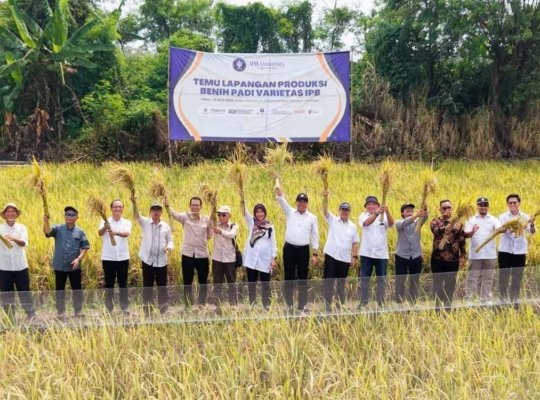
In response to this development, IPB University reaffirmed its readiness to meet the challenge posed by the Minister by continuing to develop superior rice varieties. A “Field Meeting on Rice Seed Production” was held at the IPB Experimental Rice Field in Kampung Sawah Baru, Babakan, Dramaga, Bogor (13/4).
Rector Dr. Alim Setiawan Slamet stated that IPB University continues to encourage plant breeders to produce innovative, adaptive, and high-yielding rice varieties.
“We fully support outstanding breeders such as Prof. Hajrial to continue developing superior varieties, particularly rice seeds. Alhamdulillah, IPB has produced 15 superior varieties, ranging from IPB 1R to IPB 15S, whose seeds are being harvested today,” he said.
He added that IPB University’s superior varieties are now widely accepted by the public and are cultivated on nearly 110,000 hectares of land across Indonesia. He further noted that the government has challenged IPB University to develop varieties with productivity levels of up to 15 tons per hectare.
“We will strengthen both domestic and international collaborations to meet this challenge in order to support national food security,” he added.
Meanwhile, Professor Hajrial Aswidinnoor, a senior lecturer at the Faculty of Agriculture, IPB University, explained that the development of superior varieties at IPB does not focus solely on productivity, but also on nutritional value and environmental sustainability.
“We continue to strive to produce varieties that not only yield high productivity but also contain nutrients such as zinc (Zn) and folic acid (FA), and are efficient in fertilizer and water use,” he explained.
He added that IPB University’s varieties are developed using a new plant type approach, which features a different plant architecture compared to Green Revolution varieties.
“The main characteristics include larger plant size, longer leaves, and more productive panicles. With this architecture, the plants can still achieve high yields even with lower fertilizer inputs,” he said.
According to him, this innovation is also directed toward developing rice that is more adaptive to climate change, including deeper and more efficient root systems for water use.
Vice Rector for Research, Innovation, and Agromaritime Development, Professor Ernan Rustiadi, emphasized the importance of downstream innovation so that research outcomes can be widely implemented in society.
“Our task is to bridge IPB’s innovations so they can be adopted in the field and integrated into industry, so that there is no ‘valley of death’ between research and implementation,” he explained.
He noted that over the past 15 years, IPB University’s superior rice varieties have increasingly been adopted by farmers. Of the eight national high-yield rice varieties with productivity potential above 11 tons per hectare, five are IPB innovations.
“All of these IPB superior varieties fall under the new plant type category, which is climate-resilient, water-efficient, fertilizer-efficient, low-emission, and has high productivity and disease resistance,” he added.
He emphasized that the adoption of these varieties requires a transformation in farming practices through new, more efficient, and sustainable operational standards.
Through this event, IPB University not only showcased its research achievements but also strengthened its commitment to delivering superior rice innovations capable of addressing challenges in productivity, climate change, and the improvement of nutritional quality for the Indonesian population. (AS)