




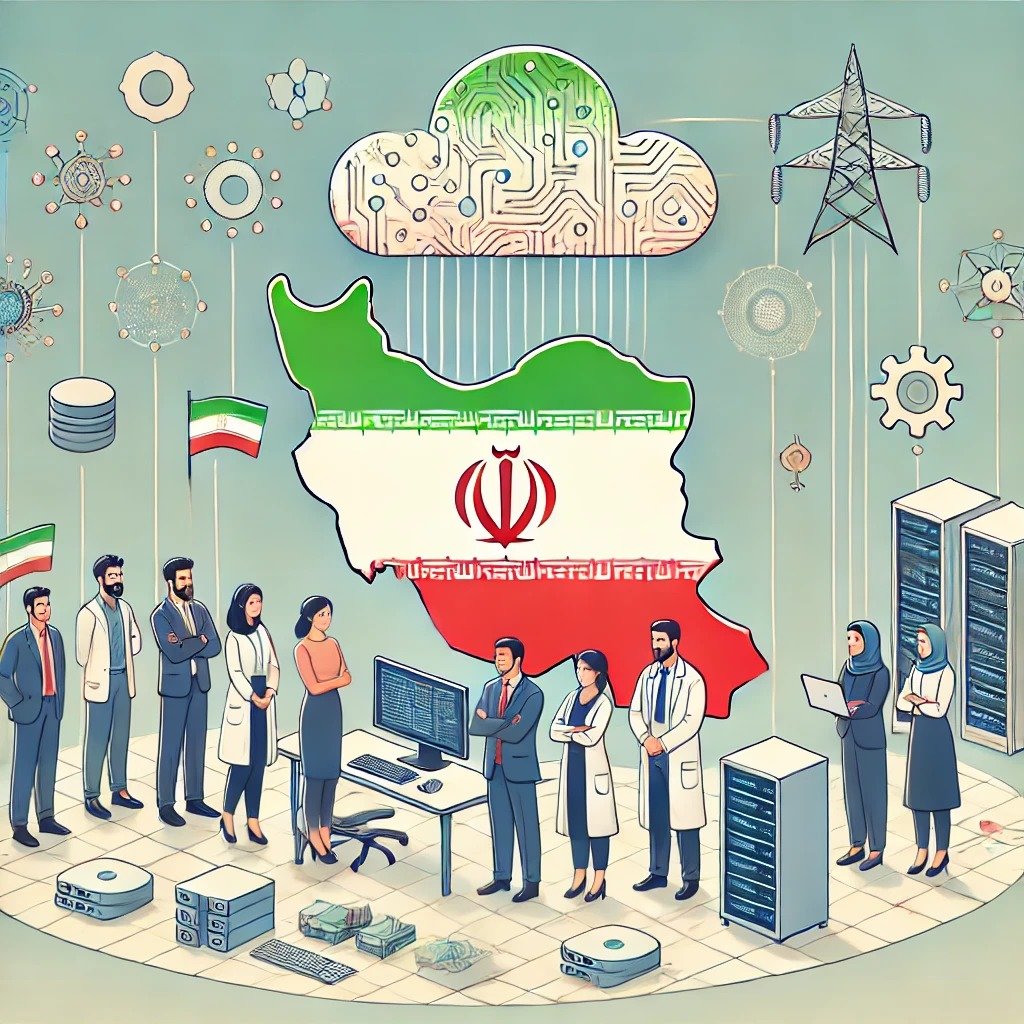
EduNewsAsia, Tehran — Iran has launched a national open-source artificial intelligence (AI) platform developed entirely by domestic experts. The prototype was unveiled on March 15, 2025, by Hossein Afshin, Iran’s Vice President for Science, Technology, and the Knowledge-Based Economy. Afshin described the launch as a strategic milestone in what he called the global “war of chips and algorithms.” “Iran has officially entered the global AI arena,” he said during the launch ceremony in Tehran, emphasizing that the platform does not rely on any foreign application programming interfaces (APIs).
The platform was developed by a team of around 100 researchers, professors, and postdoctoral scholars, involving 38 knowledge-based companies through an open call mechanism extended to universities across Iran. Sharif University of Technology serves as the main academic partner in the project. At the same time, the government is implementing the “Smart Assistant for Government” initiative in collaboration with 13 leading national universities to develop AI assistants for ministries and state officials. “We have signed serious contracts with 13 of the country’s top universities. Academics are ready to deploy a new generation of intelligent management tools within executive institutions,” Afshin said.
Hamidreza Rabiei, Head of Iran’s Advanced Information and Communication Technology Research Institute (AICTC), highlighted the platform’s strategic advantage in coping with sanctions pressure. “We are not using APIs from any foreign platforms. If the internet is cut off, nothing will happen to this platform because it is connected to the national internet network,” Rabiei stated. The platform is designed to remain operational even during external internet disruptions, function in local languages, and serve both government and public needs. Its infrastructure includes GPU-based processing, multimodal large language models, intelligent agents, and application layers for various industries.
The launch of this AI platform is part of a broader policy agenda. The Iranian government is also advancing the National Sahand Project to produce semiconductor chips domestically, while establishing the country’s first GPU data center. In education, a national AI program aims to train around two million students and 200,000 teachers online by 2025–2026. Hossein Asadi, Director of the High-Performance Computing Center and a representative of Sharif University in the project, acknowledged that Iran still lags behind regional countries in AI. “We are not in a favorable position in AI indicators compared to countries in the region,” he admitted, citing a decline in research publications and slow growth of AI companies as clear evidence.
Iran’s ambition to build digital sovereignty through this national AI platform reflects its long-standing “resistance economy” strategy — developing strategic capabilities independently amid international sanctions. The beta version of the platform is scheduled for release in September 2025, with the full-featured final version expected by March 2026. Iranian President Masoud Pezeshkian previously emphasized that “any delay in AI development in Iran would result in irreparable losses.”
(Sources: Iran Science, Technology and Innovation Vice-Presidency; Organization for Development of International Cooperation in Science and Technology Iran (cistc.ir); Iran International (iranintl.com); Biometric Update (biometricupdate.com); & Borna News TS2)