




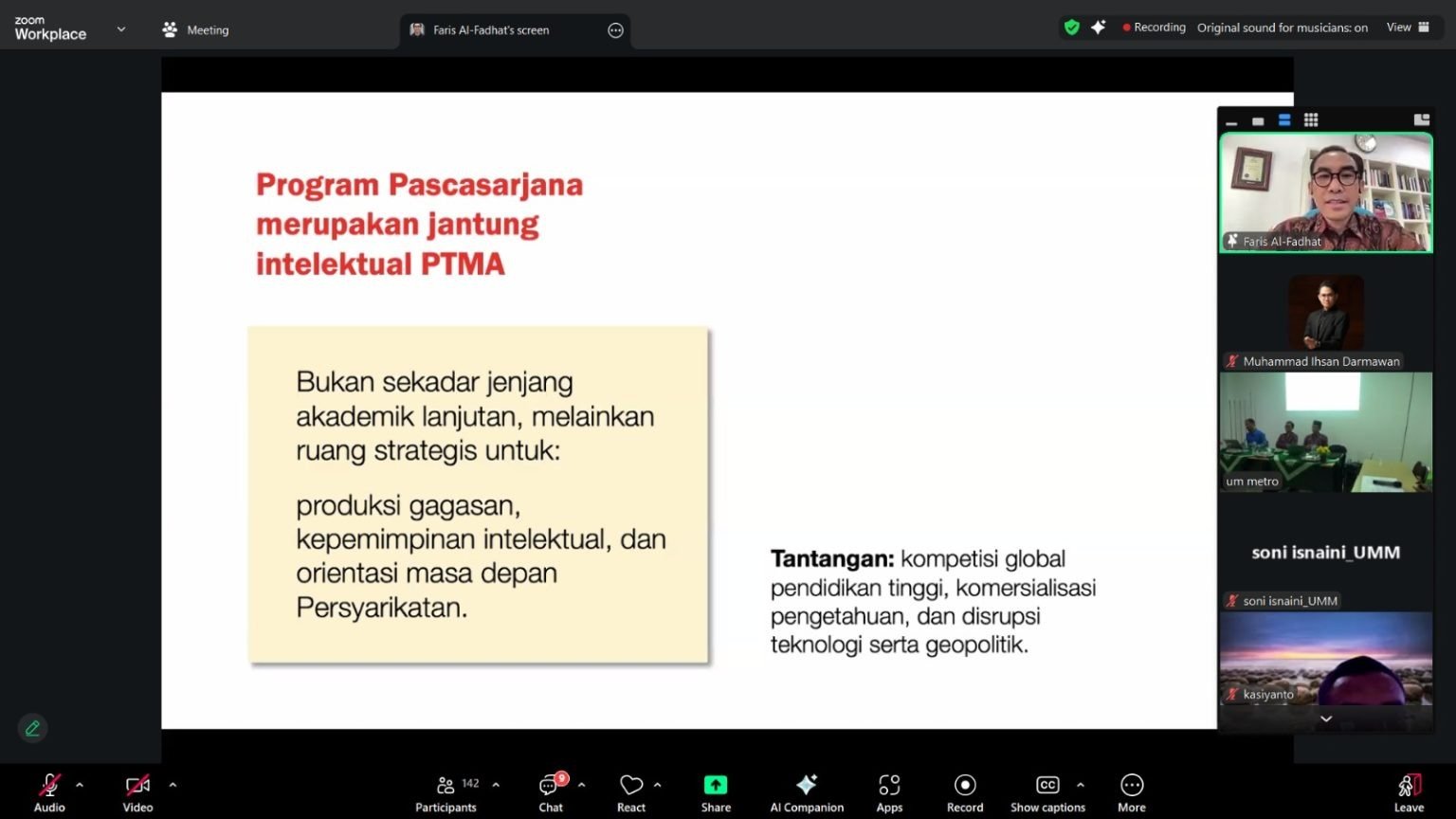
EduAsiaNews, Yogyakarta – Postgraduate programs are considered the “intellectual heart” of a university because they play a central role in research production, academic publications, and academic leadership. Strengthening postgraduate programs in Indonesian private universities, including Muhammadiyah and ’Aisyiyah Higher Education Institutions (PTMA), is a strategic step to position campuses as centers for idea generation, research, and intellectual leadership. Without such strengthening at this level, universities will struggle to build sustainable global competitiveness.
This perspective was conveyed by Prof. Faris Al-Fadhat, Ph.D., Vice-Rector for University Development and Al-Islam Kemuhammadiyahan (AIK) at Universitas Muhammadiyah Yogyakarta (UMY), during a Public Lecture for Postgraduate Programs at Universitas Muhammadiyah Metro, Lampung. The event, held online on Saturday, 7 February, carried the theme: “Strategies of PTMA Postgraduate Programs in Strengthening Prophetic Campuses with Global Competitiveness.”
According to Prof. Faris, the strategic position of postgraduate programs is often misunderstood and treated merely as a continuation of undergraduate education. In reality, it is at this level that universities should produce theories, policies, and academic critique that determine the institution’s reputation nationally and globally.
“Postgraduate programs should not be treated merely as an extension of undergraduate studies. This is the center for knowledge production, research, and academic leadership of the campus,” he emphasized.
He stressed that strengthening postgraduate programs is key for PTMA institutions to distinguish themselves amid the dominance of public universities (PTN) and foreign campuses that are increasingly offering master’s and doctoral programs in Indonesia.
Prof. Faris further explained that PTMA’s advantage lies in its strong value foundation through the prophetic campus paradigm. Within this paradigm, knowledge is not positioned as a value-neutral entity but must serve humanity, liberation from backwardness, and be grounded in the principle of tauhid.
“At PTMA, knowledge cannot be value-neutral. Knowledge must have social impact, be liberating, and remain rooted in Islamic ethics. This is our primary distinction in global competition,” he explained.
In his presentation, Prof. Faris proposed four main strategies to strengthen PTMA postgraduate programs. First, curriculum reorientation based on prophetic values and responsive to strategic national and global issues.
Second, strengthening research and publications, positioning postgraduate programs as the main producers of the university’s scholarly output. The UMY Professor in International Political Economy emphasized that PTMA postgraduate programs should boldly exceed existing minimum quality standards.
The third strategy is gradual internationalization, through strengthening global networks, organizing international conferences, conducting collaborative research, and implementing joint supervision schemes.
The fourth strategy, which he deemed most crucial, is strengthening faculty as the primary actors of postgraduate programs.
“If public universities set publication targets in Sinta-indexed journals at level three or four, PTMA must dare to raise the standard even higher. Without excellent, visionary faculty who are willing to take intellectual positions in the public sphere, it is impossible for postgraduate programs to achieve reputation and competitiveness,” concluded Prof. Faris.