




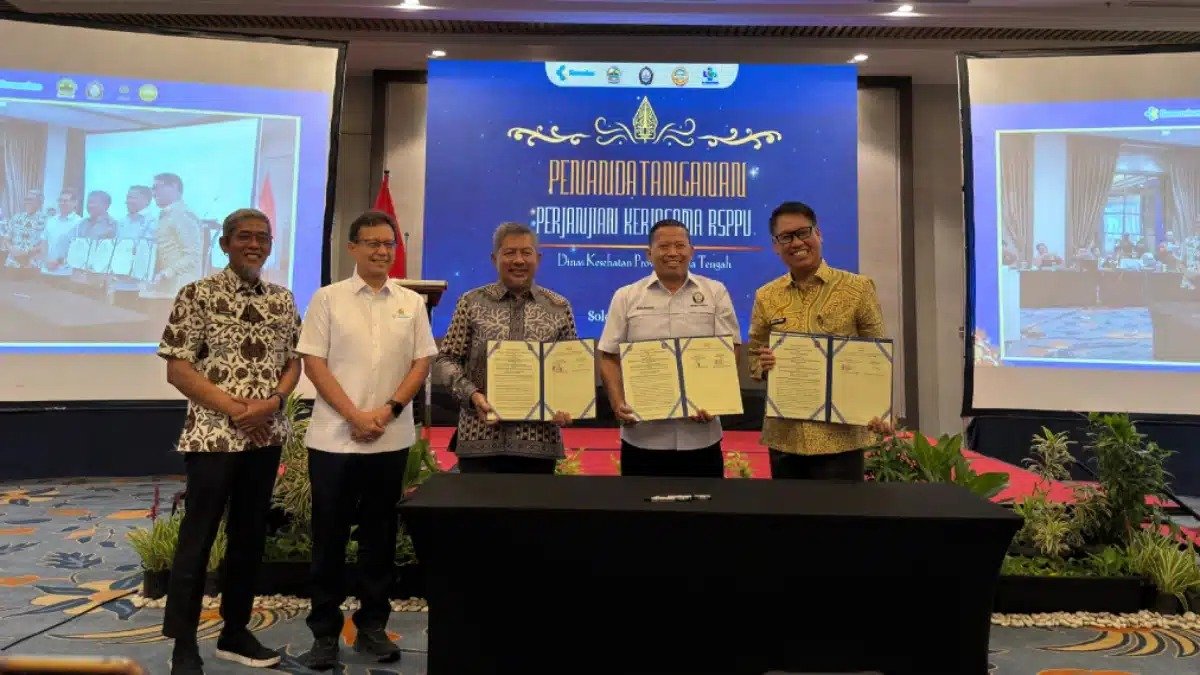
EduAsiaNews, Semarang – Diponegoro University (UNDIP) has officially become a Partner Higher Education Institution in the establishment of the Ministry of Health’s Primary Teaching Hospital Program (Rumah Sakit Pendidikan Penyelenggara Utama/RSPPU). Through the signing of a cooperation agreement on the fulfillment of specialist and subspecialist doctors with Margono Soekarjo Regional General Hospital, Purwokerto, and Dr. Moewardi Regional General Hospital, Surakarta, UNDIP strengthens its role as a strategic partner of the government in national health development. This collaboration represents a concrete implementation of the Asta Cita in the health sector and supports the Health Transformation agenda of the Ministry of Health of the Republic of Indonesia, carried out in alignment with the policies and approvals of the Ministry of Higher Education, Science, and Technology through the six pillars of health system transformation.
The cooperation agreement was signed by the Rector of Diponegoro University together with the President Director of Margono Soekarjo Regional General Hospital and the President Director of Dr. Moewardi Regional General Hospital, and was directly witnessed by the Minister of Health of the Republic of Indonesia, the Head of the Central Java Provincial Health Office, the Dean of the Faculty of Medicine of UNDIP and staff, the Regional Secretary of Central Java Province, the Director General of Advanced Health Services, and the Director General of Health Human Resources of the Ministry of Health.
This cooperation focuses on the fulfillment and equitable distribution of specialist and subspecialist doctors through strengthening the role of the Primary Teaching Hospital (RSPPU), which is directly related to the Health Human Resources Transformation Pillar. Through this scheme, UNDIP and its partner hospitals develop a specialist medical education system that is regionally needs-based, sustainable, and quality-oriented.
In addition, this collaboration also supports the Referral Services Transformation Pillar by strengthening the capacity of regional hospitals as centers for high-quality, safe, and integrated specialist and subspecialist services. This strengthening of referral services is expected to improve public access to advanced healthcare services without reliance on hospitals in central regions.
In his remarks, the Minister of Health of the Republic of Indonesia expressed high appreciation for the role of Diponegoro University as a Partner Higher Education Institution and of regional hospitals in translating health transformation policies into concrete implementation. The Minister emphasized that the RSPPU program is aligned with the direction of Health Human Resources Transformation, as it systematically educates local talents to become specialist and subspecialist doctors and ensures their return to serve in their regions of origin.
“Health transformation cannot proceed without strengthening human resources. The RSPPU program serves as a strategic instrument because it not only increases the number of specialist doctors but also ensures equitable distribution and sustainability of healthcare services in the regions,” stated the Minister of Health.
The Rector of Diponegoro University conveyed that this cooperation also contributes to the Health Governance Transformation Pillar through strengthening collaboration among universities, hospitals, and regional governments within an integrated and accountable ecosystem. UNDIP is committed to maintaining academic standards, the quality of clinical education, and transparent governance of medical education that is oriented toward national needs.
Meanwhile, Margono Soekarjo Regional General Hospital, Purwokerto, and Dr. Moewardi Regional General Hospital, Surakarta, expressed their readiness as teaching hospitals to support the achievement of health transformation through the provision of clinical education platforms, improvement of service quality, implementation of patient safety, and strengthening of region-based referral systems. Through this strategic collaboration, Diponegoro University and its partner hospitals contribute to the achievement of the Asta Cita in the health sector and the National Health Transformation, while reinforcing UNDIP’s commitment to supporting the Sustainable Development Goals (SDGs), particularly SDG 3 (Good Health and Well-being), SDG 4 (Quality Education), and SDG 10 (Reduced Inequalities), in order to realize high-quality, equitable, and regionally responsive healthcare services.