




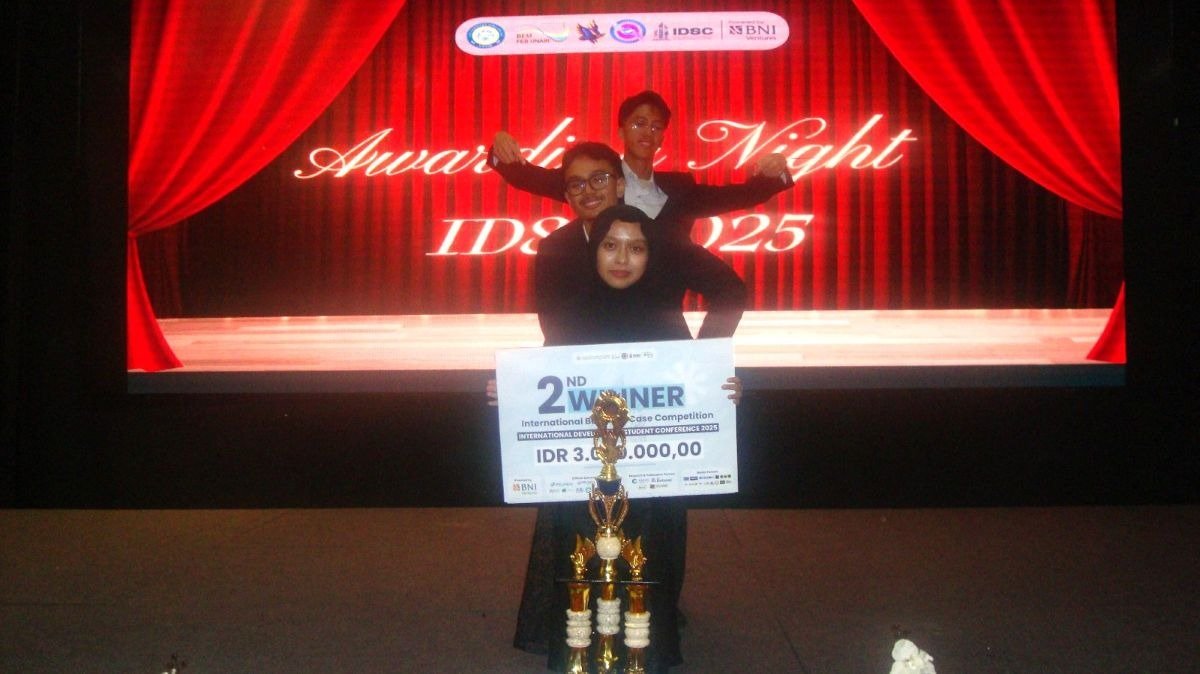
EduAsiaNews, SURABAYA – A team of students from the School of Business and Management at Institut Teknologi Bandung (SBM ITB), known as Team Marsha, secured second place at the International Development Student Conference (IDSC) organized by the Faculty of Economics and Business at Universitas Airlangga (UNAIR).
Team Marsha consists of Rasikha Zafiraliya, Darrell Rayyan Sanyoto, and Ahmad Zaki, Management students from SBM ITB, class of 2026. This national-level competition featured teams from universities across Indonesia and served as a platform for students to develop strategic ideas addressing challenges in financial management and digital services.
The IDSC competition comprises three stages. In the first stage, participants were asked to solve a financial technology case study and present it as an infographic. The next stage involved preparing a strategic proposal, requiring participants to conduct a comprehensive problem analysis and develop innovative and practical solutions.
In the final round, Team Marsha presented their developed solutions before industry practitioners and participated in a new case discussion session. At this stage, participants were evaluated not only on the quality of their solutions but also on the sharpness of their analysis, logical reasoning, and ability to present ideas clearly and convincingly.
According to Darrell, the team identified several key issues as the basis for their solution, including weak market positioning, ineffective customer acquisition and migration, and suboptimal monetization with business impact, all related to a mobile banking application.
Based on these findings, Team Marsha developed a strategic solution called W.I.R.A, an approach that integrates an AI assistant to create new value. The solution was designed to address problems comprehensively through a measurable, user-focused approach.
In brief, W.I.R.A emphasizes AI-driven personalization, end-to-end user experience, and a holistic monetization scheme. This integrative approach effectively addressed the major gaps identified and was a key factor in helping Team Marsha achieve their second-place finish.
Additionally, during the advanced case analysis session, the team highlighted challenges in onboarding micro-business users and reaching a wide user base across different regions. Based on this analysis, the team emphasized the importance of solutions that are simple, inclusive, and easily accessible to ensure optimal adoption of digital innovations.
Throughout the solution development process, Team Marsha faced several challenges, from balancing innovative ideas with feasible solutions to structuring a complex presentation in a clear and logical manner. Adequate preparation prior to execution was also key to ensuring that the proposed solutions remained relevant and realistic.
Amid their academic workload, Team Marsha shared tips on managing time between studies and competition.
“The principle is simple: fulfill academic obligations first, then focus on competition progress,” said Darrell.
Using this approach, they were able to dedicate time every day after classes to discuss and refine their solutions. They noted that the competition significantly enhanced their analytical and critical thinking skills, problem-solving abilities, and confidence in public speaking, particularly in crafting presentation narratives.
For Team Marsha, winning second place on November 7, 2025 was a valuable experience and their first major competition victory. Although the process involved long discussions, repeated revisions, and evaluations, the experience helped them develop a more mature mindset for future case competitions.
“The key lesson for us was understanding how to identify the most critical pain points, formulate relevant solutions, and present ideas confidently,” he added.